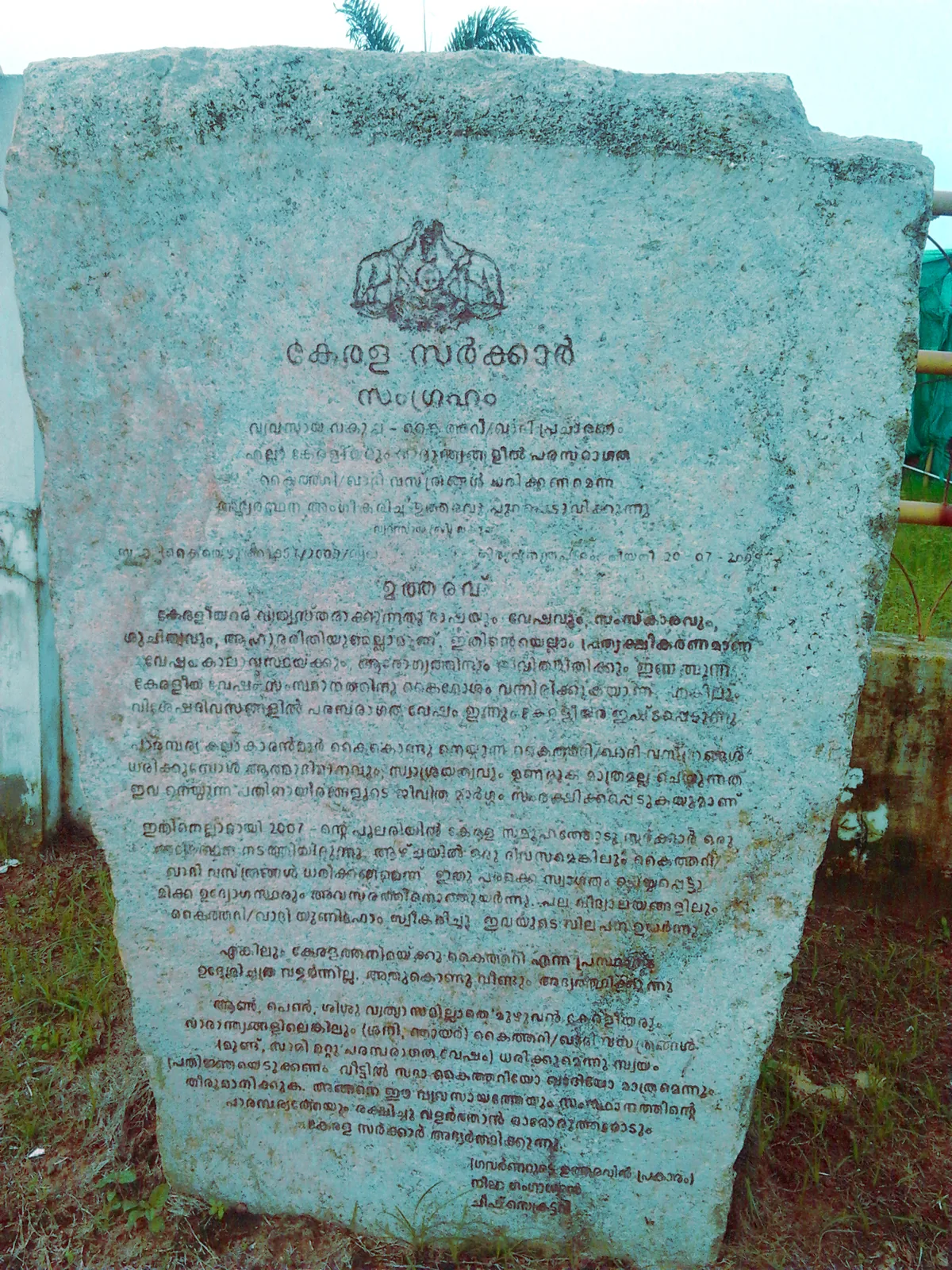
Most public monuments compress. A statue stands for a person; a plaque gives you fourteen words and a year. The object photographed on the grass at Kollam Beach in 2013 does the opposite. It is a slab of rough granite, roughly head height, and somebody has carved onto it an entire Kerala Government Order — not a summary of one, not a commemorative gloss on one, but the document: heading, abstract, subject line, body, place, date, and the formula it ends with.
What is on the stone
At the top, the emblem of the Government of Kerala. Below it, in Malayalam, the two lines that open every such document: Government of Kerala, and Abstract.
Then the subject line, in the clipped register of the file: Industries Department — handloom and khadi promotion — that all Keralites should wear traditional handloom or khadi clothing at least one day a week — request accepted, orders issued.
To the right, place and date: Thiruvananthapuram, 20 July 2009. Then the word Order, and the body.
And at the foot, the sentence that makes it a legal instrument rather than an appeal: by order of the Governor.
What the body actually argues
This is the part worth reading closely, because it is unexpectedly candid for a government document being carved into permanent stone.
It recalls that in the dawn of 2007 the Government had already made this appeal once. It notes that many officials took it up voluntarily. It records that several schools adopted handloom or khadi uniforms, and that sales rose.
And then it concedes: and yet the intended growth of handloom in Kerala has not happened, and so the request is made again.
The Order then asks men, women and children alike to wear handloom on at least one day a week — it names Saturday among them — and to decide that at home they will wear only handloom or khadi.
A state, in granite, admitting that its previous request did not work and asking a second time. That is not how monuments usually talk.
Why here
Because of the name, and this is the only place the name does any work.
The beach is Mahatma Gandhi Beach. The park beside it is Mahatma Gandhi Park. There is a Gandhi statue in the park. But there is no record of Gandhi visiting this shore, no speech, no date, and — as far as we could establish — not even a Government Order or Corporation resolution conferring the name; the beach appears to be called that simply because the park is.
So the naming is decoration, of the ordinary kind that attaches Gandhi’s name to roads and parks across India. Except at this one spot, where the state chose to carve a khadi order into stone and stand it in the sea wind. Khadi was Gandhi’s actual programme — hand-spinning as an economic and political act — and this slab is a government still trying, sixty years after independence, to make it happen, on a beach that carries his name for no documented reason at all.
One honest caveat
We cannot tell you it is still there. The photograph on which all of the above is based was taken on 12 July 2013, and the park has been worked on since. Nor can we give you the Order’s reference number: it is only partly legible on the stone, and inventing the missing characters would be exactly the sort of thing this page exists to avoid. The date, 20 July 2009, is clear.
If you walk the park and find it, it is on the grass, unlabelled, weathered green, and almost certainly the most interesting object on this beach that nobody photographs.
Frequently asked questions
What does the stone at Kollam Beach say?
It carries the full text of a Kerala Government Order from the Industries Department, dated Thiruvananthapuram 20 July 2009, asking all Keralites — men, women and children — to wear traditional handloom or khadi clothing at least one day a week. It closes with the standard formula, by order of the Governor.
Is it still there?
Unconfirmed. The photograph it is transcribed from dates to 12 July 2013 and the park has been worked on since. Treat it as installed in 2009 and photographed in 2013, not as something you are guaranteed to find.
Did Gandhi visit Kollam Beach?
There is no record of a visit, a speech or a date. Nor could we find a Government Order or Corporation resolution formally naming the beach after him — it appears to be called Mahatma Gandhi Beach because the park beside it is Mahatma Gandhi Park. Be wary of any account that supplies a Gandhi anecdote to justify the name.
Why was a Government Order carved in granite?
No explanation is recorded on the stone or anywhere we could find. What is clear from the text is that it was the second attempt — the Order itself notes that a similar appeal in 2007 had not produced the intended growth in handloom, and makes the request again.