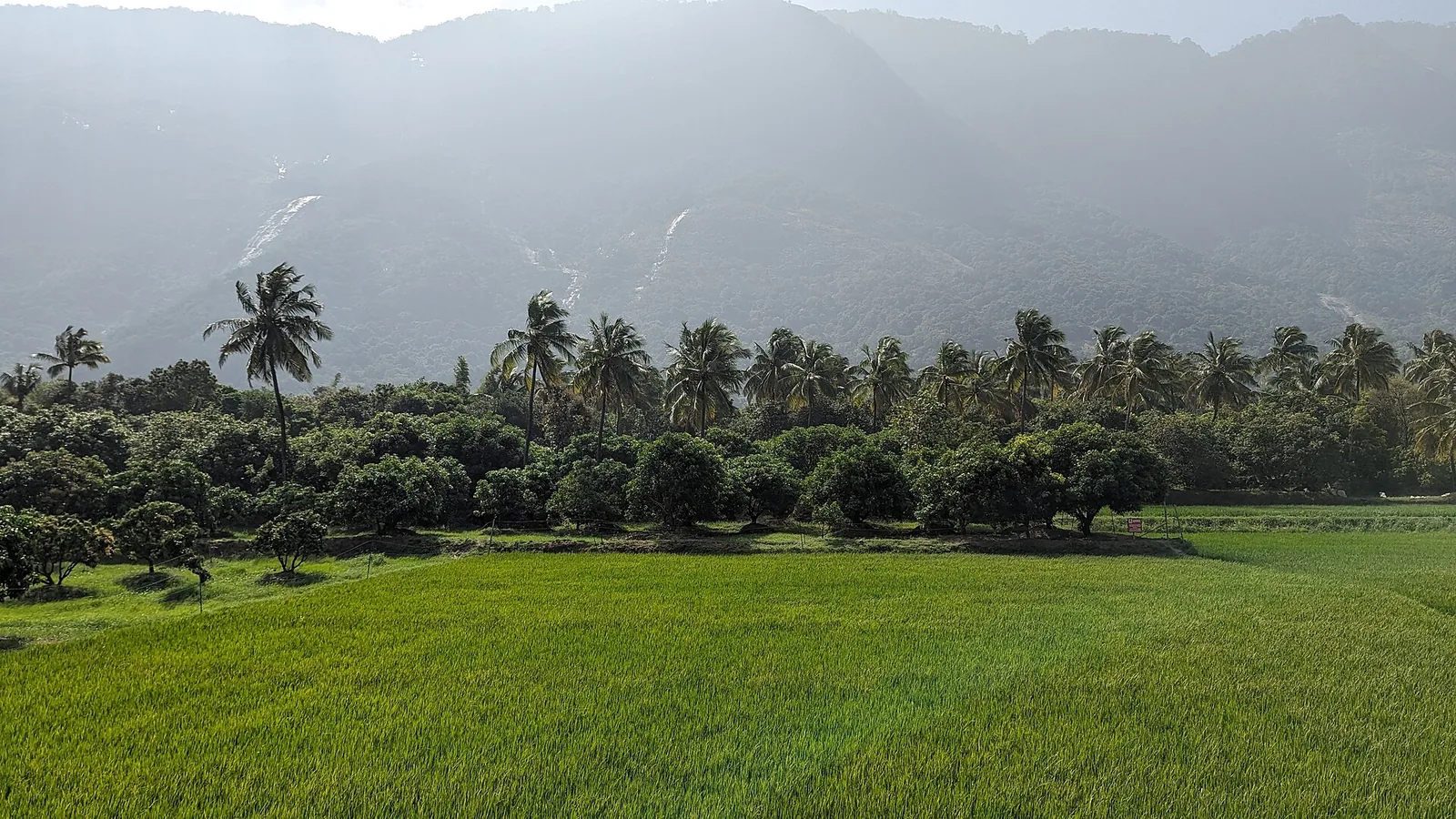
When the industrialist Anand Mahindra posted a clip of the place in 2023, he said the beauty of it left him “speechless.” The video was of ordinary work — water sheeting across flooded paddy, coconut palms leaning into the light, and behind everything the blue wall of the Nelliyampathy hills. That is Kollengode, a village in the Chittur country of Palakkad that Keralites have long called the rice bowl of the district. But the paddy is only the surface. Underneath it lie a fallen chieftaincy, a palace that reinvented itself as a healing retreat, and the grave of one of Malayalam’s greatest nature poets, who came here to teach and never left.
The land called Vengunad
Long before it was Kollengode, this stretch of paddy and low hill was known as Vengunad — and in older texts, Ayaskarapuri. Tradition traces the name to the venga trees that once covered the country, a hardwood the villages prized. Watered by the Gayathripuzha, a tributary of the great Bharathappuzha, and shielded on its eastern flank by the Western Ghats, this was fertile, defensible land at the frontier of the Palakkad plains. Whoever held Vengunad held the gateway between the rice country below and the forested hills that climbed toward Nelliyampathy. That geography — plains in front, mountains behind — is the whole story of the place, and it shaped everyone who ruled here.
How a chieftain became a raja
The rulers of Vengunad were not born kings. They were the Venganad Nambidi — a chiefly house styled Venganattudayavar, lords of the eastern side of Palakkad — and for centuries their rank was that of a powerful local chieftain rather than a crowned raja. That changed in the eighteenth century, when Mysore came down through the Palakkad Gap. According to the tradition preserved by the family and Kerala Tourism, it was Hyder Ali of Mysore who conferred the title of Raja on the Kollengode house. From a hill-country chieftaincy they emerged as the Kollengode Rajas, a dynasty whose patronage of temples, poets and the arts would outlast their political power by generations.
The palace that learned to heal
The old seat of the rajas in Kollengode town is the Kalari Kovilakom, a nineteenth-century palace built in the plain, elegant Kerala manner — a masonry ground floor, a sloping tiled roof, wide verandahs opening onto green. In its own telling the house descends from a line that reaches back, by tradition, to Prince Dharmavarma of the ancient Chera stock, and the estate was said to be ringed with the healing venga trees. In modern times that story took a literal turn: the kovilakom was converted into a residential Ayurveda retreat, where the old royal rooms now hold guests through weeks-long treatment. A separate Kollengode Palace — the one most tourists photograph — was built in 1904 by Vasudeva Raja and stands today as a heritage museum in Thrissur, a reminder of how far the family’s reach once ran.
The poet who came home to the paddy
Kollengode’s deepest claim on Malayalam memory is not a king but a schoolteacher. Panayanthitta Kunhiraman Nair — remembered simply as Mahakavi P, the great poet P — spent his life wandering Kerala and writing romantic verse soaked in its natural beauty. He took a teaching post at the Rajas High School in Kollengode, and it was from that school, among these paddy fields and hills, that he retired. When he died in 1978, the village kept him. In 1981 the campaigner Eyamkode Sreedharan, helped by Venugopala Varma, the then Raja of Kollengode who donated the land, began building a memorial to the poet. The Government of Kerala took it up as the Mahakavi P Memorial Art and Culture Centre — today a music school, a library, a Kathakali school, and a small museum holding the poet’s books, his chair, his clothes and a gold chain gifted to him by the Guruvayur Devaswom on his sixtieth birthday.
An ancient shrine of Vishnu
A few kilometres from the town, at Payyallur, stands the Thiru Kachamkurissi temple — an old and much-revered Vishnu shrine set at the foot of the Govindamala hill. Legend holds that it was consecrated by the sage Kashyapa, and the temple has drawn pilgrims from across the Palakkad country for generations. Its setting is characteristic of Kollengode: a working temple in a working landscape, the granite and the paddy sharing the same horizon of hills. For visitors, it is the quiet counterpoint to the palaces — proof that the sacred and the agricultural have always been braided together here.
Where the plains meet the hills
Kollengode sits roughly nineteen kilometres south of Palakkad town, and it is the natural threshold to the highlands beyond. The rhythm of the plains is agricultural and ancient — sowing after the monsoon breaks in June, the long green wait, and harvest through October and November that turns the fields gold. Then the land tilts upward. The Seetharkundu viewpoint opens a panorama across the Western Ghats; the hill of Govindamala and the settlement of Govindapuram sit on the way up; and the forested Nelliyampathy plateau, with its tea and its cool air, rises just beyond. Waterfalls like Palakapandi hide in the folds. Stand in a Kollengode paddy field at dusk and you can read the entire vertical geography of Palakkad in a single glance.
A living stage for the old arts
The rajas are gone as a ruling power, but the culture they patronised did not go with them. The memorial centre in the poet’s name is a working theatre for the region’s performing traditions — Kathakali, and the vigorous Palakkad folk forms of Kanyarkali and Porattukali, staged for audiences who have grown up with them. This is what makes Kollengode more than a scenic detour. It is a place where a chiefly house, a temple, a poet and a farming village have kept one another company for centuries, and where the paddy that first made the land wealthy still frames every festival, every shrine and every palace wall.
Visiting Kollengode
Kollengode lies about nineteen kilometres south of Palakkad town in Chittur taluk, easily reached by road; the nearest major railhead is Palakkad Junction. Come after the monsoon, from roughly September to February, when the paddy is at its greenest or gold and the air off the hills is cool. Give a morning to the palace and the Mahakavi P memorial, a quiet hour to the Kachamkurissi temple, and an afternoon to the climb toward Seetharkundu and Nelliyampathy. For the full map — where to stay, eat and continue toward the highlands — see Kollengode and the wider Palakkad hub.
Frequently asked questions
Who were the Kollengode Rajas?
They were the ruling house of Vengunad, originally the Venganad Nambidi chieftains who held the eastern side of Palakkad. By tradition, Hyder Ali of Mysore conferred the title of Raja on the family, after which they were known as the Kollengode Rajas and became noted patrons of temples and the arts.
Is there really a palace to see in Kollengode?
The old royal seat in Kollengode town is the nineteenth-century Kalari Kovilakom, now run as a residential Ayurveda retreat. A separate Kollengode Palace built by Vasudeva Raja in 1904 stands as a heritage museum in Thrissur. The village itself is best known for its palaces, its paddy country and the Mahakavi P memorial.
Why is Kollengode called the rice bowl of Palakkad?
It is surrounded by vast paddy fields watered by the Gayathripuzha and framed by the Nelliyampathy hills. Sowing follows the June monsoon and harvest comes in October and November, and the endless green-to-gold fields under the Western Ghats are what draw visitors and poets alike.