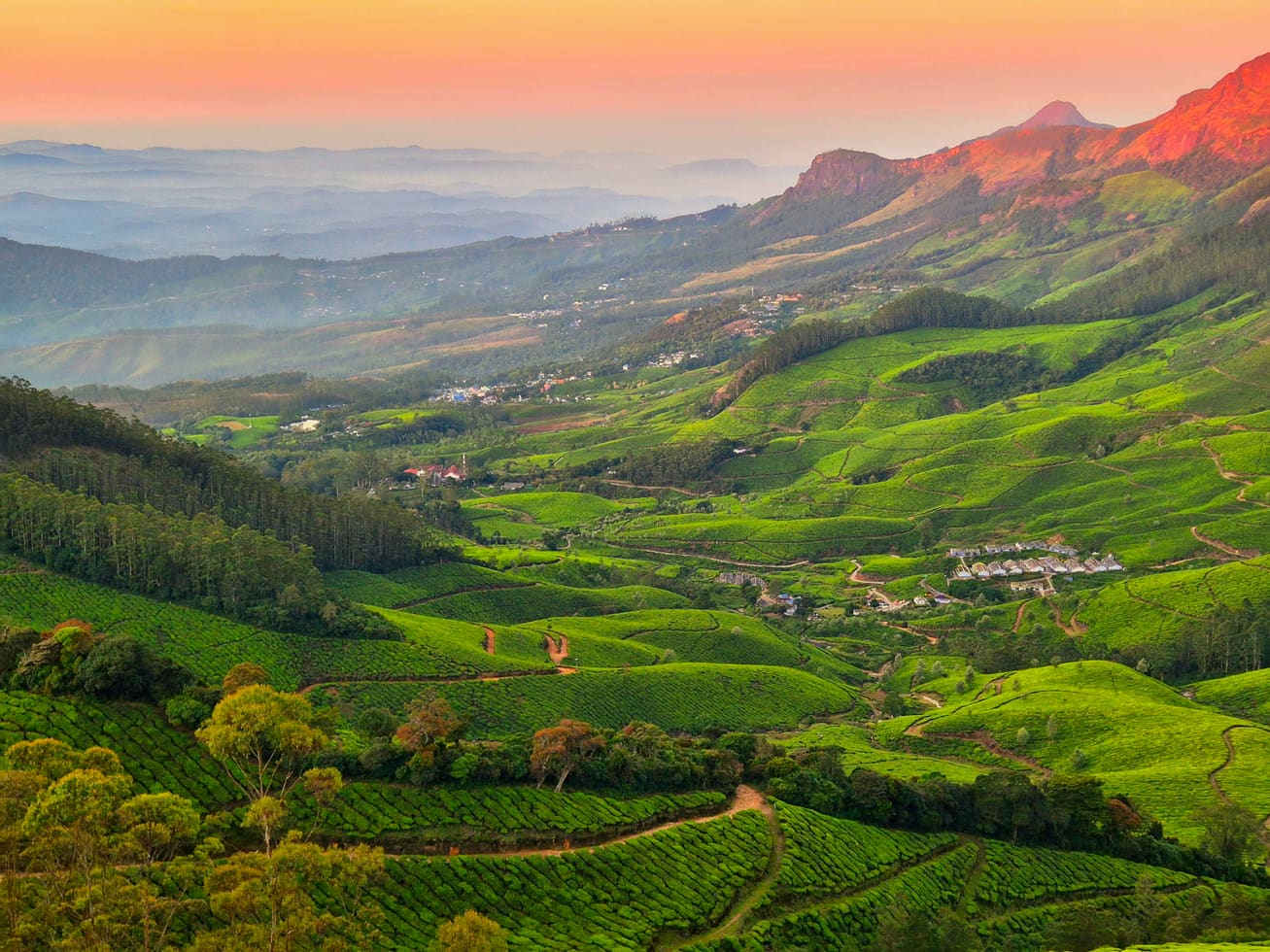
Some places earn their superlatives the hard way. Kolukkumalai sits on a knife-edge ridge roughly 7,900 feet (about 2,400 metres) above the sea, where the wind never quite stops and the cloud rolls in below your feet by mid-morning. Tea should not really grow this high. And yet, wrapped in mountain fog on the frontier between Kerala and Tamil Nadu, an estate here has been picking, rolling and firing leaf for close to a century — and the world still calls it the highest organic tea plantation on earth.
A ridge on the edge of two states
Geographically, Kolukkumalai is a curiosity. The estate itself lies in the Bodinayakanur area of Tamil Nadu’s Theni district, yet almost everyone who visits arrives from the Kerala side, climbing up through Idukki district from the Munnar–Suryanelli belt. The plantation drapes over the crest of the Western Ghats, so that from the top you look east across the Tamil plains and west over the Kannan Devan hills. It is a place that belongs, in a sense, to both states and neither — a garden balanced on a watershed.
The planter’s gamble
The story most often told is that Kolukkumalai was opened in the early 1900s by a Scottish planter, during the great colonial rush that turned these hills around Munnar into one long carpet of tea. Bringing the bush to such an altitude was a gamble: growth is painfully slow up here, the yield modest, and the terrain punishing. But the same thin, cold, misty air that makes the plant struggle is exactly what concentrates its character. High-grown leaf, picked at a crawl, ends up carrying a briskness and aroma that lower gardens cannot match.
Accounts of the exact dates vary from source to source, but the estate is generally described as taking shape in the opening decades of the twentieth century, with its landmark factory following in 1930. Whichever year you pin it to, the essential truth holds: this was a deliberate attempt to grow fine tea higher than almost anyone had tried before.
- Altitude: roughly 7,900 ft / about 2,400 m (some sources cite figures around 7,500 ft — confirm locally).
- Location: Theni district, Tamil Nadu, but reached via Idukki, Kerala.
- Claim to fame: widely described as the world’s highest organic tea estate.
- Recognition: a Golden Leaf Award from the Tea Boards of India and the USA for tea quality.
Organic, because it never changed
Kolukkumalai’s organic reputation is partly a story of isolation. The estate is so remote, and the track up so steep and narrow, that heavy modernisation never really reached it. The garden was never re-tooled for the fast, industrial CTC (crush, tear, curl) method that transformed much of Indian tea. Instead it kept to the slower orthodox way, and largely kept chemicals out of its soil. What began as remoteness has become a selling point: a high-altitude leaf grown without synthetic fertiliser or pesticide, its briskness widely praised for a distinctive muscatel-like character.
The estate today
The plantation, spread over roughly 80 hectares of terraced slope, is a working estate managed under the Kottagudi Plantations name, not a museum. Pickers still move across the bushes at first light; the leaf still goes down to the old factory to be made by hand and machine. What has changed is the audience. Where once only planters and pickers came up this ridge, now a steady stream of travellers grinds up before dawn in four-wheel-drive jeeps to watch the sun break over the plains — and to see, with their own eyes, a place that turned altitude, wind and stubbornness into the world’s highest cup of tea.
Frequently asked questions
Is Kolukkumalai really the world’s highest tea plantation?
It is very widely described as the world’s highest organic tea estate, sitting at roughly 7,900 feet (about 2,400 metres). Exact altitude figures differ slightly between sources, so treat the number as approximate.
Is Kolukkumalai in Kerala or Tamil Nadu?
The estate itself lies in Theni district, Tamil Nadu, but it sits right on the ridge line and is almost always visited from the Kerala (Idukki) side, near Munnar and Suryanelli.
Who started the Kolukkumalai tea estate?
It is generally credited to a Scottish planter in the early 1900s, during the British-era expansion of tea across the Munnar hills. Its historic factory dates to 1930.
Why is the tea considered special?
The very high altitude, cool air and mountain fog slow the bush’s growth and concentrate flavour, giving a brisk, aromatic orthodox tea that has won recognition including a Golden Leaf Award.