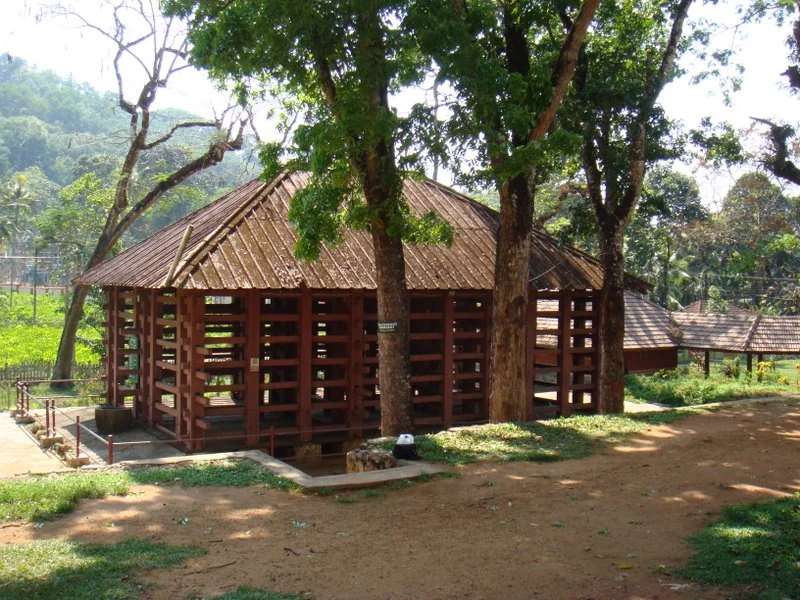
The timber kraal is the most distinctive structure at Konni Elephant Camp. Its closely spaced upright posts and substantial horizontal members make its purpose visible before a visitor reads a panel. This is an enclosure built around the size and strength of an elephant. Looking at its construction is a way into the camp’s history, provided the structure is not romanticised as a harmless piece of rustic architecture.
Start with the scale
Stand in the visitor area and compare the timbers with the openings between them. The repeated uprights create a strong rhythm, but they also show how closely the enclosure controls movement. The roof shelters the structure while the sides remain visually open. A photograph that includes the ground and roof is more informative than a close crop of a single beam.
The tourism account identifies the wood as kambakam and dates the present kraal to 1942. That date belongs to this structure in the published account; it should not be confused with the earlier history of elephant capture and training associated with Konni. The building and the institution have related but different timelines.
A structure with a difficult purpose
Konni’s older story includes the capture and training of wild elephants. The kraal belongs to that history of confinement and human control. Understanding it does not require assuming that every historic practice continues in the same form today. It does require recognising what the enclosure was designed to do, rather than describing the heavy timbers only as an attractive traditional craft.
Look for the relationship between the horizontal members and the upright posts. Their visual weight explains why an ordinary cattle-shed comparison is inadequate. The enclosure was made for a very different animal. Its physical form carries information that a general description of Kerala’s timber architecture would miss.
Read the camp around it
The current visitor programme combines the kraal with an elephant museum and a living elephant-care setting. Those elements should be read together. The museum can supply context that is not visible in the timbers, while the presence of staff and elephants makes clear that the wider campus is also a workplace. Keep the public viewing boundary clear for their movement.
An older photograph records the kraal at a particular time. It does not establish the condition of each beam today or which opening visitors may approach. Use the present barriers and staff directions to decide where to stand. There is no need to reach through a gap or touch the structure to understand its construction.
What to take away
The useful question at Konni is how a building expresses its purpose. The mass of the timbers, the repeated gaps and the roofed enclosure answer that question directly. The published construction date then locates the surviving form within a longer institutional history. Together, these details make the kraal a specific historical object rather than interchangeable scenery behind an elephant photograph.
Sources: Kerala Tourism’s Konni account and the Forest Department ecotourism programme.
Plan the visit: Konni Elephant Camp.