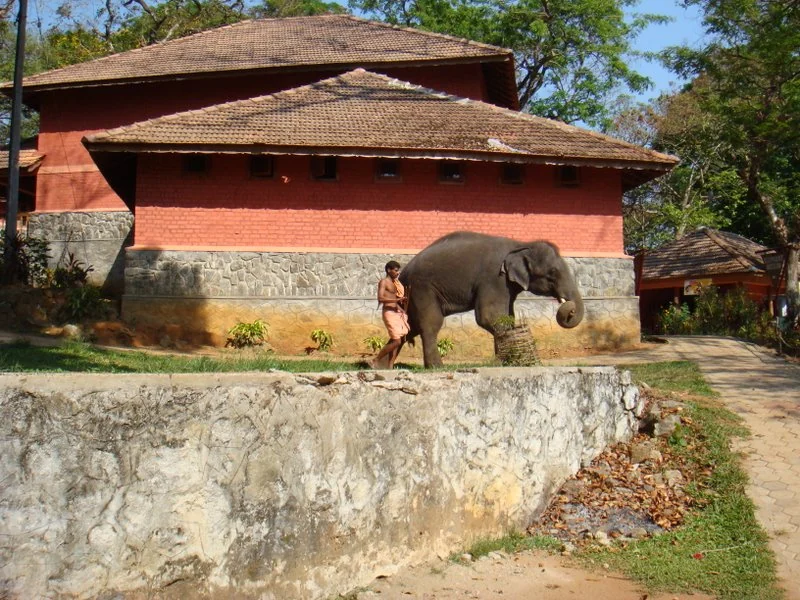
In this photograph, an elephant and a mahout move along a camp path together. The scene is simple, but it places a person’s work beside the animal that usually receives all the attention. At Konni, the visitor encounter depends on staff routines and the space needed to carry them out. Understanding that relationship makes an ordinary moment more informative than a staged demand for an elephant to perform.
Begin with what is visible
The elephant and the accompanying person share the path. The image shows movement through the campus, not a public procession or a scheduled visitor show. It is a record of one moment and should not be used to promise that the same walk occurs at a fixed time each day.
The size difference is immediately apparent. It helps explain why the path must remain clear and why visitors should not step into the animal’s route for a photograph. A public viewing position is useful precisely because it allows people to watch while leaving the working space intact.
The role sits within a changing institution
Konni’s published history connects the campus with elephant capture and training, while contemporary visitor descriptions also discuss care for animals brought from the forest. The mahout’s presence belongs within that wider institution. It should not be reduced to a picturesque costume or treated as proof that every older training practice remains unchanged.
The old kraal and the museum provide ways to explore that history beyond a brief animal sighting. The timber enclosure shows the physical infrastructure of an earlier system, while museum interpretation can place the human role in context. Moving between these elements makes the visit less dependent on whether an elephant happens to be visible at a particular moment.
Let care routines remain care routines
A staff member moving with an elephant may be attending to a task rather than leading a visitor activity. The distinction is practical. Wait where directed, avoid crowding the route and allow the movement to finish without trying to secure a closer angle. Observation does not require inserting a visitor into the scene.
Questions about an elephant’s name, history or routine are best asked when staff are available to answer. A brief working moment cannot support a broad conclusion about an individual animal’s temperament. Nor should a visitor interpret a calm-looking photograph as permission to approach that animal independently.
A more complete camp visit
The photograph can serve as a prompt to notice the human organisation of the campus: the paths, enclosures and separate visitor areas that allow work to continue. These are part of the place’s present identity, just as the kraal is part of its history.
Finish the visit with both scales in mind. The elephant is an individual animal, and Konni is an institution with staff, buildings and changing responsibilities. Paying attention to the mahout’s working space helps connect those scales without turning a care setting into an assumed performance.
Sources: Kerala Tourism’s Konni account and the Forest Department ecotourism programme.
Plan the visit: Konni Elephant Camp.