Most temples grow away from their origins. Stone replaces timber, timber replaces thatch, and the shed the whole thing started as survives only as a sentence in a legend.
Kottankulangara rebuilds its shed.
The Kuruthola Pandal
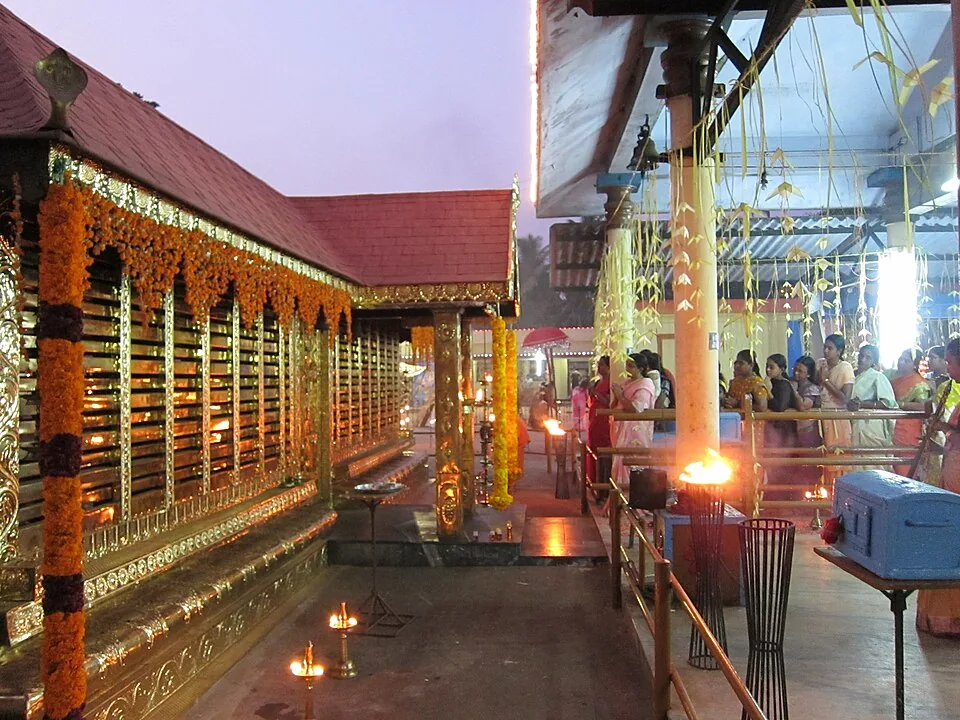
Once a year the temple erects a Kuruthola Pandal: a model of the ancient temple, constructed in the old manner from poles and the tender leaves of the coconut palm.
Kuruthola is the pale, soft, unopened frond — the thing Kerala uses for festival decoration precisely because it is fresh and impermanent, and which yellows and dries within days. To build your origin story out of it, deliberately, every year, is a particular kind of statement. The permanent temple stands there in tile and timber and beaten brass; beside it, annually, goes up the perishable thing it used to be.
It also quietly supports something about this temple’s architecture. The founding account describes a temple without an outer wall — poles, leaves, a roof, and open sides. That is what a pandal is. The tradition being preserved is about openness at the edges, not about an absent roof, which is worth knowing given how often this temple is described as having no roof over its sanctum. We take that claim apart properly elsewhere on this page.
There is also Jeevatha Ezhunnallathu, a step-dance procession in traditional dress, in the temple’s calendar.
What an ordinary day looks like
Quiet, and quick — half an hour covers it.
The shrine sits under a tiled hipped roof with a gilded finial, its walls made of close-set dark timber slats, its base clad in worked brass. Marigold garlands hang along the eaves. A small gilded subsidiary shrine stands in the forecourt with an offering tray in front of it. The gable, if you look up, is sheathed in beaten repoussé metal worked into scrollwork and figures, and it is the best single thing to look at here on a day when nothing is happening.
The deity is Durga Bhagavathy, addressed also as Aadi Shakthi, the supreme mother of power. This is a working neighbourhood temple in Chavara rather than a monument, and it makes very little effort to explain itself to a visitor.
Which produces an odd experience, and an honest one: on an ordinary morning there is almost nothing here to suggest that on two nights in Meenam several thousand men in saris will walk to this compound carrying lamps.
The number problem
Since we have mentioned thousands, we should be straight about the figures, because they disagree badly.
Chamayavilakku is routinely described with attendance upward of twenty-five thousand. The temple’s own website, writing about its 2011 festival, says around four thousand people participated.
That is roughly a sixfold gap, and we are not going to pick a number. Part of it is almost certainly the difference between participants — men who dress and carry a lamp — and the far larger crowd that comes to watch. Part of it is the ordinary inflation that festival figures acquire in retelling. Both numbers are printed on this site with their sources, and neither is presented as the figure.
Getting there, and what to pair it with
Chavara is about twenty kilometres north of Kollam, on the strip of land between the sea and the backwater, just off NH66. It has its own station on the Kollam–Alappuzha coastal line, though Kollam Junction has far more services, and buses along the highway are frequent.
The pairing that teaches most is Oachira, about twenty kilometres further north — the great Kollam shrine with no idol, no image and no roofed sanctum, where worship is directed at the formless under old trees. Between the two of them, and Poruvazhy Malanada inland, this district holds an unusual concentration of temples that do without something the temple system normally treats as essential: an image, a wall, a sanctum, a Brahmin priesthood.
Kottankulangara’s version of that is the most human of the three. What it does without is the assumption that you come to a goddess as yourself.
Frequently asked questions
What is the Kuruthola Pandal?
An annual reconstruction of the ancient temple, built in the old manner from poles and the tender leaves of the coconut palm. Kuruthola is the pale unopened frond, which dries within days — so the temple deliberately rebuilds its own perishable first form once a year beside the permanent one.
Is it worth visiting outside the festival?
It is a quiet half-hour. The metalwork is the reward — a repoussé-clad gable of scrollwork and figures, brass at the shrine base, timber-slatted walls under a tiled roof. It is a working neighbourhood shrine and makes little effort to explain itself.
Who is the deity?
Durga Bhagavathy, addressed also as Aadi Shakthi, the supreme mother of power.
How many people attend Chamayavilakku?
The figures disagree by about six times. The temple’s own website says around four thousand participated in its 2011 festival; attendance claims upward of twenty-five thousand are widely repeated. Part of the gap is likely participants versus the watching crowd. We print both and neither as the answer.
How do I get to Chavara?
About 20 km north of Kollam off NH66, on the strip between the sea and the backwater. Chavara has its own station on the Kollam–Alappuzha coastal line; Kollam Junction has many more services, and highway buses are frequent.
What should I combine it with?
Oachira, about 20 km north — no idol, no image, no roofed sanctum — and, inland, Poruvazhy Malanada, which has no sanctum at all. Together they make this district unusually rich in temples that dispense with something normally treated as essential.