On the tenth and eleventh nights of the Malayalam month of Meenam, in March or early April, several thousand men and boys at Chavara put on women’s clothes, light a lamp, and walk in procession to a goddess.
It is the sort of thing that gets written up as Kerala’s strangest festival, and that framing gets it wrong in the first sentence. What is happening at Kottankulangara is not an inversion, a carnival or a licensed transgression. It is a vow being discharged in the only form this deity is said to have accepted — and the reason is in the temple’s own account of how it began.
The legend that explains the festival
In the temple’s telling, this place starts with cowherd boys and a game.
A group of them, herding cattle and playing, used to act as shy girls and offer flowers and a kottan — a coconut dish — to a stone. That is all: children dressing up, playing at being someone else, making pretend offerings to a rock in a field.
And then the game was answered. One of the boys received a divine response from the Devi. A temple without an outer wall was raised over the stone, and the ritual of men dressed as women offering prayers to the goddess began there.
Read Chamayavilakku back through that and the strangeness drains out of it. The men in saris are not doing something extraordinary on a holy night. They are doing precisely what the boys were doing at the moment the goddess first answered. The festival is a re-enactment of the founding, and the costume is not a wrapper around the worship — it is the worship.
And the legend that explains nothing
There is a second origin story in wide circulation, and comparing the two is instructive.
In it, cowherds obtained a coconut and struck it against a stone to remove the husk, and found drops of blood dripping from the stone. An astrologer, consulted, declared that the stone possessed supernatural power, and worship began.
It is a perfectly serviceable sacred-stone legend, of a type Kerala has in quantity, and it explains why there is a shrine here. It contains no boys playing at being girls, and it explains nothing whatever about the festival the temple is famous for.
We are not going to adjudicate which is older. But when two legends circulate and only one accounts for the practice that is still being performed every year, that asymmetry is worth pointing at rather than smoothing over. A story that has to be supplemented to explain the ritual is doing less work than one that produces it.
What the word means
Chamayam is adornment — being dressed and made up. Vilakku is the lamp. Chamayavilakku is the adorned lamp-bearer, and the compound is a fair description of the ritual: you are dressed, and then you carry light.
The attire is not issued by anyone. Accounts of the festival describe the set sari, the pattu sari, the half sari, and dance costumes, chosen by the person wearing them — which means the getting-ready is itself part of the observance, and a good deal of it happens in ordinary houses around the temple through the afternoon.
Participation is drawn from the neighbourhood, from across Kerala, and increasingly from outside the state.
How to be there
If you go, go as you would to any other act of devotion, because that is what it is. The men taking part are generally fulfilling a specific promise made to the goddess. They are not performing for visitors.
That has a direct implication for cameras, and we would rather say it plainly than leave it to be worked out. Participants are identifiable individuals in a small place, photographed in circumstances that carry meaning for them and could carry an entirely different meaning once the picture leaves. Ask before you photograph anyone. On this particular night, consent matters more than the photograph does.
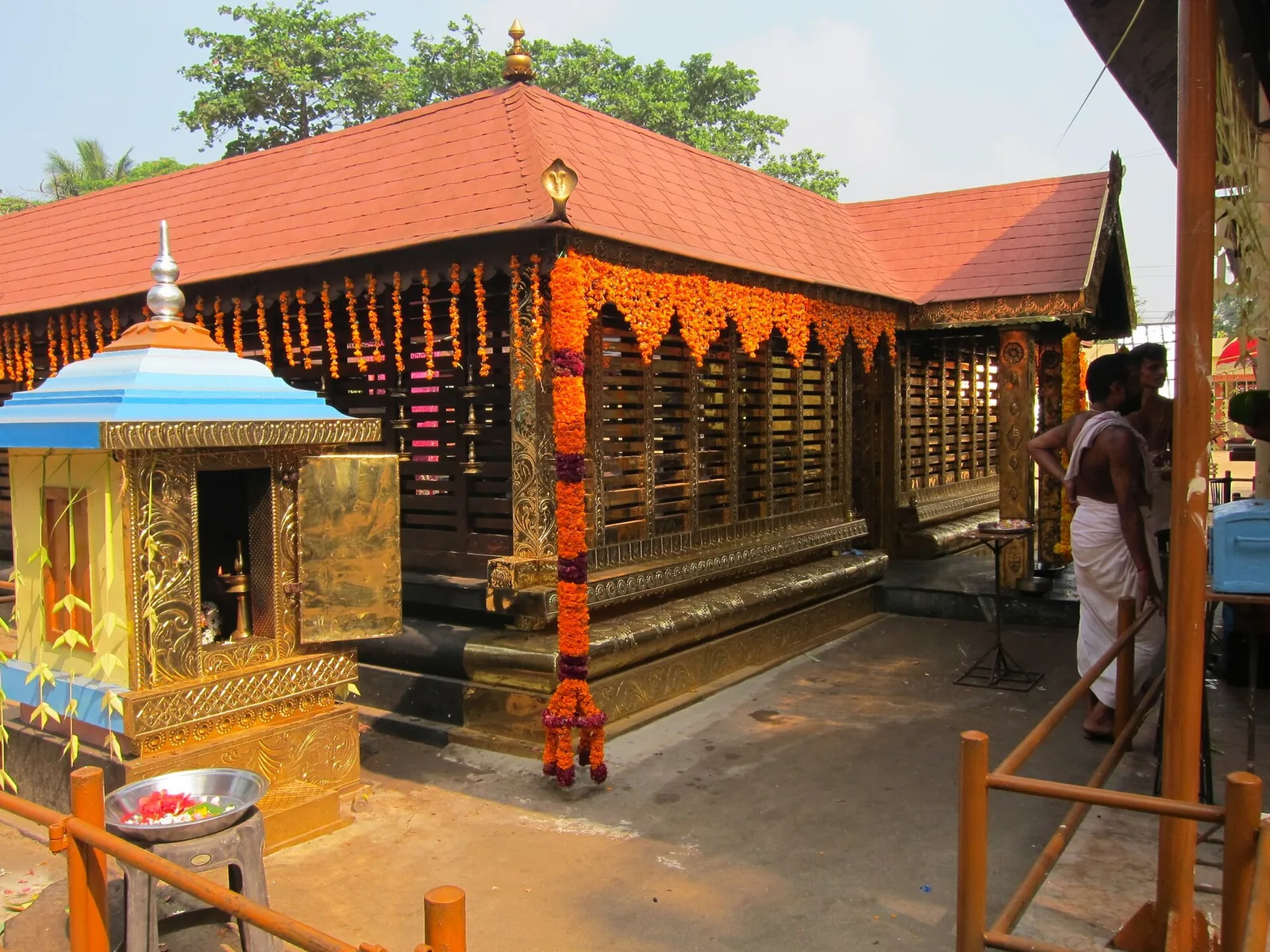
It is also, incidentally, why this page has no picture of the festival. The only Chamayavilakku photograph we could find under any open licence carries a non-commercial condition we cannot publish under. Every image here is the temple on an ordinary day — a quiet neighbourhood shrine that explains almost nothing about what happens on two nights in Meenam.
Frequently asked questions
Why do men dress as women at Kottankulangara?
On the temple’s own account, because that is how the goddess first answered. Its founding legend has cowherd boys at play acting as shy girls and offering flowers and a kottan to a stone; one received a divine response, and the ritual of men dressed as women began from that. The festival re-enacts the founding rather than inverting anything.
What does Chamayavilakku mean?
Chamayam is adornment — being dressed and made up — and vilakku is the lamp. The name describes the ritual: you are dressed, and then you carry light in procession to the temple.
Is it a spectacle for visitors?
No. It is a devotional vow, generally the discharge of a specific promise to the Devi. Visitors are not the audience it exists for, and the right manner is the one you would bring to any other act of worship.
Can I photograph the participants?
Ask first, every time. Participants are identifiable individuals in a small place, and a photograph can mean something quite different once it leaves the night it was taken in. Consent matters more here than the picture does.
What do participants wear?
Women’s attire of their own choosing — accounts describe the set sari, the pattu sari, the half sari and dance costumes. Nothing is issued; the getting-ready is part of the observance and much of it happens in houses around the temple.