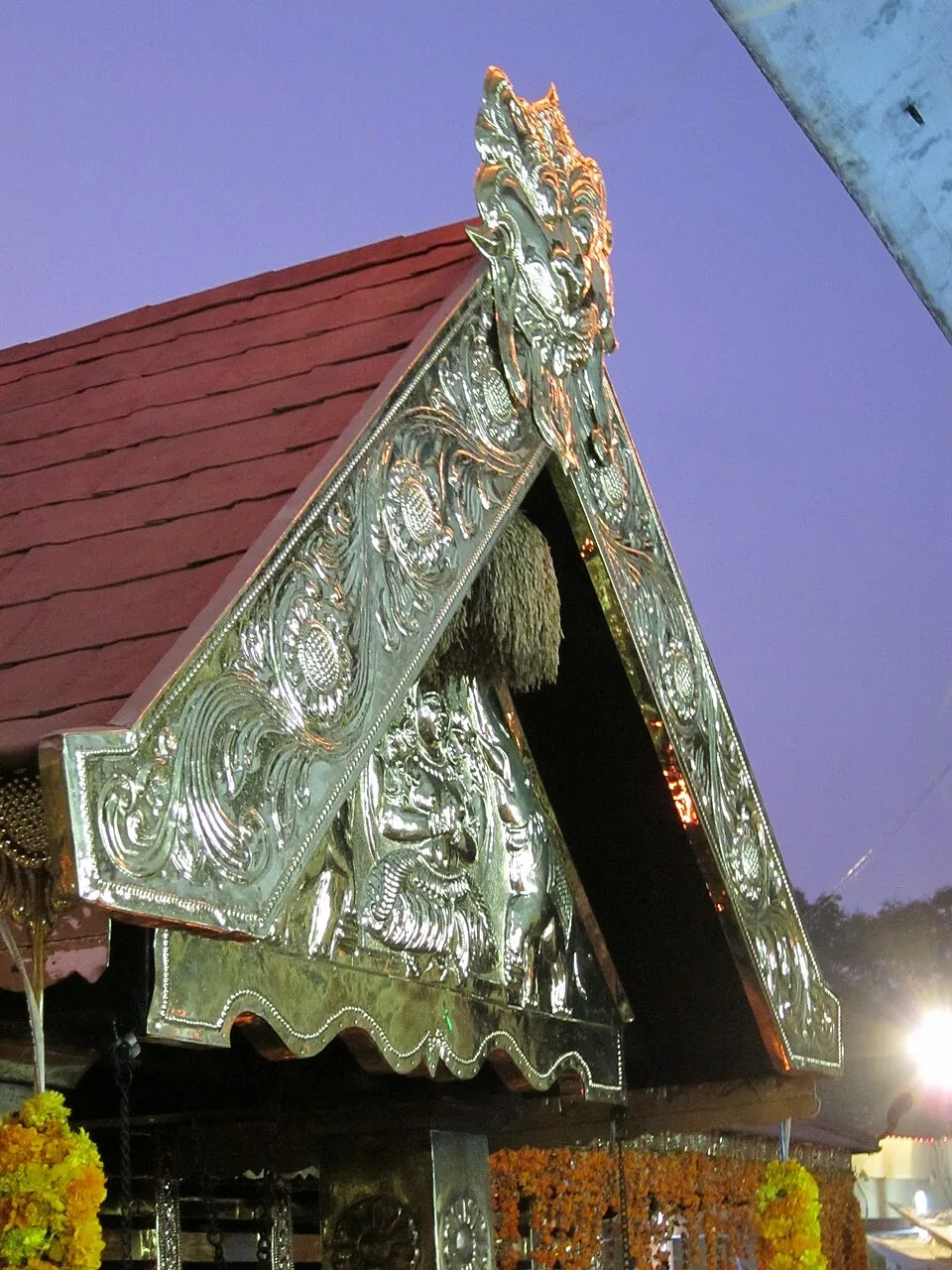
One sentence follows this temple everywhere: Kottankulangara is unique in Kerala for having no roof over its sanctum sanctorum.
We were ready to repeat it. We had it in our own working notes for this page. Then we opened the photographs, and it fell apart three separate ways.
One: look at it
The principal shrine in the available photographs carries a substantial tiled hipped roof with a gilded finial at the apex, over dark timber-slatted walls with a brass-clad base.
The other frame is closer still: a triangular gable end entirely sheathed in beaten repoussé metal, worked into scrollwork and figures, with red roof tiles running away behind it into the dusk. You cannot have a metal-clad gable without a pitched roof to put it on. It is a photograph of a roof.
That is not a subtle piece of visual analysis. It is the first thing you see.
Two: the temple says something else
The temple’s own website, describing its founding, does not say the sanctum has no roof. It says that a temple without an outer wall was constructed over the stone.
No outer wall and no roof over the sanctum are different architectural claims about different parts of a building, and only one of them is what the institution asserts about itself. It looks very much as though a wall became a roof somewhere in the retelling, and then the retelling was copied.
There is a supporting detail that makes the wall version more plausible, too. The temple annually erects a Kuruthola Pandal — a model of the ancient temple built in the old manner from poles and the tender leaves of the coconut palm. A structure of poles and palm leaves is exactly the kind of thing that has a roof and no walls. The tradition the temple keeps alive is about openness at the sides, not overhead.
Three: "only" is wrong regardless
Even if the roof claim were true of this temple, the word only would not survive, and the counter-examples are on this site already.
The Oachira Parabrahma temple, about twenty kilometres up the same coast, is famous precisely for having no idol, no image and no roofed sanctum — worship is directed at the formless under carefully tended old trees.
At Thirumandhamkunnu in Malappuram, the Sreemoolasthanam — the original sanctum — by custom stands open to the sky without a roof, which devotees read as a mark of its antiquity as a hilltop grove shrine rather than a later built temple.
And Poruvazhy Peruviruthy Malanada, in this same district, does not have a roofless sanctum because it does not have a sanctum: only a raised althara under an open pillared mandapam, with no idol and no chamber at all.
Two of those three are in Kollam district. A uniqueness claim that our own pages refute twice over within forty kilometres is not one we are going to print.
Why bother correcting it
Because the false fact is crowding out a true one, and the true one is better.
Kottankulangara does not need an architectural oddity. It has Chamayavilakku — two nights when thousands of men and boys dress in saris and carry lamps to the goddess, in a ritual its own founding legend produces rather than merely permits. That is genuinely unusual, it is well attested, and it is what the temple is actually known for across Kerala.
A borrowed claim about a missing roof adds nothing to that. It just gives a reader something to repeat that a single photograph disproves.
Frequently asked questions
Does Kottankulangara have a roof over its sanctum?
Yes. The photographs show a substantial tiled hipped roof with a gilded finial over the principal shrine, and a close-up of a metal-clad gable with roof tiles behind it. The widely circulated claim that it has none does not survive its own images.
Where does the roofless claim come from?
Most likely from a garbling of what the temple itself says. Its website describes the original shrine as a temple without an outer wall — a different claim about a different part of the building. The annual Kuruthola Pandal, rebuilt in poles and tender coconut leaves, is consistent with openness at the sides rather than overhead.
Are there temples in Kerala with roofless sanctums?
Yes, several. Oachira Parabrahma has no idol, no image and no roofed sanctum. Thirumandhamkunnu’s Sreemoolasthanam by custom stands open to the sky. Poruvazhy Malanada has no sanctum at all, only a raised platform under an open mandapam. Two of those are in Kollam district.
So what is genuinely unusual about this temple?
Chamayavilakku — the two nights in Meenam when thousands of men and boys dress in women’s attire and carry lamps in procession to the Devi, in a ritual the temple’s own founding legend directly produces. That is what it is known for, and it needs no help from an architectural claim.