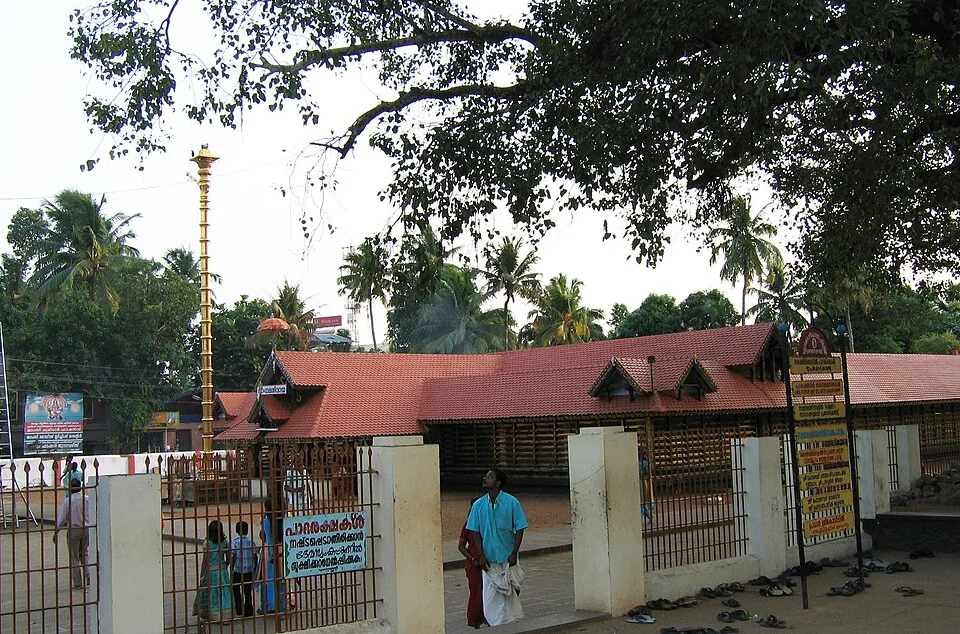
Kathakali is the most recognisable thing Kerala has ever exported: the green face, the vast skirt, the eyes reddened and trained to carry meaning across a courtyard. Almost every account of where it came from passes through a small taluk town on the MC Road, twenty-six kilometres east of Kollam.
What is widely held
In the seventeenth century a ruler of Kottarakkara — Veera Kerala Varma, remembered simply as the Kottarakkara Thampuran, with dates given as 1653 to 1694 — composed Ramanattam, a cycle of eight plays on the life of Rama.
The eight are named, and the list is worth having because it shows what the innovation actually was: puthrakameshti, seetha swayamvaram, vicchinnabhishekam, kharavadham, balivadham, thoranayudham, sethubandhanam, and yudham — the war.
That is the Ramayana staged as a sequence. Not a single episode performed as ritual on a single occasion, but a narrative arc built to be watched over successive nights. And it was composed in Malayalam rather than Sanskrit, which put it within reach of an audience that temple theatre had not been written for.
Ramanattam is very widely held to be the immediate ancestor of Kathakali. Our own page on Kathakali sets out the descent in more detail — how the form absorbed older Kerala traditions, the temple theatre of Kutiyattam, ritual forms such as Theyyam and Mudiyettu, and how reformers associated with Vettathu Raja and later Kaplingadu Namboodiri deliberately reshaped the make-up, the costume and the staging into what we now recognise.
And now the story everybody tells
The traditional explanation for why Ramanattam was written at all goes like this. The Zamorin of Calicut had composed Krishnanattam, a cycle on the life of Krishna, dated to 1657. The ruler of Kottarakkara wanted a performance for an occasion of his own and asked to borrow the Zamorin’s troupe. The Zamorin refused — and, in the telling, added a remark to the effect that the Kottarakkara court would not be capable of appreciating them.
So Kottarakkara wrote his own. On Rama rather than Krishna, and in the people’s language rather than in Sanskrit. Insult repaid with a whole new art form.
It is a magnificent story. It has a motive, a villain, a reversal and a moral, and it explains a formal choice — Rama not Krishna, Malayalam not Sanskrit — as an act of defiance. That is the shape of a very good anecdote.
It is also the shape of a manufactured one
Our page on Kathakali already says this, and we are not going to say something softer here just because this page is standing closer to Kottarakkara: the elements are real enough — Krishnanattam and Ramanattam both existed, and Kathakali plainly descends from that milieu — but the snub itself is the kind of neat causal insult that oral tradition is very good at manufacturing, and the surviving evidence for the exchange is thin.
Notice what the story is doing. Two chieftains were political rivals; the tradition has converted that rivalry into an artistic one, complete with dialogue. The dialogue is the part nobody can produce. Even the Wikipedia article on Ramanattam, which presents the refusal fairly flatly, carries a notice that it needs more citations, and observes in passing that rivalry between chieftains turned into rivalry in art — which is a description of a narrative process, not of an event.
Take the rivalry as the frame the tradition chose for itself. The plays are real. The insult is a story about the plays.
The distinction that actually matters here
There is a second conflation, and it is the one that concerns this temple directly.
"Kathakali was born here" runs two separate claims together. The first is that the Kottarakkara Thampuran composed Ramanattam. That is a claim about a person and a court, and it is widely held. The second is that he composed it at this temple — sitting, in the usual telling, beneath a banyan tree in its grounds. That is a claim about a place, and it is tradition only.
The two get printed as one, as though the second followed from the first. It does not. A raja’s literary project belongs to his court before it belongs to his temple, and the tree is doing the work of attaching one to the other.
There is a sourcing detail that sharpened this for us, and it surprised us enough to record. We expected to find the Kathakali connection asserted on Kerala Tourism’s page for this temple. It is not there. That page covers the Shiva dedication, the Ganesha sub-shrine, the unniyappam and the location, and says nothing at all about Kathakali, Ramanattam, the Kottarakkara Thampuran or Perumthachan. The state tourism department, writing about this temple, does not make the claim.
That does not make the tradition false. It does mean it is a tradition rather than an official history, and we would rather you knew which one you were being handed.
Where to go instead of the tree
If you have come to Kottarakkara for the Kathakali connection, there is a better address for it than a banyan.
The town has a Kottarakkara Thampuran Memorial Museum of Classical Arts — a real institution, mapped, photographed, holding exhibits on the performing traditions the Thampuran is remembered for. It is the checkable version of the story, and it is a short distance from the temple.
Then go back to the temple for the tank at dusk, and let the Ramanattam story be what it is: a superb piece of cultural memory, about a real cycle of plays, wrapped in an argument nobody can produce a witness for.
Frequently asked questions
Who composed Ramanattam?
Veera Kerala Varma, remembered as the Kottarakkara Thampuran, with dates given as 1653 to 1694 — sources use that span for both his reign and his life and none we found says which. He composed a cycle of eight plays on the life of Rama, in Malayalam rather than Sanskrit.
What are the eight plays?
Puthrakameshti, seetha swayamvaram, vicchinnabhishekam, kharavadham, balivadham, thoranayudham, sethubandhanam and yudham — the war. Together they stage the Ramayana as a sequence to be watched over successive nights, which was itself the innovation.
Did the Zamorin really insult the Kottarakkara ruler?
Treat it as tradition. Krishnanattam and Ramanattam both existed and Kathakali descends from that milieu, but the evidence for the exchange itself is thin, and it has the shape of a causal insult that oral tradition manufactures well. Political rivalry between chieftains has been converted into artistic rivalry, complete with dialogue nobody can produce.
Was Ramanattam written at the temple?
That it was composed by the Kottarakkara Thampuran is widely held; that he wrote it beneath a banyan tree at this temple is tradition only. The two claims are frequently printed as one. Notably, Kerala Tourism’s own page for the temple makes no Kathakali claim at all.
Is there anywhere in town to see this properly?
Yes — the Kottarakkara Thampuran Memorial Museum of Classical Arts, in the same town, which holds exhibits on the performing traditions the Thampuran is remembered for. It is the practical address for the connection.