It is worth knowing before you go that this is not a forest shrine or a hilltop sanctuary. Kottarakkara is a taluk headquarters, and the temple is in the middle of it.
Within a few hundred metres of the compound there is a taluk office, a sub-registry of half the government departments Kerala runs, a treasury, an RTO, a private bus stand, a KSRTC depot, hotels, banks and a market. The MC Road — the trunk route between Kollam and the interior — runs through the town. Kottarakkara is a place people change buses in.
Which is exactly why the tank matters
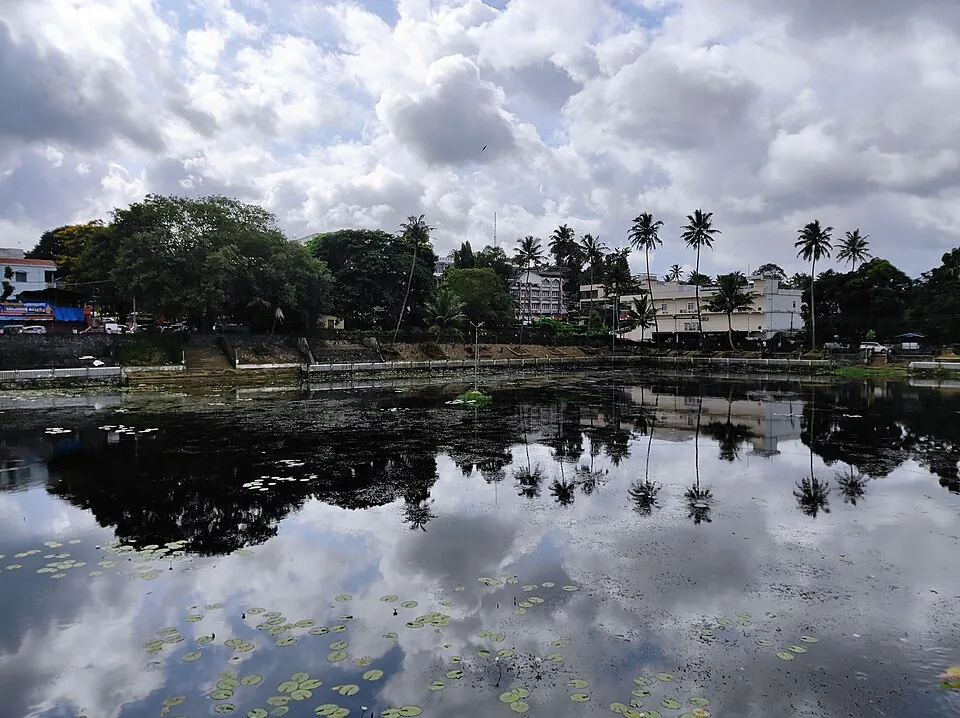
A large rectangular sheet of water sits beside the temple, edged with laterite retaining walls that drop straight in, lily pads spreading across the surface, steps at intervals down to the water.
From the far side at dusk the whole complex reads as a single low line of red tiled roof with its reflection beneath it, palms behind, and nothing of the taluk office in the frame at all. It is the one place in Kottarakkara where the town gets out of the way.
That is not an accident of scenery. In this part of Kerala the temple tank is part of the institution — for ritual bathing, for the water itself, for the space it holds open in a place where land is otherwise built on. A temple in a market town with a tank has room to breathe; the same temple without one would be a compound behind a wall. Walk the whole way round it. It takes ten minutes and it is the best thing here.
What you meet at the gate
The footwear comes off at the outer railing, not at the sanctum door — you will see the rows of it on the ground outside the compound, and a Malayalam notice at the gate about exactly that. Traditional temple dress is expected, as at most Kerala temples: men customarily in mundu with the upper body bare or modestly covered, women in saree or salwar.
Inside the railing, the architecture is the regional idiom done well. Long ranges of tiled roof with carved gabled dormers set into them. Walls of close-set vertical timber slats standing on laterite. A tall dhwajastambham sheathed in gold-coloured metal in the forecourt, and notice boards in Malayalam listing offerings and rates.
The honest bit about timings
We could not find published opening hours from the temple itself, and we are not going to invent a schedule for you.
What is safe to assume is the ordinary Kerala pattern: a morning session from early morning to late morning, the sanctum closed through the middle of the day, and an evening session. If a particular listing gives you exact times to the minute, treat it with the caution you would give any unsourced number — including on festival days, where the pattern changes.
Vinayaka Chaturthi is the natural high point for a temple known across Kerala for its Ganapathi shrine. The temple and Kerala Tourism do not publish a formal utsavam programme or dates online, so obtain the current schedule locally or at the counter.
Eat the unniyappam
Do not skip this on the grounds that it is a snack. The unniyappam here is the reason a great many people in Kerala know the word Kottarakkara at all — a small dark round sweet fried in ghee, rice with jaggery and banana, cardamom and pieces of coconut, made at this temple in volume as the characteristic offering.
It is one of very few Kerala temple offerings that has become a regional food in its own right, and tradition credits the first one here to Perumthachan, the legendary master carpenter who is also said to have made the Ganapathi idol. Eating it is the shortest route into the temple’s own account of itself.
Making a half day of it
Two things pair naturally. The Kottarakkara Thampuran Memorial Museum of Classical Arts is in the same town, and is the proper address for the Ramanattam and Kathakali connection that brings most outside visitors here. And the Kottukal rock-cut cave temple — a monolithic Shiva shrine carved out of living rock — is in the same taluk, at Ittiva, and is a genuinely different order of thing to look at.
Kottarakkara sits about twenty-six kilometres east of Kollam on the MC Road, with its own station on the Kollam–Sengottai line, though Kollam Junction has far more services. It is one of the easiest places in the district to reach by bus, because half the district changes buses here anyway.
Frequently asked questions
What are the temple timings?
We could not find hours published by the temple itself and have not invented any. Assume the ordinary Kerala pattern — a morning session, the sanctum closed through the middle of the day, and an evening session — and confirm locally. Treat listings that give exact times with caution.
Is there a dress code?
Yes, the usual Kerala temple expectation: men customarily in mundu with the upper body bare or modestly covered, women in saree or salwar. Footwear is left at the outer gate rather than at the sanctum door, and there is a notice about it at the entrance.
Is there an entry fee?
Darshan is free. Vazhipadu offerings, including the unniyappam the temple is known for, are paid at posted rates at the counter.
What is the best time to visit?
October to March for the weather, and early morning or dusk for the visit — dusk especially, because the tank with the whole complex reflected in it is the best thing on the site.
How do I get there?
Kottarakkara is about 26 km east of Kollam on the MC Road and is a major bus junction, very well served from Kollam, Thiruvananthapuram, Adoor and Punalur. Kottarakara station is on the Kollam–Sengottai line; Kollam Junction has many more services.
What else is worth seeing nearby?
The Kottarakkara Thampuran Memorial Museum of Classical Arts in the same town, and the Kottukal rock-cut cave temple at Ittiva in the same taluk — a monolithic Shiva shrine carved from living rock.