Almost everything written about Kottukal is written from above — the century, the dynasty, the protection order, the place of the monument in the history of south Indian rock-cut architecture. It is all worth knowing and none of it is how the place is actually experienced by the people who live around it.
Go and stand in the compound and a different building appears.
The sleeping elephant
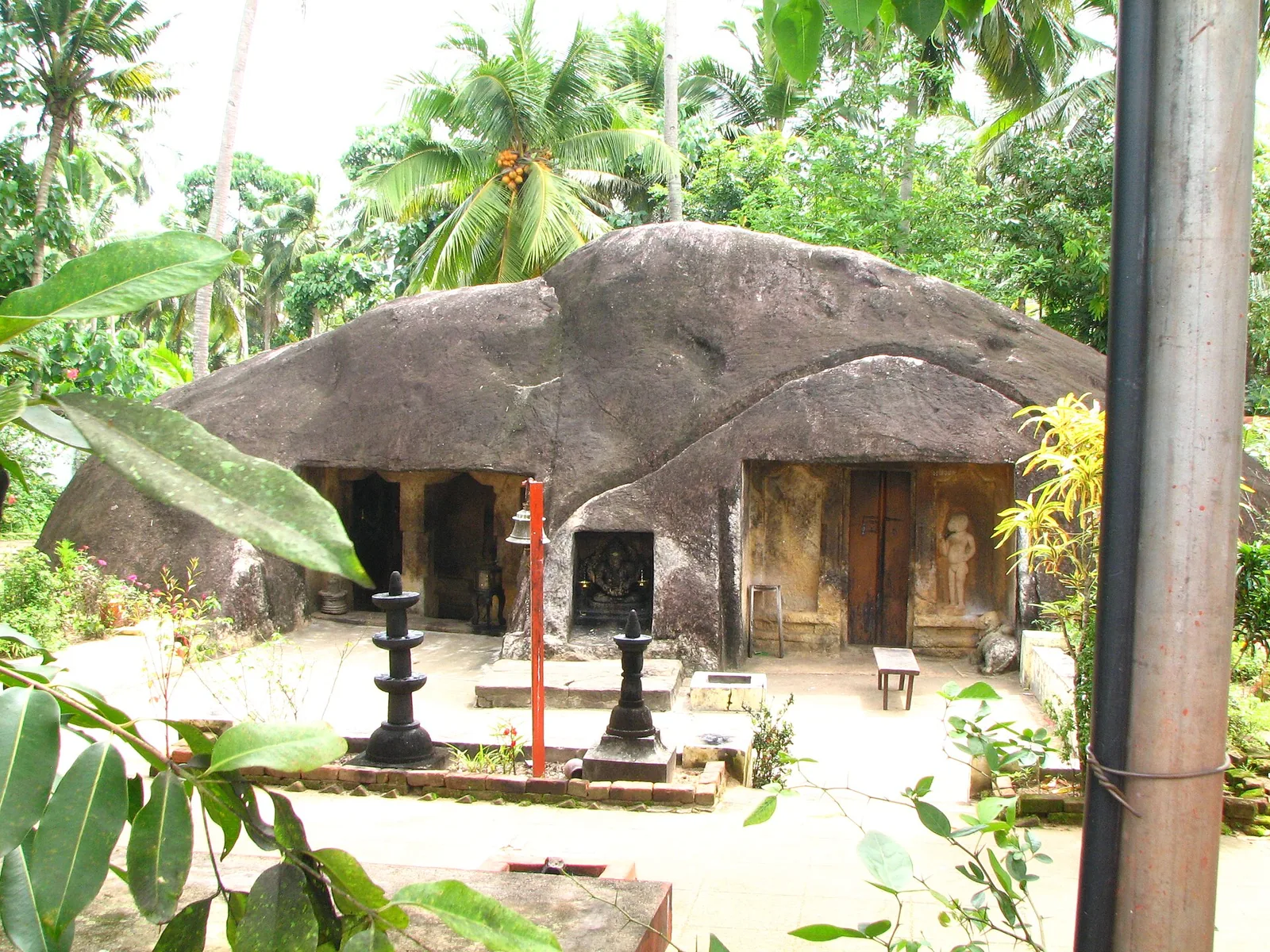
The first thing anyone local will tell you about the rock is not its date. It is that it looks like a sleeping elephant: a long grey back rising out of the greenery, sloping down at one end, at rest.
Once it has been said you cannot unsee it, and it is a better description than any of the technical ones — because it is a description of the whole mass, which is what you see from the road, rather than of the two doors, which are what the archaeology is about. Most of this monument is the part nobody excavated.
The headache rock
A short way from the great boulder lies a smaller stone that villagers call chummadu para — the headload rock, from the loads carried on the head along these lanes for as long as anyone can remember.
Tradition holds that resting an aching head against it, or against the mother rock, brings relief. There is no shrine to it, no priest attends it, and it appears in no protection order. It is simply a stone with a job, and it has held that job alongside the temple for a very long time.
This is the layer that gets edited out of heritage writing, and it is often the older layer. A boulder this size in a settled landscape acquires uses and stories long before anyone arrives with chisels, and it keeps acquiring them afterwards.
A swept yard, not a ruin
The compound around the rock is not what the phrase "protected monument" leads you to expect. It is walled and paved and swept. There are cast-iron lamp-stands, a bell hung on a post, a low bench, flowering shrubs in a bed edged with brick, and a coconut garden pressing in on all sides.
Worth correcting one printed detail while we are here: the rock is often described as rising out of paddy fields. It does not. It stands in a garden compound in coconut and rubber country, and that is what you will find when you arrive.
Daily worship continues under the Travancore Devaswom Board. The doors of the cells are wooden, and they are opened and closed like the doors of any small temple. Oil is poured, lamps are lit, the floor is swept. On an ordinary weekday you may well have the place to yourself apart from whoever is doing that work.
And then Shivaratri
The exception is Maha Shivaratri, usually falling in February or March and shifting each year with the lunar calendar. Both cells hold a Shivalinga, and on the night of the vigil a shrine that is silent for most of the year fills with lamps, chanting and steady traffic.
It is the one occasion when the scale of the boulder makes obvious sense: a crowd standing in the yard at night, the rock lit from below, two doorways of unequal size open in the side of it.
Who it belongs to
Formally, the answer is layered and slightly absurd. The monument is protected by the Kerala State Department of Archaeology under an order of 1966. The notice at the gate is issued by the District Collector. The worship inside it is conducted under the Travancore Devaswom Board. Three separate authorities, one boulder, no visible coordination between them.
Informally, the answer is simpler, and it is the reason this page is worth reading before you go. The archaeologists have custody of the excavated part. The neighbourhood has the rest of the rock — the elephant, the headache stone, the shade, the yard — and it has had it far longer.
Visit accordingly. Take your shoes off, keep your voice down if a lamp is burning, and give the smaller stone a moment on the way out.
Frequently asked questions
What is the chummadu para at Kottukal?
A smaller stone near the main boulder — the name means headload rock, after the loads carried on the head along these lanes. Local tradition holds that resting an aching head against it, or against the great rock itself, relieves headaches. It has no shrine and no priest; it is an unofficial belief attached to the place.
Why is the rock called a sleeping elephant?
Because from a distance the boulder's long grey back and sloping end genuinely read as an elephant lying down. It is the local description of the rock and it captures the whole mass, most of which was never excavated.
Is the temple still in daily use?
Yes. Daily worship continues under the Travancore Devaswom Board inside a monument that has been protected by the Kerala State Department of Archaeology since 1966. On an ordinary day it is very quiet.
When is the temple busiest?
Maha Shivaratri, usually in February or March — the date shifts each year with the lunar calendar, so check before planning around it. Both cells hold a Shivalinga and the night vigil is when the site is most alive.
Does the rock stand in paddy fields?
No, though that is often printed. It stands inside a walled, paved and swept garden compound with lamp-stands and a bell, surrounded by coconut and rubber country.