Cross the Ghats into Tamil Nadu and rock-cut shrines are everywhere — Pallava caves at Mahabalipuram and Mandagapattu, Pandya caves scattered through Madurai, Tirunelveli and the Pudukkottai country, hundreds of them, a whole architectural civilisation cut backwards into stone.
Come back over the pass into Kerala and they very nearly stop.
Why the technique did not take here
Kerala built temples the other way round: up, out of assembled parts. Laterite that cuts like cheese when quarried and hardens in air, granite for plinths and bases, and above all timber — the sloping, deeply overhanging, copper- and tile-roofed shrine that is the state's architectural signature, designed for a coast that takes two monsoons a year.
Rock-cut excavation belongs to a drier idiom and to different patrons. It was the prestige mode of the Pallavas and the Pandyas at a particular moment, and its distribution follows their political reach rather than the availability of rock. Kerala has no shortage of granite boulders. It simply had different rulers, a different building tradition and a different climate to build for.
The short list
What survives on this side of the mountains can be counted on your fingers. The best known are the Vizhinjam Rock-Cut Cave Temple near Thiruvananthapuram, the Trikkakkudy cave at Kaviyoor in Pathanamthitta, the cave at Trikkur near Thrissur, the shrine at Irunilamkode, and the rock temple at Kallil. Kottukal belongs to that list.
That is roughly it. A handful of monuments for an entire state, against several hundred across the border — which is why an eighth- or ninth-century cave in a Kollam village is a genuinely significant building and not merely a pretty one.
What Kottukal has that the others do not
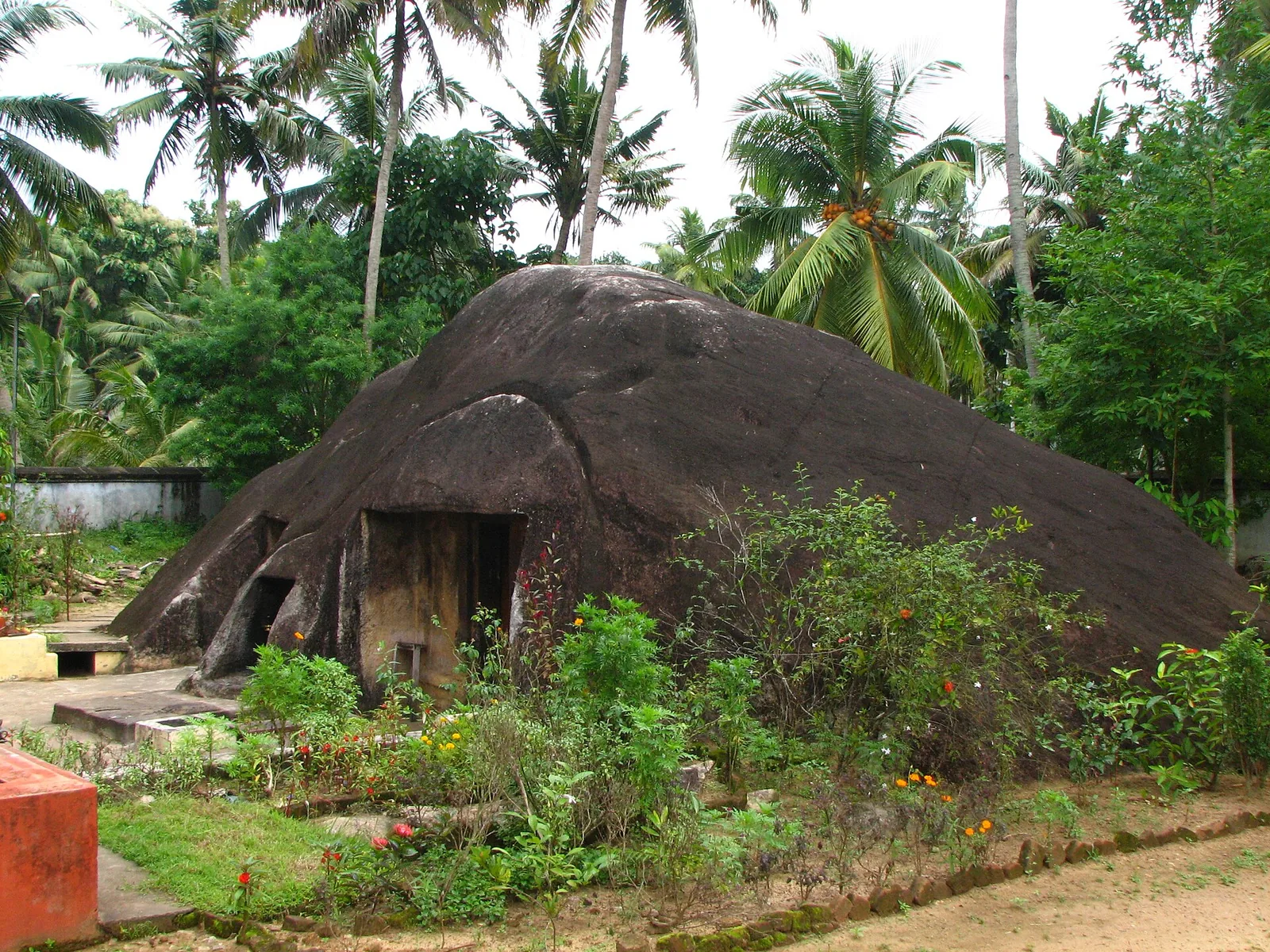
Most of the Kerala caves are single cells: one excavated chamber, one deity, sometimes a rudimentary front. Kottukal has two chambers, cut from one rock and facing east, and the larger of them is worked out into a proper sequence of spaces — a garbhagriha, an ardhamandapa in front of it, and a pillared façade, with two pillars left standing in the living rock of the mukhamandapa.
That is architecture rather than excavation. Somebody here was not simply hollowing out a shelter for an image; they were reproducing, in negative, the plan of a built temple — sanctum, antechamber, pillared porch — inside a boulder. The Kerala State Department of Archaeology calls it "an idyllic example of rock-cut temple architecture", and the plan is why.
The two cells are also, plainly, unequal — you can see it from the garden, one broad opening and one much narrower. That is worth knowing because the most-copied description of this temple gives both chambers identical measurements, ten feet by eight, which cannot be right and is contradicted by the state's own account of what the larger one contains.
And what it does not have
It is only fair to say the other half.
Kottukal has almost no narrative sculpture. There is a Ganapathy projected on the wall between the cells — the state calls it the stand-out feature — a standing Hanuman in a niche of the small cell with a couchant bull at his feet, the lingas and their monolithic Nandis. Beyond that the surfaces are plain.
Go to Trikkakkudy at Kaviyoor and you will find carving in a different class: a bearded ascetic, a four-armed doorkeeper, a portrait figure, all cut with real confidence. Vizhinjam has its unfinished Dakshinamurthy and a Shiva-and-Parvati panel that repay a long look. If sculpture is what you have come for, those are the caves to plan a day around.
Kottukal's claim is the plan and the ambition of the excavation, not the carving on its walls. Both things can be true, and a page that told you only the first would be selling you something.
How to look at it
Stand back far enough to take in the whole boulder first — that is when the scale of the removal registers, and when the two unequal doors read as deliberate rather than accidental. Then go close and look sideways along the façade of the larger cell, where the pillars stand clear of the rock behind them.
Everything you are looking at is absence. There is no joint anywhere in this building, because nothing was ever brought to it.
Frequently asked questions
Why are rock-cut temples rare in Kerala?
Because the technique belongs mainly to the Tamil country east of the Ghats, where Pallava and Pandya patronage made it the prestige mode. Kerala's own tradition is structural — laterite, granite and above all timber, under the deep sloping roofs a two-monsoon coast demands. The scarcity is about patrons and building culture, not about a shortage of rock.
What other rock-cut caves are there in Kerala?
A very short list. The best known are Vizhinjam near Thiruvananthapuram, Trikkakkudy at Kaviyoor in Pathanamthitta, Trikkur near Thrissur, Irunilamkode, and Kallil — with Kottukal among them.
What makes Kottukal architecturally distinctive?
Two chambers cut from a single rock rather than the usual single cell, and a larger chamber worked into a full sequence — garbhagriha, ardhamandapa and a pillared façade, with two pillars left in the living rock of the mukhamandapa. It reproduces the plan of a built temple in negative.
Is the sculpture at Kottukal worth the trip?
Honestly, the carving is not its strength. There is a Ganapathy on the wall between the cells, a standing Hanuman in a niche of the small cell, and the lingas with their monolithic Nandis; beyond that the surfaces are plain. For carving, Trikkakkudy at Kaviyoor and Vizhinjam are considerably richer. Come to Kottukal for the plan and the scale of the excavation.
Are the two chambers the same size?
No, and it is obvious on the ground — one opening is broad, the other much narrower. The widely copied description giving both chambers as "10 feet by 8 feet" cannot describe both, and it conflicts with the state's own account of what the larger cell contains.