If you search for this temple you will quickly meet a warning, phrased more or less like this: do not confuse the Kottukal cave near Kollam with the Kottukal cave near Vizhinjam.
The warning is useful and its premise is wrong. There is no cave called Kottukal in Thiruvananthapuram district.
Where the name clash actually comes from
The coastal monument people are thinking of is the Vizhinjam Rock-Cut Cave Temple, on the rise above the old fishing harbour — a small eighth-century Ay-period shrine of Vinadhara Dakshinamurthy. Its name is Vizhinjam. It has never been called Kottukal.
What it has is a Kottukal address. Vizhinjam village sits inside Kottukal grama panchayat, in Neyyattinkara taluk, so postal addresses and administrative records down there carry the word Kottukal in them. Somebody read an address as a monument name, and the error has been propagating ever since — including, until recently, on this site.
So the collision is not between two caves with the same name. It is between a village in Kollam district and a panchayat in Thiruvananthapuram district that happen to share a name, with a genuinely famous cave temple standing inside the second one.
One year, two legal universes
Here is the part that repays attention, because it changes what you actually encounter at each site.
The Vizhinjam cave has been a centrally protected monument under the Archaeological Survey of India since 1965. The Kottukal cave in Kollam district was declared a protected monument by the Kerala State Department of Archaeology in 1966.
One year apart, and on opposite sides of a constitutional line. Archaeology in India is a divided subject: the Union government protects monuments of national importance through the ASI, and the states protect everything else through their own departments, under their own legislation, with their own budgets and their own staff.
That is not a technicality a visitor can ignore. It determines who pays for conservation, who is legally empowered to stop somebody chipping a name into the rock, whose signage you are reading, and — in practice — how much attention a small monument gets.
The board on the gate
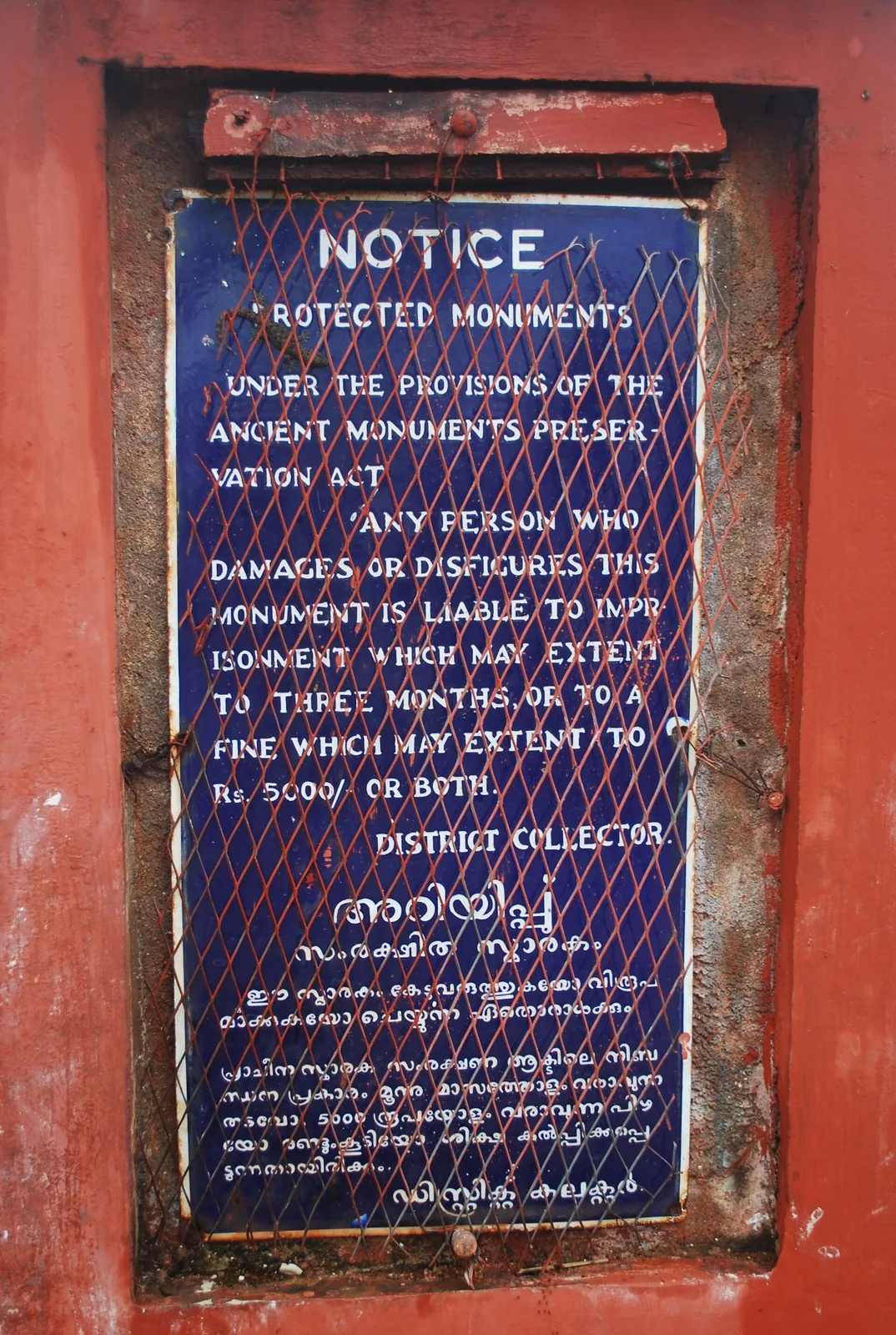
You can see the difference before you see the temple. The notice at Kottukal is a blue enamel plate behind rusted chicken wire, and it reads, in English and then again in Malayalam:
- Notice — PROTECTED MONUMENTS
- Under the provisions of the Ancient Monuments Preservation Act
- "Any person who damages or disfigures this monument is liable to imprisonment which may extent to three months, or to a fine which may extent to Rs. 5000/- or both."
- Signed: District Collector
Not the Archaeological Survey of India. The District Collector — the senior revenue officer of Kollam district, whose ordinary work is land records, elections and disaster relief, and who is also, here, the authority whose name stands behind a ninth-century monument.
Three months, or five thousand rupees, or both. It is a modest deterrent for a shrine that has stood for eleven or twelve hundred years, and the board itself has weathered enough that the wire in front of it is now more conspicuous than the text behind it.
And it is still somebody's temple
The third layer is the one that makes Kottukal genuinely unusual among protected monuments. It is not a fenced-off ruin. Daily worship continues here under the Travancore Devaswom Board, which means the site is simultaneously a legally protected antiquity of the Kerala government and a working shrine of a statutory religious body.
Two arms of the state with different mandates, sharing one boulder. The archaeologists would like nothing to change; the Devaswom needs lamps lit, oil poured, doors opened and closed, and a floor swept every morning. Both are happening, and the accommodation between them is entirely informal.
If you are navigating
Set your directions to Anchal or Kadakkal, in the Ittiva area of Kottarakkara taluk. Do not set them to Vizhinjam, and do not accept a route that takes you towards the coast: the two sites are in different districts, roughly seventy kilometres apart, and the road between them is nothing like a detour.
Both are worth seeing. They are simply not the same place, and one of them is not called what everybody thinks it is called.
Frequently asked questions
Is the Kottukal cave temple the same as the Vizhinjam cave temple?
No. They are separate monuments in different districts, about seventy kilometres apart. The Kollam one is the Kottukal Cave Temple at Ittiva, Kottarakkara taluk; the coastal one is the Vizhinjam Rock-Cut Cave Temple near Thiruvananthapuram.
Why do so many sources say there is a "Kottukal cave near Vizhinjam"?
Because Vizhinjam village lies inside Kottukal grama panchayat in Neyyattinkara taluk, so its addresses contain the word Kottukal. An address was mistaken for a monument name. There is no cave actually called Kottukal in Thiruvananthapuram district.
Who protects the Kottukal cave temple?
The Kerala State Department of Archaeology, which declared it a protected monument in 1966. It is not an ASI site — the notice at the gate is issued by the District Collector under the Ancient Monuments Preservation Act. The Vizhinjam cave, by contrast, has been ASI-protected since 1965.
Can you still worship there, or is it only a monument?
Both. Daily rituals continue under the Travancore Devaswom Board inside a site that is legally protected antiquity — an unusual pairing, and one of the more interesting things about the place.
What is the penalty on the notice board?
Imprisonment of up to three months, or a fine of up to Rs 5,000, or both, for damaging or disfiguring the monument — under the Ancient Monuments Preservation Act, signed by the District Collector.