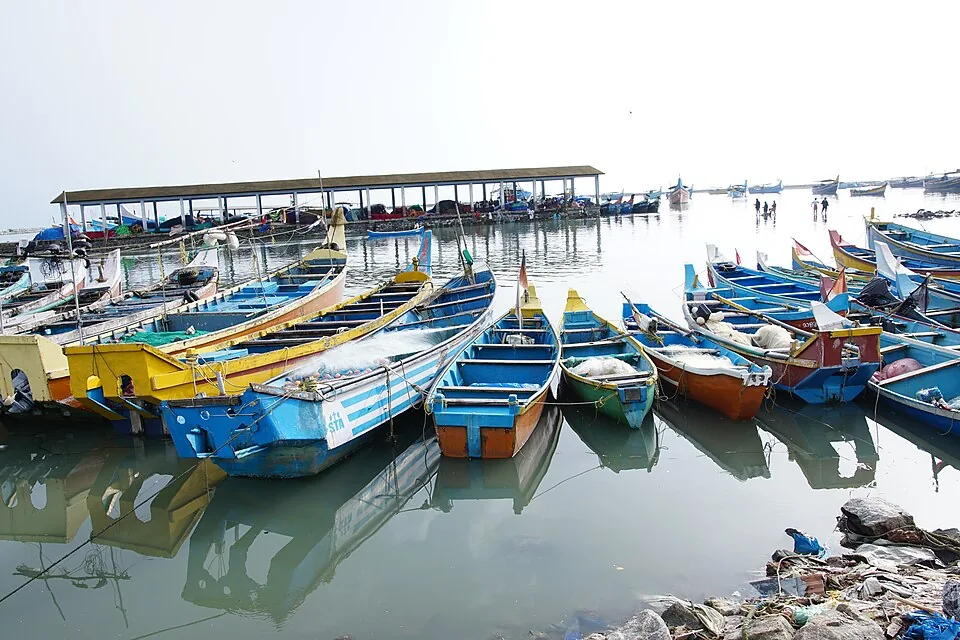
Ibn Battuta came down this coast in 1342 or 1343, and his description of the town he calls Fandarayna is short enough to give whole. In Gibb and Beckingham’s translation for the Hakluyt Society: from Budfattan we continued our journey to Fandarayna, a large and fine town with orchards and bazaars. The Muslims occupy three quarters in it, each of which has a mosque. The cathedral mosque is on the sea front, a magnificent building with gazebos and loggias overlooking the sea. Its qadi and preacher is a man from Oman, and he has a brother, a worthy man. It is at this town that the Chinese vessels pass the winter.
That last sentence is the one everybody quotes and the one that is easiest to distrust. Travellers say things. A single line about Chinese ships in a fourteenth-century Arabic travelogue is exactly the kind of detail that gets repeated for six centuries because it is pleasing rather than because it is true.
Except that he corroborates himself, without meaning to
Twenty pages later Ibn Battuta is describing a disaster in the Calicut roads — the destruction of the fleet carrying the Delhi Sultan’s gifts to China, in 1342. He is counting what survived. None of them were left, he writes, but the one which contained the present, another junk whose owners had decided to pass the winter at Fandarayna, and the kakam referred to. Then, on the Saturday morning, the junk whose owners were making for Fandarayna was driven ashore and broken in pieces. Some of those who were on board died and some escaped.
This is a different kind of evidence from the first passage. He is not describing a custom; he is doing arithmetic on a wreck. The wintering practice appears incidentally, as the reason one particular ship was where it was — and that ship’s crew died for it. A custom attested twice, once deliberately and once by accident, is a custom you can print. Ibn Battuta then watched the Zamorin standing barefoot on the beach among the wreckage.
The rest of the Chinese record
It is not only him. Mongol-dynasty documents of 1296 capped exports to a place written as Fantalaina at fifty thousand ting in paper money. Wang Dayuan, writing in 1349, was the first Chinese author to note precious stones at Fandarina. Chinese renderings of the name include Fan-ta-la-yi-na and Pan-ta-li. These reach us through secondary scholarship rather than from the Chinese texts directly, and should be carried as such — but they are consistent with each other and with the Arabic sources.
And there is the evidence you can still hear in the street. Chinakotta — Chinese fort. Chinapalli — Chinese mosque. Chinachery, the Chinese settlement, over at Kappad. A Silk Street. These survive as ordinary local place names, attached to nothing you can visit, which is the pattern for everything in Koyilandy: the port left vocabulary rather than masonry.
Why here, and not Calicut
The plain answer is the seabed. Calicut had no port and still does not. What this coast has is a set of offshore mud banks that damp down the monsoon swell, and a shoreline behind them where a heavy ship could lie out a season safely. Colonel Sankey of the Madras Engineers guessed at exactly this in 1881 when he wondered whether the snugness of the harbours frequented by the Chinese junks, such as Pandarani, was mostly due to banks of that kind.
Wintering is a serious commitment. A junk laying up for a season needs somewhere to careen and repair, provisions for a crew of many dozens, a market that can absorb a cargo and assemble a return one, and a legal order that will not simply confiscate an idle foreign ship. Ibn Battuta’s description supplies most of that in a single paragraph — three Muslim quarters, bazaars, orchards, and a qadi from Oman to arbitrate. It is a port with institutions, not a beach with traders on it.
The name ladder
Because so many trading worlds used this town, the name comes down to us in layers. Logan listed some of them: mentioned as Pandarani by Portuguese writers, the Flandarina by Friar Odoric, Fandreeah in Rowlandson’s translation of the Tuhfat al-Mujahidin, the Fandaraina by Ibn Battuta. Add Al-Idrisi’s Fandarina around 1150, the Yuan documents’ Fantalaina, and the Malayalam Panthalayani Kollam — the northern Kollam, to distinguish it from the one in the south.
The modern name is Koyilandy, romanised on the railway nameboard as Quilandi. And the medieval one has not quite gone: wards 11, 14 and 15 of the municipality are Panthalayani North, Panthalayani Central and Panthalayani South.
One thing Al-Idrisi said that nobody can explain
Al-Idrisi, around 1150, described Fandarina as a town built at the mouth of a river coming from Malabar, where vessels from India and Sind cast anchor, with rich inhabitants, well-supplied markets and flourishing trade. Logan spotted the difficulty at once: there is no river mouth at Panthalayani. He wondered whether the Kotta river once flowed into the Agalapuzha and out to the sea here. As far as we can tell nobody has answered him, and the question is a good deal more interesting than a tidy answer would be.
Frequently asked questions
Did Chinese ships really winter at Koyilandy?
The evidence is better than usual for a claim of this age. Ibn Battuta states it directly, and then corroborates it incidentally twenty pages later by describing a junk whose owners had decided to winter at Fandarayna and which wrecked in 1342 trying to get there.
What was the town called?
Fandarina to Al-Idrisi, Fandarayna to Ibn Battuta, Flandarina to Friar Odoric, Fantalaina in Yuan Chinese documents, Pandarani to the Portuguese, and Panthalayani Kollam in Malayalam. Koyilandy today, romanised Quilandi on the station board.
Is anything Chinese still visible?
Only names: Chinakotta, Chinapalli, Chinachery at Kappad, a Silk Street. There is no Chinese-era structure to visit.
Why did ships winter here rather than at Calicut?
Calicut has no natural harbour. This stretch has offshore mud banks that flatten the monsoon swell, giving safe holding through the season — the same feature that made the Zamorin’s pilot move da Gama’s fleet here in 1498.