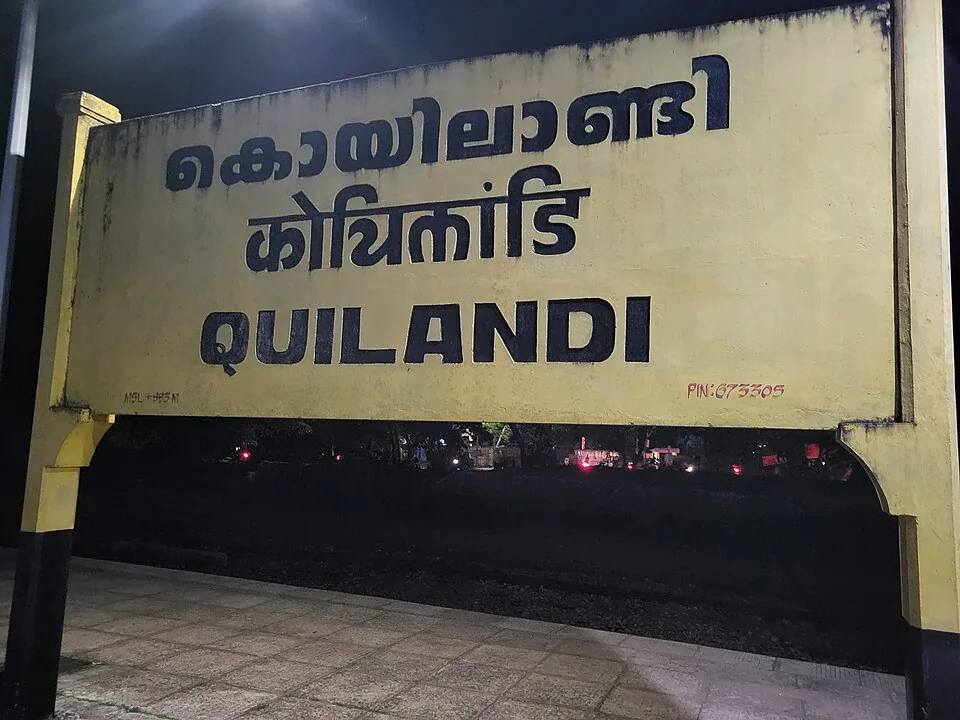
Here is the difficulty with writing about Koyilandy, and it is worth stating before anything else. This was one of the significant ports of the medieval Indian Ocean. Arab geographers described it, Chinese fleets wintered in it, a Portuguese armada lay off it for the better part of three months, and the town was burned at least once for resisting. There is no fort. There is no excavated port site. There is no museum, no interpretation centre, and no board at the harbour telling you any of it. An architectural survey of the town found that this heritage is not merely unmarked but largely unknown to the people living on top of it.
So the honest way to write the place is to go looking for what did survive, and to be precise about how much weight each thing will bear.
The name, in the ward register
The best-preserved thing in Koyilandy is a word. The municipality has forty-four wards, and wards 11, 14 and 15 are Panthalayani North, Panthalayani Central and Panthalayani South. Ward 43 is Kollam West. The name of the medieval port is on the administrative map of a town of some seventy-two thousand people, doing ordinary municipal work — a survival more durable than most masonry, and one that has never needed conserving because nobody noticed it was a monument.
The inscription
The Koyilandy Jumu’ah Mosque holds an Old Malayalam inscription in mixed Vatteluttu and Grantha script, dated to the tenth century, published as number 162 in volume VIII of South Indian Inscriptions in 1932. It is read as recording patronage by the Hindu king Bhaskara Ravi to the Muslims of Kerala — which puts it in the same small family as the inscription at Muchundi Palli in Kozhikode city, and makes this coast’s record of Hindu rulers endowing Muslim institutions less singular and more like a pattern.
Two cautions. We have not seen the volume; we have verified that the citation exists and is attached to that reading. And we could not establish that the stone is on public display. Do not travel to Koyilandy expecting to be shown it.
Logan recorded something else in the same mosque’s bathing tank: a granite slab with a temple inscription in vattezhuthu, which he read as evidence of a temple site converted to a mosque, and which he concluded — along with the famous footprint rock nearby — was of Jain origin. That is Logan’s reading, from the 1880s, and it should be attributed to him rather than repeated as settled.
The graveyard, which is the Portuguese monument
On the rocks north of town stands Parappally, held locally to be one of the mosques founded on this coast by Malik Ibn Dinar; a list preserved in the Qissat Shakarwati Farmad includes Panthalayani among them. The complex sits on Mayyith Kunnu — Burial Hill — with further mosques and a number of tombs. Some very specific claims circulate about who is buried there and when; they rest on the thinnest sourcing we encountered anywhere in this town’s literature, and we are not printing them.
What the graveyard is, though, is the physical residue of the sixteenth century. Logan recorded that about a third of the Muslims of the town died fighting the Portuguese. The large burial ground is what that sentence looks like on the ground.
The dates of those attacks should not be tidied into one, and often are. Zainuddin Makhdum’s Tuhfat al-Mujahidin records fighting at Pantalayani in 1524 and the burning of the town and its Juma mosque in 1550. Logan adds a raid by the Viceroy Henrique de Menezes in February or March 1525 that burned Ponnani and Koyilandy, the town defended by twenty thousand Nairs and Muslims, and separately a descent in 1550 that destroyed mosques and houses. Earlier still, in March 1505, a fleet assembled here to carry Muslims out of the Zamorin’s kingdom was destroyed, with a chronicler’s figure of seventeen vessels taken and two thousand men killed. Attacks across the 1520s, a burning in 1550, and a figure or two that should be attributed rather than asserted.
The hookah
The most tangible survival is a thing you can hold. The Koyilandy hookah is made by the Moosari coppersmith community: a water bowl of coconut shell, a body cast in brass or bronze, a wooden stem, patterning laid in wax, two different clays used in the mould. In the Gulf it is known simply as the Malabar hookah.
The origin story is the one that ties the object to everything else on this page: Yemeni merchants living at Koyilandy about five hundred years ago commissioned local smiths to make them, and the craft stayed after the merchants left. Around two hundred families once made them. A handful still do, and the trade has been written about in the past few years in the register normally reserved for obituaries.
What else is actually there
Pisharikavu, a Bhadrakali temple with two sreekovils, holding the sword Nandakam that is processed at its annual Kaliyattam — though be warned that two incompatible months circulate for that festival and there is a different Pisharikavu at East Hill in Kozhikode city. Kollam Thali, a Vishnu temple, described in the one survey we have as poorly conserved. Ananthapuram temple, where the Zamorins kept a palace that no longer exists. And Poyilakavu just south, a broad quiet backwater between low wooded headlands, which is the most straightforwardly attractive thing in the area and has nothing historical about it at all.
And the harbour. Go at dawn, when the boats come in, or in the evening for the auction. It is the one place in Koyilandy where the town is doing now what it has always done, and it is on the same water the junks wintered in and the Portuguese anchored in. Nothing there will tell you that. It is still true.
Frequently asked questions
Is there a fort or a port site to visit?
No. No standing fort, no visible Portuguese factory, no excavated port site, no museum and no interpretation centre. This is the defining fact about visiting Koyilandy.
What is the Koyilandy hookah?
A water pipe with a coconut-shell bowl and a cast brass or bronze body, made by Moosari coppersmith families and known in the Gulf as the Malabar hookah. Tradition holds that resident Yemeni merchants commissioned the first ones about five hundred years ago. Around two hundred families once made them; very few still do.
What happened here in the Portuguese period?
Repeated attacks. A fleet was destroyed here in March 1505; there was fighting in 1524 and a viceregal raid in February or March 1525; and the town and its Juma mosque were burned, with heavy loss of life, in 1550. Logan records that about a third of the town’s Muslims died fighting the Portuguese. The dates in circulation are often collapsed into one and should not be.
Where can I see the medieval name?
On the municipality’s own ward list: wards 11, 14 and 15 are Panthalayani North, Central and South, and ward 43 is Kollam West.