There is an argument that the single best hour anywhere in Kozhikode is the one either side of sunset on the beach, and that it has very little to do with the sunset. Kozhikode Beach at dusk is a food event that happens to have a sea view, and the food is the reason to come.
The shape of the evening
Nothing much happens here in the middle of the day. The sand is hot, the light is flat, the promenade is empty and the whole place looks like it is waiting for something. From about four o’clock it begins to fill, and by six the transformation is complete: carts wheeled into position along the promenade, burners lit, the crowd arriving in family-sized units, and a smell of hot oil and chilli running the length of the seafront.
Understanding that rhythm is most of the practical advice you need. Arrive at three and you will wonder what the fuss is about. Arrive at half past five and you will be in the middle of it.
Fried fish first
The thing to eat here is fish, fried. Malabar does this better than almost anywhere and the beach version is the unfussy one: whatever came in that day, rubbed with a red masala heavy on chilli, turmeric and a sour note, and put straight onto a hot tawa. Squid gets the same treatment and is worth ordering if it is there. The coating should be thin and almost dry rather than battered — this is not a fish-and-chips tradition, and the masala is doing the work that batter does elsewhere.
Point at what looks freshest rather than ordering by name, watch what the family next to you is having, and do not be alarmed by the level of chilli. It is Malabar. It is meant to be like that.
Then the sweet-and-savoury middle ground
Kerala’s tea-time repertoire is a category of its own and the beach carts run through most of it. Pazham pori is the essential one: ripe plantain sliced lengthways, dipped in a lightly sweetened batter and deep fried until the outside crisps and the inside collapses into something closer to jam. It should be eaten within about ninety seconds of leaving the oil and is a considerably worse thing cold.
Unnakkaya is the more ambitious cousin and a genuinely Malabar speciality — a mashed ripe plantain casing wrapped around a filling of sweetened coconut with cashew and raisin, shaped into a torpedo and fried. It is rich enough to be a dessert and is not sold everywhere in Kerala, so eat it when you see it. Alongside these sit the bhajji family, vegetables in gram-flour batter, and stalls of cut fruit with salt and chilli for anyone who has had enough frying.
The halwa question
Kozhikode is a halwa town — the sweet is so associated with the city that the street where it is sold is known to everyone as Mittayi Theruvu, Sweetmeat Street. Beach carts sell it, but this is one item where the beach is not the best venue. Halwa is bought properly at the shops in the old bazaar, where you can see the slabs in their colours and taste before committing. Treat what you buy on the sand as a sample and go to the source afterwards.
Sitting down with it
The sea wall is the seating, and by six most of it is occupied. The etiquette is straightforward: people shuffle along to make room, nobody minds a stranger sitting at the end of a family group, and staring at the water for an hour is entirely normal behaviour. Bins exist and are worth walking to.
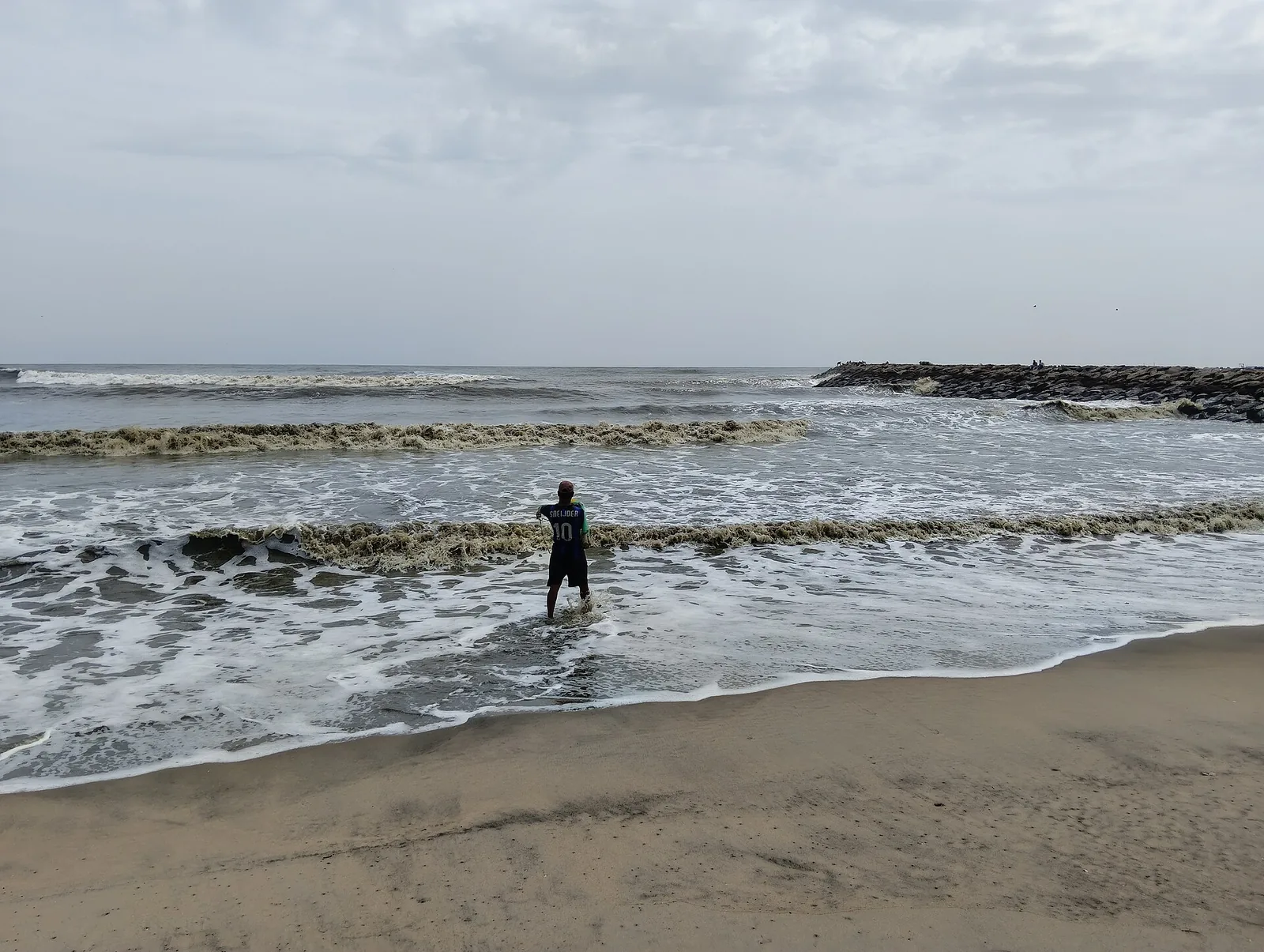
One caution that has nothing to do with the food: this is a promenade beach, not a swimming beach. The surf is often heavy, there are currents, and it is not supervised in the way a resort beach would be. Paddling at the edge is what people do; going in properly is not advisable, and in monsoon conditions the sea here is genuinely dangerous.
Why it works
A few practical notes worth having. Cash is the safe assumption at the carts, in small denominations — this is a high-volume, low-ticket trade and nobody wants to break a large note at the busiest hour. Prices are low and are generally the same for everyone, but it does no harm to glance at what is being charged ahead of you. If you have a delicate stomach, the sensible rule at any street-food stall anywhere is to eat what is cooked hot to order in front of you and be more cautious about anything sitting out; the fried items here are made in continuous batches, which puts them in the good category.
Timing against the weather matters too. This is the Malabar coast, and during the south-west monsoon from roughly June to September the evening ritual is heavily disrupted — the sea is rough, the promenade is wet and windy, and the carts thin out considerably. The beach is at its best from around October through to March, when the evenings are dry and the sunsets are reliable. If you are here in the monsoon, the food culture has not gone anywhere; it has simply moved indoors to the tea shops and bakeries of the town, which is its own kind of pleasure.
And a small point of appreciation. Almost everything sold on this promenade is a variation on one idea — something starchy or something from the sea, seasoned assertively and put into hot oil — but the range within that is remarkable, and it is entirely a local repertoire. There is no imported street food here, nothing adapted for visitors, no concessions. You are eating what Kozhikode eats, cooked the way Kozhikode cooks it, at the price Kozhikode pays. That is rarer on any well-known seafront than it ought to be.
What makes the evening memorable is not any single item — it is that the whole city turns up. Office workers, students, grandparents, courting couples and children come to the same strip of sand at the same hour and eat the same fried food looking at the same sea. Very few cities still have one place that everybody uses. Kozhikode does, it costs almost nothing to join in, and it happens every single evening. Plan the rest from the Kozhikode hub.