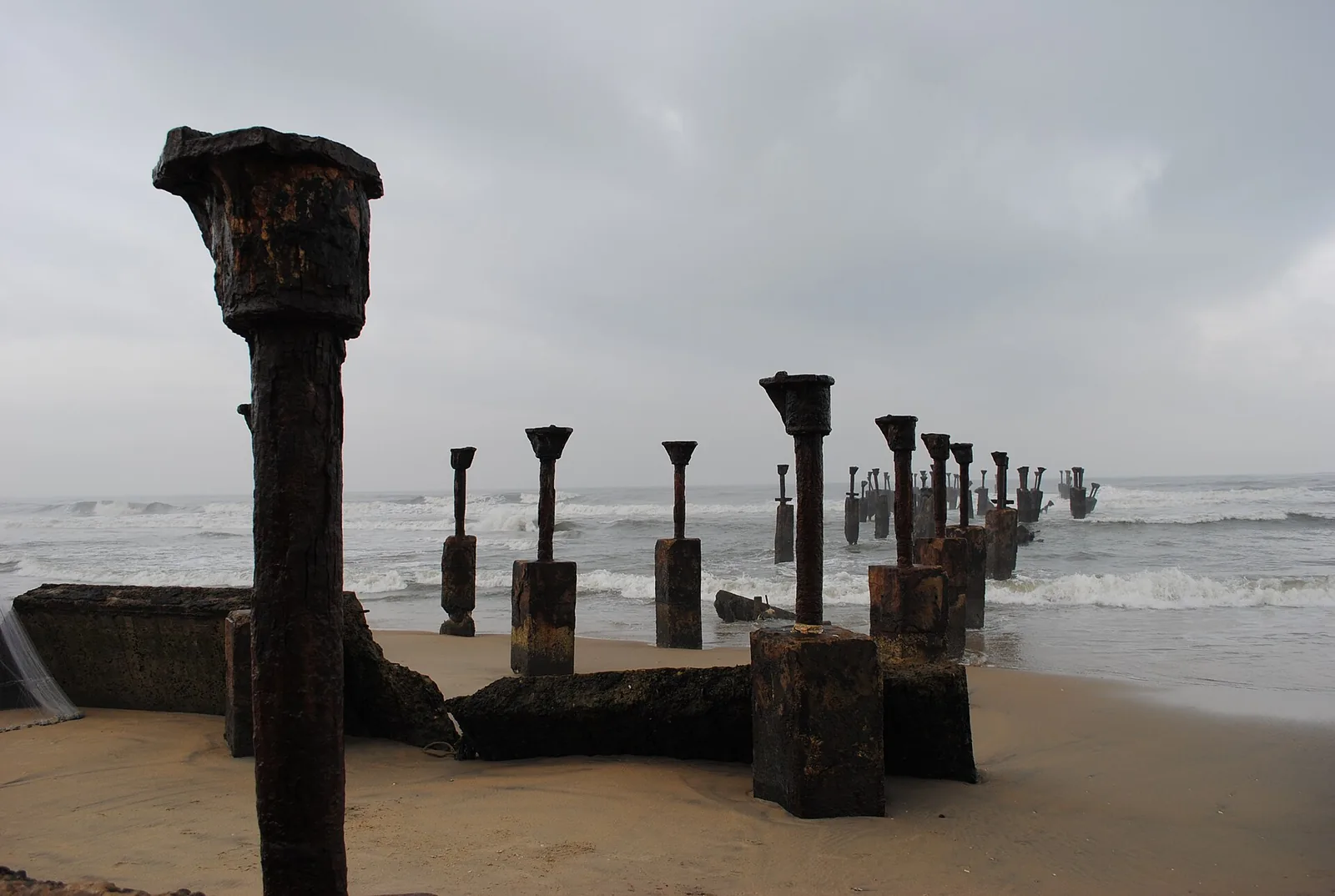
A line of rusted iron stumps walks out of the sand at Kozhikode Beach and into the surf, gets smaller, and stops. Most people photograph it at sunset and file it under picturesque decay. It deserves better, because those stumps are the remains of a specific and rather ingenious piece of Victorian engineering, and the reason they were built explains something fundamental about the city behind them.
Calicut never had a harbour
Start with the fact that undoes the romance. For the entire period that made this city famous — the Zamorins, the Arab spice merchants, the arrival of the Portuguese, the centuries when Calicut pepper reached Europe — there was no harbour here at all. There is no river mouth deep enough, no headland, no bay. Ships bound for Calicut simply anchored offshore in the open roadstead, held there by nothing but their own ground tackle, fully exposed to the weather.
Everything then moved by small boat. Cargo was rowed out through the surf, lifted aboard by hand, and the process was reversed for everything landing. This is called lightering, and it was the standard arrangement at a great many tropical ports, but it is worth pausing on what it meant here: the wealth that drew three continents to this coastline crossed this beach in armfuls, carried by men wading through the same water people now paddle in on a Sunday evening.
What a screw-pile pier actually is
By the nineteenth century, under British administration, there was pressure to do better. The northern pier was built in 1871. It ran roughly four hundred feet out to sea and finished in a T-shaped head so that boats could come alongside on either face. And it was built as an iron screw-pile structure — which is the interesting part.
A screw pile is a cast-iron column with a broad helical blade, like a single turn of a corkscrew, forged onto its lower end. Rather than being hammered into the ground, it is rotated — screwed down into the seabed by gangs of men turning capstan bars, the blade pulling the column steadily deeper. The technique was developed in the 1830s and it solved a problem that had defeated engineers for centuries: how to found a permanent structure on soft, shifting sand where a driven pile will simply work loose.
It went around the world fast, carrying lighthouses and piers onto sandbanks and mudflats from the Thames estuary to the Gulf of Mexico. Calicut got one because Calicut had exactly the problem it was invented for — miles of open sand and nothing solid to build on.
Why the ruins are still there
This also answers the question people ask while looking at them: how has anything survived a century and a half of monsoon surf on an exposed coast? The answer is in the foundation. Those legs are not standing on the seabed. They are wound into it, several metres down, with a blade at the bottom of each resisting both lift and lateral load. The decking, the rails and the cranes went long ago because they were the lighter parts sitting on top. The piles stayed because pulling them out would take roughly the effort it took to put them in.
What the piers were for
With cranes mounted along them, the piers loaded cargo for ships standing off the beach, and the destinations recorded for that trade are a fair map of the late-nineteenth-century world economy: Aden, Genoa, Oslo, London, Bremen, Hamburg, New York. Spices, timber, coir, coffee and produce from the Malabar hinterland went down the rails and out to sea from this sand.
But a pier is a compromise, not a solution. It gives you a crane and a walkway. It does not give a ship shelter, and in the south-west monsoon, when the open coast becomes unworkable for months, it gives you nothing at all.
Beaten by a hole in the ground
What ended the arrangement was not decay but a decision taken seventy miles south. From 1928 the harbour at Cochin was dredged into a true deep-water port under the engineer Robert Bristow, and the spoil lifted out of the channel was used to build up Willingdon Island, finished in 1936. Kerala suddenly had somewhere an ocean-going ship could sail into and lie safely alongside in any weather.
Cargo goes where the shelter is. A roadstead with a pier cannot compete with a harbour, and the trade that had crossed this beach for a thousand years moved down the coast to a channel that had been dug for it. The piers were not abandoned because Calicut failed. They were abandoned because somebody finally built the thing Calicut never had.
Looking at them properly
One further thing is worth noticing while you are down there: there were two piers, not one, and they were not contemporaries. A working roadstead port acquires its infrastructure piecemeal, as trade justifies the outlay and as engineering improves, so the structures on this beach represent separate decisions taken decades apart rather than a single planned harbour scheme. That is characteristic of the whole enterprise. Nothing about the port of Calicut was ever designed as a system. It was assembled, item by item, by people solving the immediate problem in front of them with the best available technology of the day, and the ruins record those attempts in sequence.
It is also worth resisting the instinct to see the piers as a monument to loss. Ports move. The trade that left this beach did not evaporate — it relocated to a better facility a short way down the same coast, where it continues at a scale the Zamorins could not have imagined. What ended at Calicut was a particular technique for handling cargo, made obsolete by a better one, which is the ordinary fate of every technique ever devised. The stumps are not a tragedy. They are a discontinued method, left standing in the water because removing them would cost more than ignoring them.
Go at low tide, when more of the structure is exposed and you can see how the piles are spaced and how far the line actually runs. Late afternoon gives you the light; the hour before sunset turns the rust to something close to bronze. Do not climb on them — they are corroded iron in moving water and there is no safe footing. And when you have got your photograph, walk back up the sand and look at the city: it grew to greatness with no harbour at all, on the strength of nothing but its position and the people willing to row out to the ships. More of old Calicut is on the Kozhikode hub.