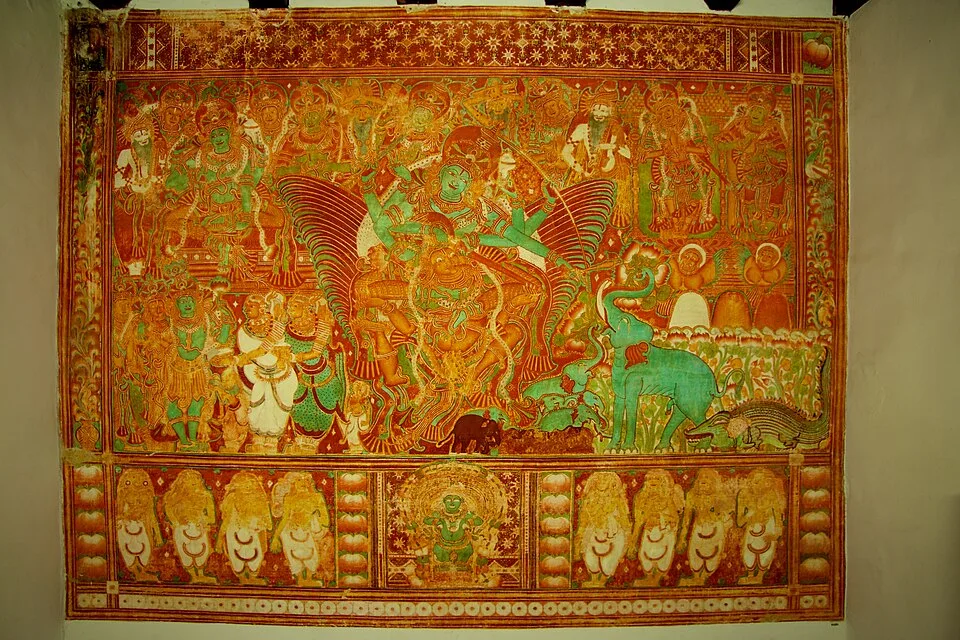
The Gajendra Moksham mural at Krishnapuram Palace is one of the most photographed paintings in Kerala, and nobody can tell you how big it is.
Kerala Tourism describes it as an expansive masterpiece spanning forty-nine square metres — about five hundred and twenty-seven square feet. Other travel sources give fifty-three square feet. This page said roughly fourteen feet by eleven, a little over a hundred and fifty. Those are not variations. The largest is ten times the smallest.
The one figure everybody agrees on
The height. Kerala Tourism gives three metres, and so does essentially everyone else. That is the number to carry away, and it is the number this site now leads with.
Why the area is a mess
Look at a high-resolution photograph of the whole wall and the problem becomes visible. The painting is not one uniform field. There is a large main panel — Vishnu on Garuda at the centre, the green elephant and the crocodile at the right, crowds of gods and sages filling the rest. Below it, separated by a painted band, there is a distinct lower frieze register of seated figures. Around the whole thing runs a decorated border.
So: does the mural include the frieze? Does it include the border? Is the frieze a separate work that happens to be on the same wall? Depending on which of those you decide, you will measure a very different rectangle — and none of the published figures says which convention it is using.
That also bears on the other claim made about this painting, which is that it is the largest single-band mural discovered in Kerala. A painting with a main panel and a separate lower register is precisely the case where "single band" needs defining, and nobody defines it.
The superlatives
There are three in circulation and they are not compatible. Our page said Kerala’s largest single-panel mural. One Kerala Tourism page says the largest single band of mural painting so far discovered in Kerala. Another Kerala Tourism page is titled to say Krishnapuram is where you find India’s largest mural painting.
No comparative survey of Kerala murals by area is cited by any of them, and India is a very large claim to make without one. We have stopped repeating them. The mural is about three metres high, it is unquestionably among the great Kerala murals, and it is more than large enough to be impressive without a record attached.
What to actually look at
Go for the elephant. Gajendra is painted green, trunk raised with the lotus, the crocodile locked on his foot at the water’s edge, and the whole right-hand side of the composition belongs to him. Then track left to Vishnu coming down on Garuda, and notice how much of the surface is given to spectators — rank on rank of gods and sages, watching.
And look at the top left, where the wall is damaged. It is a reminder that this is a painting on a working building rather than a museum object, and that its survival at all is the more remarkable fact.
Frequently asked questions
How large is the Gajendra Moksham mural?
About three metres high — the only dimension all sources agree on. Published areas range from 53 square feet to 49 square metres (about 527 square feet), a tenfold spread, and we do not repeat any of them as fact.
Why do the area figures differ so much?
Because the painting has a large main panel, a distinct lower frieze register of seated figures beneath it, and a decorated border around the whole. Whether you count the frieze and the border changes the answer, and no published figure states which convention it uses.
Is it really India’s largest mural?
Kerala Tourism says so on one page and calls it the largest single band discovered in Kerala on another; our own page previously called it Kerala’s largest single-panel mural. None of these cites a comparative survey, and they are not compatible with each other, so we report the disagreement rather than pick a winner.