Krishnapuram Palace is almost always described as the place with the enormous mural. That is fair — the Gajendra Moksham is the reason most people come. But it means the building itself goes largely unread, and the building is saying something quite specific.
It is a victory monument.
What Marthanda Varma was doing here
Anizham Thirunal Marthanda Varma reigned from 1729 to 1758 and is reckoned the founder of modern Travancore. He built that state by absorbing the smaller kingdoms around it, one after another, in a sustained campaign of annexation. One of them was Odanad, whose seat was at Kayamkulam, taken in the mid-1740s.
This palace was built after that, in the territory he had just taken, near the Krishnaswamy temple at Krishnapuram. Kerala Tourism’s account notes that the site underwent significant renovation in the eighteenth century, which implies he was building on or beside something already standing — that is, on or beside the ground of the dynasty he had removed.
And then there is the sword
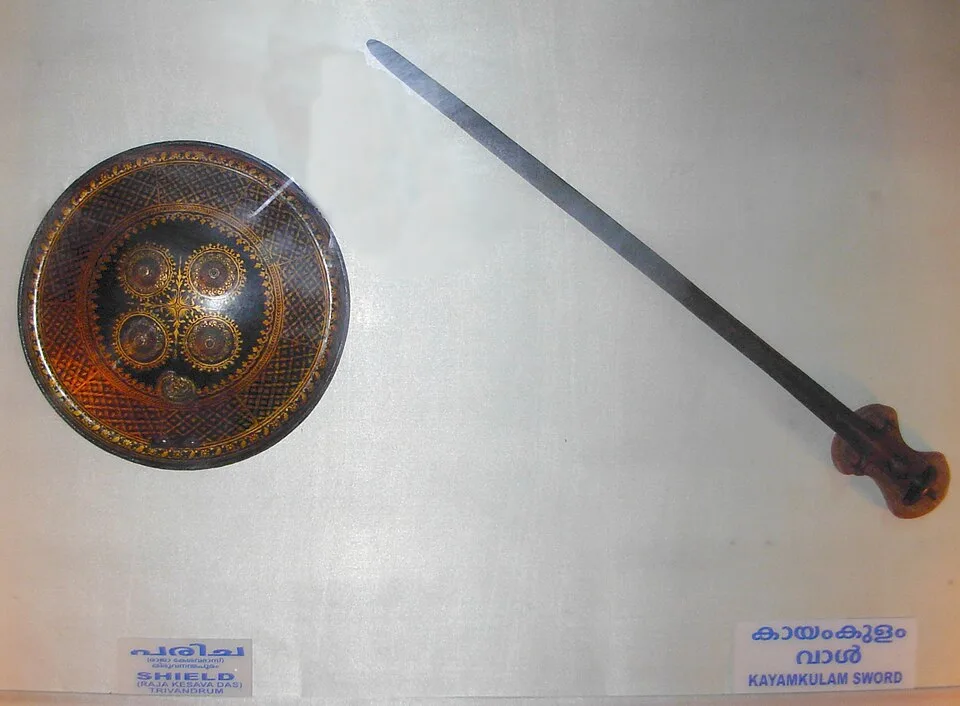
The palace is now an archaeological museum run by the Kerala Department of Archaeology, and among its holdings is the Kayamkulam Vaal — the sword of the Kayamkulam raja.
Sit with that for a moment. The defeated dynasty’s weapon, displayed in a palace built by the man who defeated them, on the land he took from them, curated by the successor state of his kingdom. There are few heritage sites in Kerala where the politics is this legible, and almost nothing written about Krishnapuram mentions it, because the mural takes all the oxygen.
We are not going to overdo the interpretation — a museum acquires objects for many reasons and this one is a regional archaeology collection rather than a triumphal display. But the combination of building, site and object is what it is, and a visitor who knows it will look at the place differently.
What else is in there
The collection is a good regional museum rather than a palace treasury. There is a tenth-century stone Buddha; a Saptamatrika panel; bronzes and panchaloha figures; coins; megalithic relics; stone and wood sculpture; an old stone horse trough. There is a Travancore Anchal box — the post box of the princely state’s own postal service, exactly the sort of ordinary object that disappears completely and then turns out to be rare. In the compound there is a spring-fed stepped bathing tank.
One clarification about that Buddha, because two of our pages could otherwise blur together. The Krishnapuram Buddha is a complete seated figure, both hands in dhyana mudra in the lap, in grey lichen-stained stone, displayed in a mandapam against a carved timber backdrop. It is not the Karumadikuttan — the famous mutilated black Buddha at Karumadi in Ambalappuzha taluk, which is a separate object with its own page. Both are evidence of Buddhism in this region. They are not the same statue.
The building
Architecturally it is Kerala palace style — gabled tiled roofs, narrow corridors, dormer windows — and it is compared throughout the literature to Padmanabhapuram, the great Travancore palace further south. It is much smaller. From the garden the roofline is the thing: dark tiles stepping across above a low white compound wall.
Allow an hour or so. It is open from 9.00 with a midday break, closed on Mondays and national holidays, and the ticket is a few rupees — the Department of Archaeology publishes the tariff, which is worth noting because almost every third-party listing gets both the price and the opening time wrong.
Frequently asked questions
Who built Krishnapuram Palace and when?
Anizham Thirunal Marthanda Varma, the founder of modern Travancore, in the eighteenth century, after annexing the kingdom of Odanad with its seat at Kayamkulam in the mid-1740s. It stands near the Krishnaswamy temple at Krishnapuram.
What is the Kayamkulam Vaal?
The sword of the Kayamkulam raja — the ruler of Odanad, the kingdom Marthanda Varma annexed. It is displayed in the museum inside the palace he built on that kingdom’s ground.
Is the Buddha here the Karumadikuttan?
No. The Krishnapuram Buddha is a complete seated figure with both hands in dhyana mudra, displayed indoors against a carved timber backdrop. The Karumadikuttan is a separate, famously mutilated black Buddha at Karumadi in Ambalappuzha taluk.