The Sastha at Kulathupuzha is a child. That is the fact everything else on this page hangs off, and it is worth taking seriously rather than treating as a piece of colour.
Bala Sastha
The presiding deity is Ayyappa in the form of Bala Sastha — the boy. The Kerala government’s own account of the temple adds a complication that most travel writing drops: he is understood here as ugramoorthi as well as mangalapradayakan, in a fierce aspect as well as an auspicious one. A child, but not a safe one.
That combination is more coherent than it first sounds. Child deities in south Indian practice are frequently the volatile ones — quick to bless and quick to take offence, closer to the raw form of the power than the settled adult versions are. Reading Bala Sastha as simply a sweet junior Ayyappa gets the temple wrong.
Why the child matters for the fish
It also explains the thing this temple is actually famous for. The protected fish in the river are called Thirumakkal — the sacred children of the lord — and the offering made to them is meenoottu, the feeding of the fish. At a temple whose deity is a child, calling the shoal his children lands differently than it would at Sabarimala. The god and the fish are in the same register. That is not an accident of vocabulary.
The circuit, and why the lists never agree
Kulathupuzha belongs to the Pancha Sastha, the old circuit of Sastha temples in this region — and here we have to be careful, because this is the single most consistently mis-stated fact about the whole group.
No two published lists of the five agree. The Travancore Devaswom Board’s own pilgrimage circuit runs Pandalam, Kulathupuzha, Aryankavu, Achankovil and Erumeli. Devotional accounts very commonly give Kulathupuzha, Aryankavu, Achankovil, Sabarimala and Kanthamala. Other versions substitute again, and Sasthamcotta turns up in a sixth variant.
Only three names appear in every version: Kulathupuzha, Aryankavu and Achankovil. Those three are the stable core, and this temple is one of them. Anyone writing "the five Sastha temples are X, Y and Z" without saying which list they are using is picking one tradition and presenting it as the tradition.
Kulathupuzha is separately counted among the 108 Sastha shrines of Kerala — which is a different set again from the 108 Shivalayas, and worth not confusing.
The age sequence, briefly
The circuit is often described as showing the Sastha at successive stages of one life: a child at Kulathupuzha, the bridegroom at Aryankavu, the settled householder at Achankovil, the celibate at Sabarimala. Our page on the Achankovil Sastha sets that sequence out properly and our page on Aryankavu goes into the wedding at length, so there is no point in writing it a third time here. The relevant thing for this temple is only that it is the beginning: whatever else the circuit is, Kulathupuzha is where it starts.
How close the border is
One detail on the roll of sub-deities is worth stopping at. Alongside Shiva, Vishnu, Ganapathi, the Yakshi, Boothathan and the naga deities, the Kerala government’s list includes Karuppaswami.
Karuppaswami is a Tamil guardian deity — the black lord, a village protector figure of the Tamil country, not a standard fixture of a Kerala Devaswom temple. His presence here is a small piece of geography made visible. Kulathupuzha sits on the Kollam–Shencottai road, in the gap through the ghats that has carried traffic between Travancore and the Tamil plain for as long as there has been traffic, and the temple’s pantheon has picked up what came through the pass.
The same road, a little further up, reaches Aryankavu, whose Thiru Kalyanam is bound up with a Sourashtra community that migrated across from the other side. The border does not stop at the deities; the deities are just where you can see it.
What to make of the plainness
None of this is announced by the building. What you see at Kulathupuzha is a low tiled nalambalam with timber lattice walls, a gabled porch, a separate side shrine and a wide empty sand courtyard, with forest behind it and a river alongside. No gopuram, no tower, no ornament visible from the road.
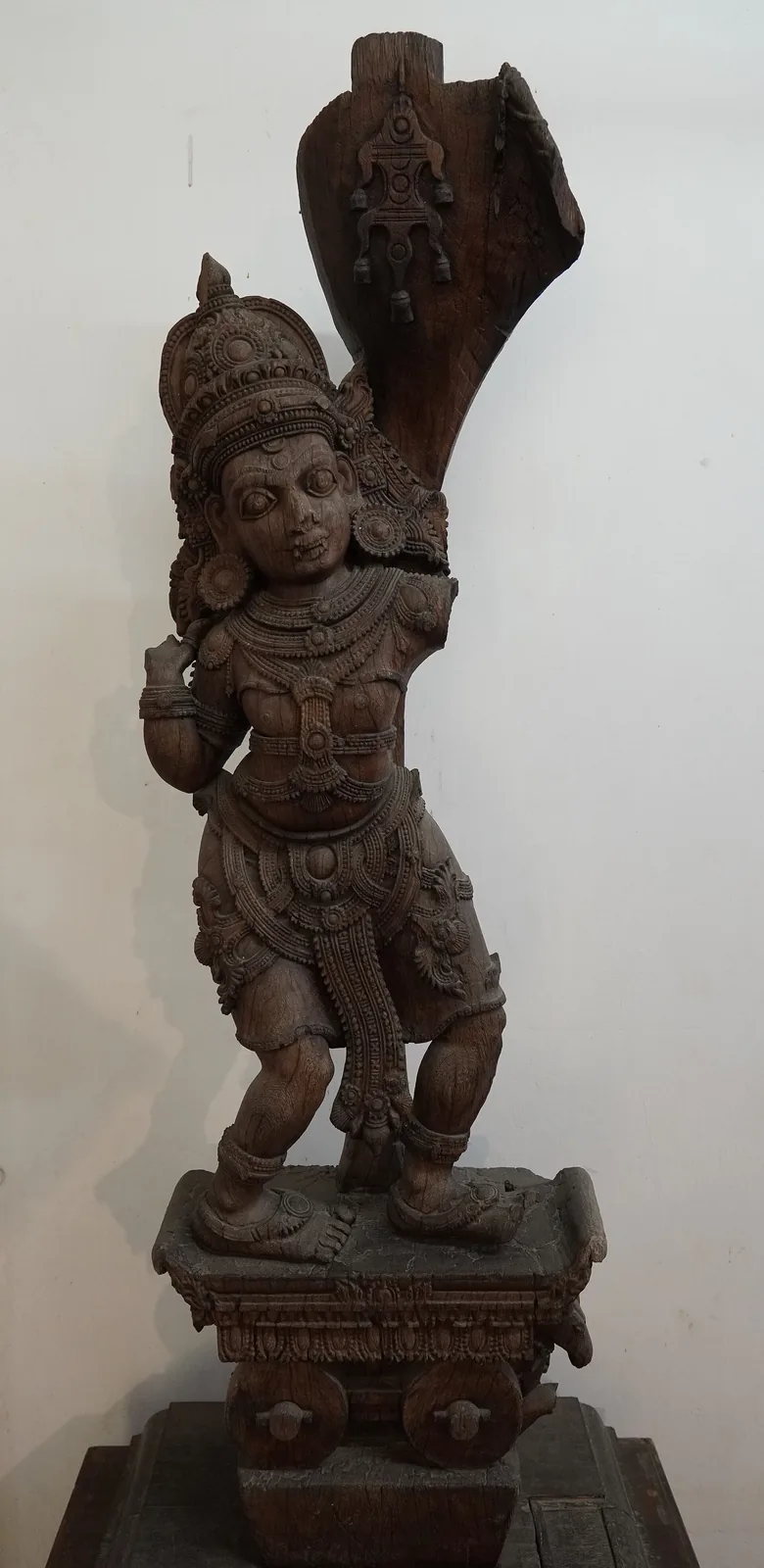
The ornament left in the fifteenth century and is in a museum in Thiruvananthapuram. What stayed is a shrine to a fierce child, a river full of his children, and a rule about not catching them.
Frequently asked questions
What is Bala Sastha?
Ayyappa in the form of a child, which is the presiding form at Kulathupuzha. The Kerala government’s account adds that he is understood here in a fierce aspect (ugramoorthi) as well as an auspicious one (mangalapradayakan) — child deities in south Indian practice are often the volatile ones.
Which are the five Pancha Sastha temples?
It depends entirely on whose list you read, and that is the point. The Travancore Devaswom Board’s circuit is Pandalam, Kulathupuzha, Aryankavu, Achankovil and Erumeli; devotional accounts commonly give Kulathupuzha, Aryankavu, Achankovil, Sabarimala and Kanthamala; other versions differ again. Only Kulathupuzha, Aryankavu and Achankovil are in every version.
Is Karuppaswami really worshipped here?
He is on the Kerala government’s list of sub-deities at this temple, alongside Shiva, Vishnu, Ganapathi, the Yakshi, Boothathan and the nagas. Karuppaswami is a Tamil guardian deity rather than a standard Kerala Devaswom figure, and his presence reflects how close and how busy the Shencottai pass has always been.
Can I do all three of the core Pancha Sastha temples in a day?
Aryankavu is up the same road towards the Tamil border and is easily combined. Achankovil is over the hills to the north and is a long, slow drive — possible in one very full day from a Thenmala base, more comfortable over two.