Ask when the Sastha temple at Kulathupuzha was built and you will not get an answer, which is unusual only in that most temple descriptions supply one anyway. The Kerala government’s account gives a chain of custody rather than a date: founded by the Raja of Pandalam, the idol installed by a Brahmin from Kottarakkara, held under the Kottarakkara raja, later passed to the Travancore Devaswom Board. In the devotional register the idol is Parashurama’s, as it is at a great many temples on this coast.
None of that is a date. But there is one, and it is sitting sixty-five kilometres away in a museum.
Three pieces in Thiruvananthapuram
The Napier Museum in Thiruvananthapuram holds three sculptures from Kulathupuzha, catalogued to the fifteenth century CE. They were photographed in May 2025 and released under a free licence, which is the only reason it is possible to write this paragraph at all.
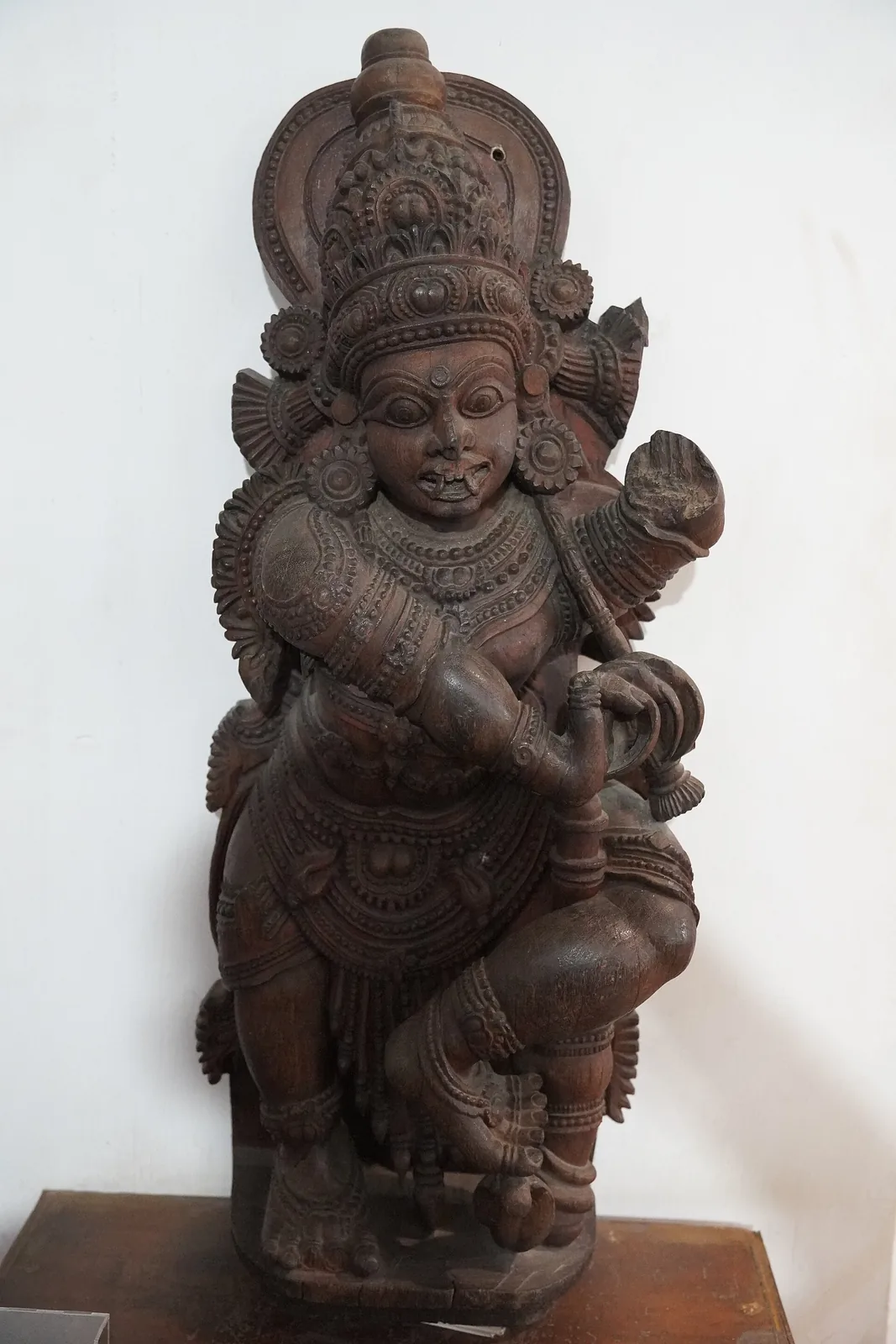
The first is a Dwarapalaka — a door guardian. Crowned, wide-eyed, tusked, hung with layered ornament from headdress to anklet, one arm raised with a club, carved fully in the round and standing about the height of a person. It is the figure that would have flanked an entrance.
The second is a Thripuranthaka Murthi: Shiva in the form that carries the bow, associated with the destruction of the three cities of the asuras. The third is a panel of Rama with Hanuman.
Why the material matters more than the date
The Dwarapalaka is wood. Not stone, not bronze — carved timber, and you can see the grain and the checking on it.
That is the load-bearing detail. Kerala is a wet, hot, termite-rich place, and wooden sculpture does not ordinarily last. Temples here are rebuilt and re-roofed constantly; timber is replaced as it fails, which is why so much of Kerala’s visible temple fabric is younger than the institution it houses. A carved wooden figure surviving from the fifteenth century has, by definition, been kept under a roof, maintained, and valued, continuously, for over five hundred years.
So the sculptures do not merely say that objects existed here in the 1400s. They say there was a shrine at Kulathupuzha in the fifteenth century that was substantial enough to commission work of this quality, and that somebody cared about it enough to keep the work alive through five centuries of monsoons.
What it does not tell us
It does not date the foundation. A fifteenth-century door guardian sets a floor, not a ceiling: the temple is at least that old and may be very much older. It does not tell us what the shrine looked like, how large it was, or whether the building standing today occupies the same footprint. And it does not confirm the Pandalam or Kottarakkara attributions, which remain traditions without documents behind them.
It also does not tell us how the pieces got to Thiruvananthapuram. Museum accession is not the sort of thing temple listings record, and we could not establish whether they were transferred, collected, or acquired after some rebuilding. That is a real gap and we are marking it as one rather than filling it in.
A better standard of evidence than the usual
It is worth pausing on how much better this is than what most temples on this coast can offer. Elsewhere in Kollam district we have had to write around ages of 1,200 years, 1,100 years and the eleventh century all being asserted for one building, with no inscription behind any of them and a round figure that happens to coincide with the founding of the city. Here there is no claimed age at all in the published sources — and a physical object, catalogued by a state museum, that puts a functioning shrine on this riverbank in the 1400s.
Given the choice between a confident number and a dated object, take the object every time.
Seeing them
The Napier Museum is in Thiruvananthapuram, in the museum-and-zoo compound off Museum Road, about seventy-five kilometres from the temple by road — which makes it an odd but genuinely rewarding pairing if you are travelling between the two. The building itself, an 1880s Indo-Saracenic confection by Robert Chisholm, is worth the visit independently.
And it changes how the temple reads when you get there. The nalambalam at Kulathupuzha is plain to the point of austerity — tiled roofs, timber lattice, an empty sand courtyard. Knowing that a wooden guardian of this quality once stood at a door here makes the plainness look like survival rather than modesty.
Frequently asked questions
How old is the Kulathupuzha Sastha temple?
No founding date is published anywhere, and the accounts give a chain of custody instead: founded by the Raja of Pandalam, the idol installed by a Brahmin from Kottarakkara, held under the Kottarakkara raja, later with the Travancore Devaswom Board. The hard evidence is three sculptures from Kulathupuzha in the Napier Museum, Thiruvananthapuram, catalogued to the 15th century CE — which sets a floor, not a ceiling.
What are the three sculptures?
A Dwarapalaka (door guardian) carved in wood, a Thripuranthaka Murthi — Shiva with the bow that destroyed the three cities — and a panel of Rama with Hanuman. All three are catalogued to the 15th century CE and all three are in the Napier Museum, Thiruvananthapuram, not at the temple.
Why is it significant that one is wooden?
Because wood does not survive in this climate without continuous shelter and maintenance. Kerala temples replace timber as it fails, which is why so much visible fabric is younger than the institution. A wooden figure surviving five and a half centuries implies an unbroken chain of people who kept it under a roof and thought it was worth keeping.
Can I see them?
Yes — they are in the Napier Museum in Thiruvananthapuram, about 75 km from Kulathupuzha by road, in the museum compound off Museum Road. The museum building itself, an 1880s Indo-Saracenic design by Robert Chisholm, is worth the trip on its own.