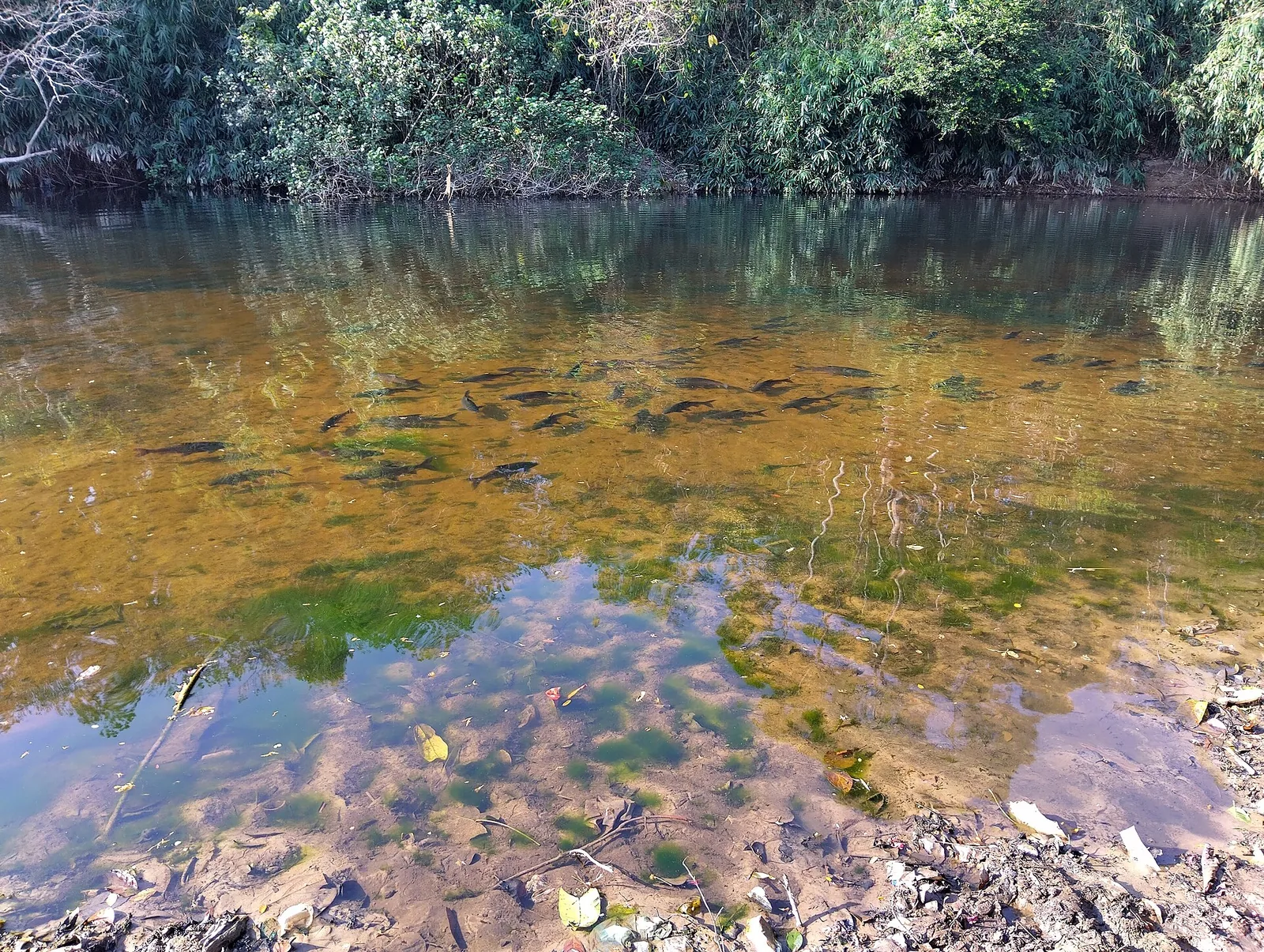
At most Kerala temples the offering you buy at the counter is a lamp, a garland, a payasam or an archana in your name. At Kulathupuzha it is a packet of puffed rice, and you take it outside and throw it in the river.
The offering is called meenoottu — the feeding of the fish — and it is the thing this temple is known for.
Thirumakkal
The fish in the Kulathupuzha are not incidental wildlife. Devotees call them Thirumakkal: thiru, the sacred honorific; makkal, children. The sacred children of the lord. Fishing here is not discouraged or regulated, it is prohibited, because the fish are held to be dear to the deity — and at a temple whose god is himself a child, that word makkal is doing a great deal of quiet work. It converts a fishing ban into a claim about family.
The story behind it is a good one. A Jala Kanyaka — a water nymph, a spirit of the river — is said to have fallen in love with the Sastha. He is a child here and a celibate at Sabarimala, so the story has nowhere ordinary to go, and the resolution is what makes it worth telling: out of compassion rather than reciprocation, the god permitted her to stay near him, living in the water in the form of a fish. The shoal is her descendants, or her company, or her; the tradition does not insist. What it does insist on is that they are not to be taken.
What meenoottu is for
The offering is made for a specific reason. Meenoottu is prescribed particularly for diseases of the skin, and the sources — the Kerala government’s own temple page among them — are consistent and unusually specific about warts.
You can reconstruct a logic for it if you want one: skin is the part of a person that water touches, the fish are the water’s children, and the god who is a child is the one you ask about a child’s complaint. Whether anyone ever reasoned it out that way is another matter. What is observable is that the ritual is small, cheap, participatory and entirely public, which is a rare combination at a Kerala temple, and that anyone may do it.
And what is actually in the water
Here the story stops being folklore and starts being a fisheries fact.
The two species that dominate this stretch are Tor khudree, the Deccan mahseer, and Hypselobarbus thomassi, the red canarese barb. You will read in a number of places that both are endangered. That is not right, and the correction matters in both directions.
Tor khudree is listed by the IUCN as Least Concern. It is found across India, and specifically — as the record notes — following large-scale introductions of artificially bred fish. It is a stocked generalist and it is not in trouble.
Hypselobarbus thomassi is a different case entirely. It is listed as critically endangered, it is endemic to the Western Ghats of Kerala and Karnataka and to nowhere else on earth, and it grows to a metre. Across most of that range it is under the ordinary pressures — netting, dams, siltation, sand extraction — and it is losing.
So the accurate version of the claim is better than the exaggerated one. It is not that the sacred fish are endangered. It is that one of them is critically endangered and endemic, and that it persists, visibly and in numbers, in a stretch of river where fishing has been forbidden for centuries by nothing more enforceable than the belief that the fish are somebody’s children.
Protection without a warden
This is not unique. Sacred groves, temple tanks and protected river reaches have preserved species across India by exactly this mechanism, and the literature on it is substantial. What makes Kulathupuzha unusually legible is that the protected animals are large, numerous and completely visible — they come up to the surface for puffed rice thrown by strangers, several times a day, all year.
It is worth being honest about the limits of it too. The prohibition protects the fish; it does not protect the river. The one clear photograph of the shoal shows plastic and litter on the near bank and among the shallows, which is what a working village river looks like anywhere in India. Nobody is managing this water as habitat. What exists is a very old rule about not killing a particular animal in a particular place, and it has outperformed a great many things that were designed on purpose.
If you go
Buy the puffed rice or the roasted peanuts at the temple rather than bringing your own, scatter it from the bank, and give it a minute — the shoal takes a moment to gather and then it is unmistakable. Keep children within reach: the bank is unfenced and the rock is slick where the water has been over it.
And do not, under any circumstances, let anyone in your party put a line in. It is the one thing this place asks.
Frequently asked questions
What exactly is meenoottu?
The feeding of the fish, offered as a formal vazhipadu at this temple in the way a lamp offering is elsewhere. You buy puffed rice or roasted peanuts at the temple and scatter them on the river for the fish. It is offered particularly for skin complaints, warts specifically, and anyone may do it.
Why are the fish called Thirumakkal?
It means the sacred children — thiru, the honorific; makkal, children. The tradition is that a Jala Kanyaka, a water nymph, loved the Sastha, and that the god allowed her to live in the temple’s water as a fish. Calling the shoal the lord’s children is what makes fishing unthinkable rather than merely forbidden.
Are the fish protected by law?
The prohibition here is religious, not statutory — it rests on the belief that the fish belong to the deity, and it has held for centuries without enforcement. Hypselobarbus thomassi, one of the two species present, is separately listed by the IUCN as critically endangered, which is a conservation assessment rather than an Indian legal protection.
Can I photograph the fish?
Yes, the river is open ground and there is no restriction on photographing the water. Inside the temple, Kerala convention applies: sanctum photography is generally not permitted, so ask before pointing a camera at anything within the walls.