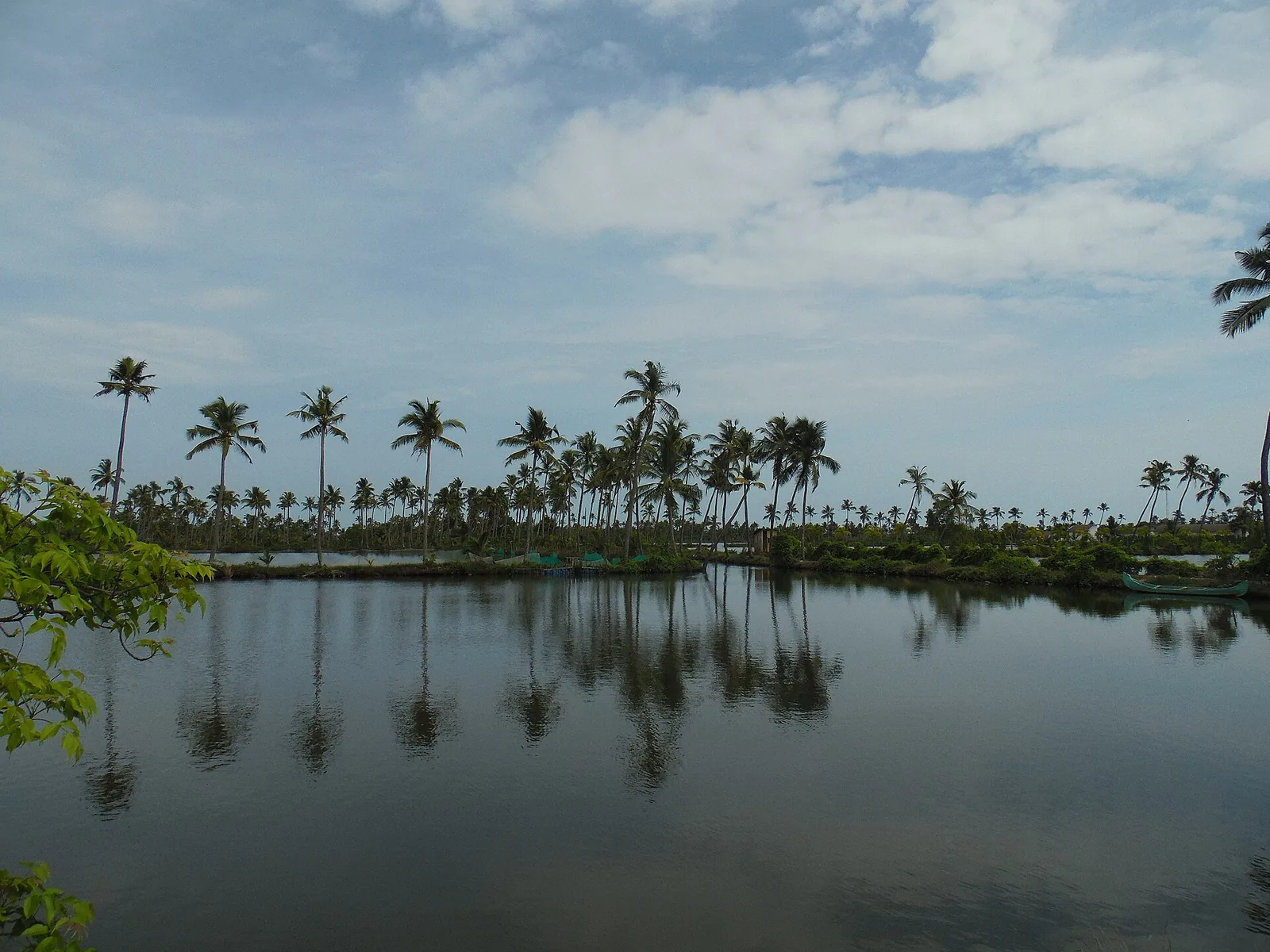
Most people arrive at the Kumbalangi backwaters with an image in their head from Alleppey: a two-storey houseboat on a wide sheet of open water, a convoy of them at sunset. That is a real thing and it is thirty kilometres south. It is not what is here, and the difference is the whole reason to come.
A net of creeks
Kumbalangi’s water is tidal channels, many of them only a few metres across, threading between mangrove roots, earthen bunds, sluice gates and low fields that are rice for part of the year and prawn ponds for the rest. A country canoe fits. A houseboat physically does not, and no amount of demand will change that geometry.
The consequence is a completely different experience of the same landscape. On a wide lake you look at the backwaters from a distance. Here you are inside them — at water level, under overhanging branches, close enough to the bank to see crabs move and to hear a kingfisher before you see it.
Why the mangroves matter
The mangrove is not scenery. It is the reason there is anything to catch. The tangle of prop roots between land and water is a breeding and nursery ground for prawns, crabs, oysters and small fish — the whole basis of the village’s fishery grows up in there before it is big enough to be caught outside it.
Mangrove also holds the bank together, absorbs storm energy and stores a remarkable amount of carbon for its footprint. On a canoe route it reads as a green wall you keep brushing past. What it actually is, is the infrastructure the whole island depends on, and the part of the ecosystem under the most pressure as the village grows.
- First light or last light. Midday on open water in Kerala is a punishment.
- Canoe over motorboat — quieter, closer to the water, and the money stays local.
- Book through your homestay rather than at the roadside.
- Take binoculars. Kingfishers, herons, egrets, cormorants and darters all work these creeks.
- Ask to be shown a sluice gate being operated. It explains the entire pokkali cycle in two minutes.
What you actually see
At first light the surface is still enough to hold the far bank upside down, and the loudest sound is a pole coming out of the water. You pass Chinese fishing nets — more than a hundred of them stand along these creeks — being lowered and raised by families rather than performed for an audience. You pass clam collectors working the mud, coir soaking in the shallows, and the low green line of pokkali fields behind the bunds.
It is not dramatic. Nothing here is going to make you gasp the way a mountain does. What it is instead is unusually intimate — a working landscape at a scale you can reach out and touch, which is a rarer thing than a view.
How it fits a Kochi trip
Kumbalangi is about twelve kilometres from Kochi city and works badly as a two-hour day trip and beautifully as an overnight. Stay in a homestay, take the canoe at dusk, eat late, and go out again at dawn. If you are here between March and May, ask about kavaru — the bioluminescence — and keep a moonless night free.
Frequently asked questions
Can you take a houseboat in Kumbalangi?
No, and that is the point. The waterways here are narrow tidal creeks, often only a few metres wide, threading between mangroves and sluice gates. Country canoes and small boats fit; houseboats do not. For the classic houseboat experience you would go to Alleppey or Kumarakom.
What is the best time of day for a Kumbalangi canoe ride?
First light or the hour before sunset. The water is stillest at dawn, the birdlife is most active at both ends of the day, and midday on open water in Kerala is genuinely unpleasant.
What wildlife can I see on the creeks?
Kingfishers, herons, egrets, cormorants and darters are the regulars, along with crabs on the mud and mudskippers in the shallows. The mangroves are a nursery for prawns, crabs, oysters and small fish, which is why the birds are there.
Why do the mangroves matter here?
They are the nursery ground for the prawns, crabs, oysters and fish that the village’s entire fishery depends on, and they hold the banks together and absorb storm energy. They are the working infrastructure of the island, not decoration — and they are under pressure as the village grows.
Should I take a canoe or a motorboat?
A canoe, unless mobility makes that impractical. It is quieter, it puts you at water level in narrow channels a motorboat cannot enter comfortably, it disturbs the birdlife far less, and the money goes to a local boatman rather than an operator.
Is Kumbalangi a day trip from Kochi?
It can be, but it is much better as an overnight. It is only about 12 km from the city, but the two hours worth having are dusk and dawn, and a day trip misses both. Homestays are the only accommodation — the village prohibits purpose-built tourist structures.