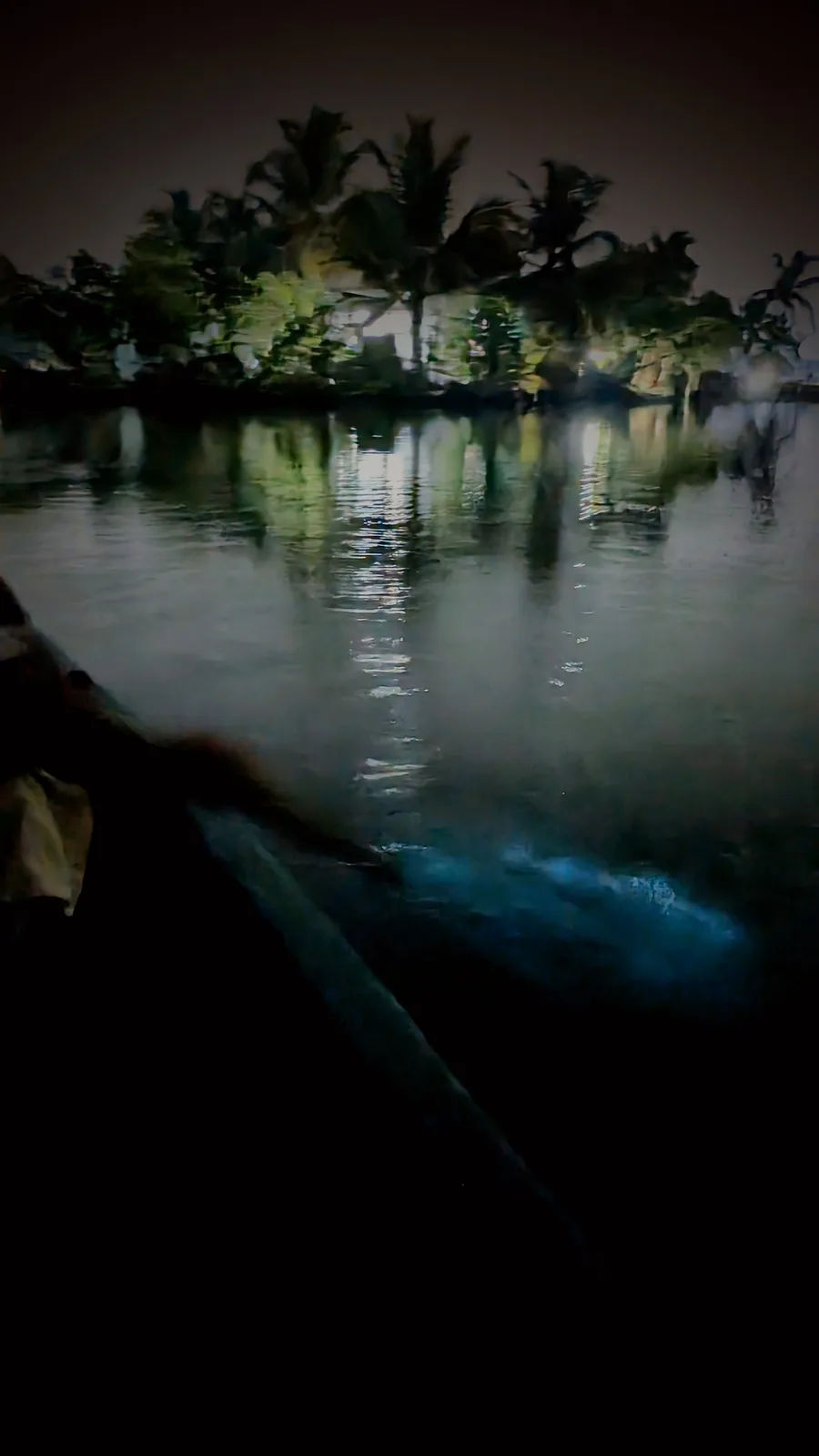
Put your hand into the Kumbalangi backwaters on the right night in April and the water breaks into cold blue light around your fingers. Pull a paddle through it and it leaves a burning wake. Fish moving under the canoe become visible as streaks of blue in the dark. The Malayalam word for it is kavaru, and it is the most extraordinary thing that happens anywhere in Ernakulam.
What is actually glowing
The organism is Noctiluca scintillans, a single-celled marine plankton widely called sea sparkle. It produces light through a chemical reaction triggered by mechanical disturbance — a wave, a paddle, a hand, a fish. Undisturbed water shows nothing at all, which is why the phenomenon is invisible until you touch it and then behaves as though the water is answering you.
It blooms in these creeks and the surrounding pokkali fields roughly between March and May. That timing is not coincidence. In the summer months the fields are flooded with salt water for the prawn season, salinity climbs sharply, and nutrients accumulate — from the previous rice crop, from the fish, and from everything draining off the surrounding land. Noctiluca thrives in exactly those conditions.
How to actually see it
This is where most people fail, and the reasons are simple and fixable.
- Season: roughly March to May. Outside that window, do not plan around it.
- Moon: a dark, moonless night. A bright moon washes it out completely.
- Time: late — after midnight is commonly recommended.
- Light: torch off, phone screen off, and keep them off.
- Patience: allow about fifteen minutes for your eyes to dark-adapt. Most people give up at four.
- Vessel: a canoe or small boat, so the paddle is doing the disturbing.
And a caution about expectations. It is a natural bloom, not a scheduled event. It can be spectacular one night and absent the next, and no operator can guarantee it. Anyone who does is selling you something they cannot deliver. Treat a night trip as a boat ride on very dark water that might also be miraculous.
Why the creeks here are good for it
Kumbalangi’s water is not the wide-open backwater of the houseboat brochures. It is a net of tidal creeks a few metres across, running between mangrove roots, sluice gates and low fields. The banks are dark and largely unlit, the water is shallow and enclosed, and a canoe fits where a houseboat cannot. All of that makes faint light much easier to see here than from a lit shoreline — the romance is earned by the setting as much as by the plankton.
The part the reels leave out
The glow is a symptom. Noctiluca blooms on excess nutrients, and the excess here comes from agricultural and industrial runoff and from the drainage of a fast-growing city. That is eutrophication — the same process that strips oxygen out of water and kills fish. What visitors photograph as magic, marine scientists read as a warning light.
Both readings are true at once, and we would rather you held both. Kumbalangi’s most beautiful phenomenon is also the clearest available evidence that its water is under strain, and the households whose income comes out of these creeks are the ones who will find out first if the strain wins. Going to see it is not the problem. Going to see it while believing it is simply a wonder, with no cause and no cost, is.
Frequently asked questions
What is kavaru?
The Malayalam word for the bioluminescence seen in Kerala’s backwaters — light produced by the plankton Noctiluca scintillans, commonly called sea sparkle, when the water is physically disturbed. At Kumbalangi it appears as a blue glow around a paddle, a hand or a moving fish.
When can you see bioluminescence at Kumbalangi?
Roughly between March and May, when the fields are flooded with saline water for the prawn season and salinity and nutrient levels rise. Within that window you need a dark, moonless night, ideally late — after midnight is commonly recommended.
Is the bioluminescence guaranteed?
No. It is a natural plankton bloom, not a scheduled event — spectacular one night, absent the next. No operator can promise it, and any who does is overselling. Book the boat trip for its own sake and treat the glow as a possibility.
How do I give myself the best chance of seeing it?
Go on a moonless night in the March–May window, take a canoe rather than a motorboat, keep torches and phone screens off entirely, and allow a good fifteen minutes for your eyes to dark-adapt before deciding nothing is happening. Most people give up far too early.
Is the glowing water safe or harmful?
It is not dangerous to be on or to touch. But it is worth knowing that these blooms are driven by nutrient enrichment — eutrophication — from agricultural, industrial and urban runoff, and that severe blooms can strip oxygen from water and harm fish. The beauty and the warning are the same phenomenon.
Why is Kumbalangi the place people go for it?
Because the setting suits it. The creeks are narrow, shallow and enclosed, the banks are dark and largely unlit, and a canoe puts you at water level with a paddle doing the disturbing. It also became nationally known after the 2019 film Kumbalangi Nights. The plankton itself is not unique to here.