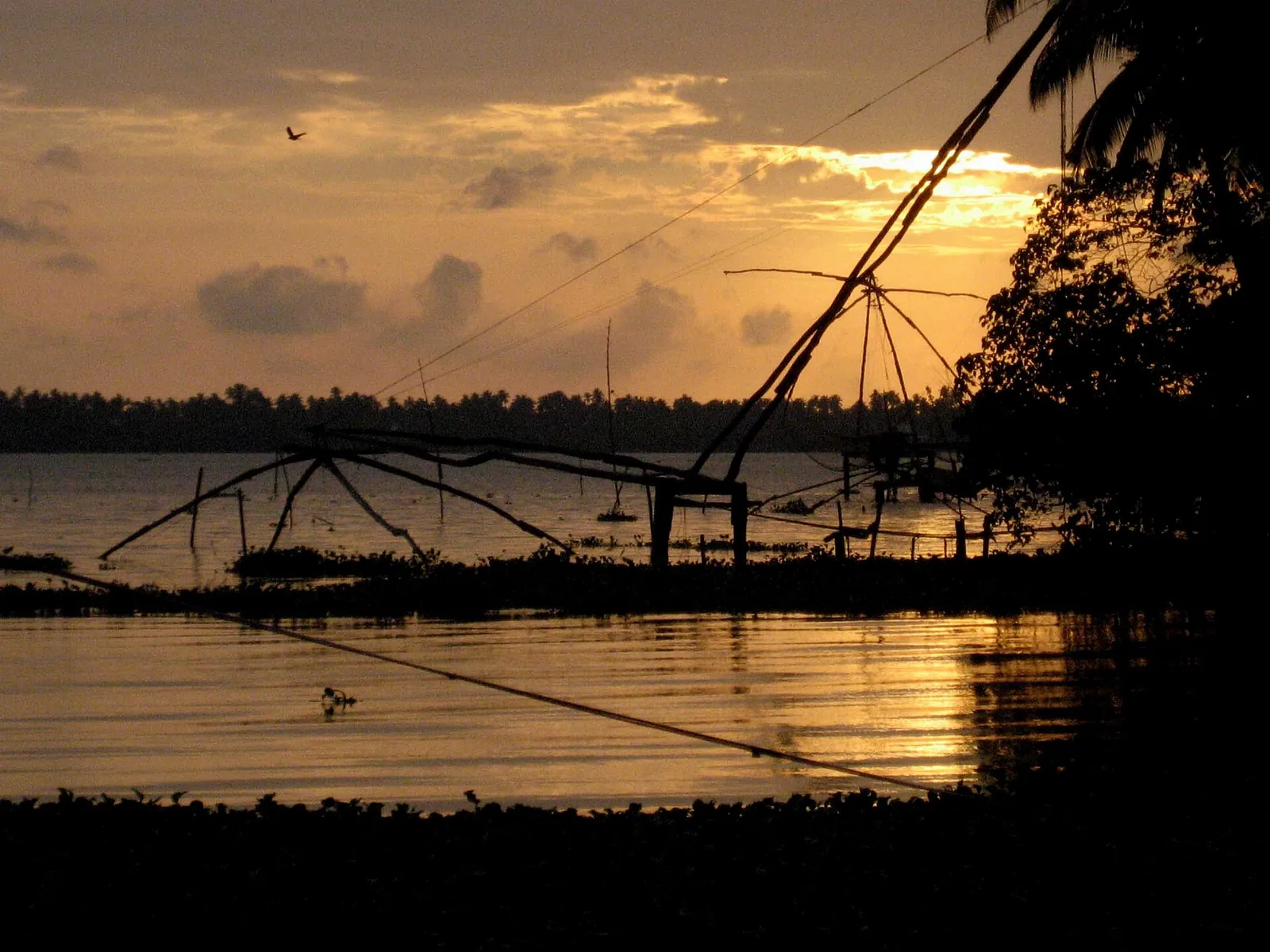
The Chinese nets at Kumbalangi are photographed constantly and explained almost never. They are not a symbol and not a decoration. They are a machine with a specific job — taking a large, gentle scoop out of shallow water without a boat and without an engine — and once you can read the mechanism, watching one worked becomes far more interesting than watching one silhouetted.
The mechanism, part by part
A cheena vala is a shore-mounted cantilever. A fixed platform of teak and bamboo stands in the shallows. From it, a long arm reaches out over the water carrying a horizontal net — commonly around twenty metres across — suspended from four converging poles so that it hangs flat, like a shallow tray rather than a bag.
At the shore end of the arm, a line of large stones hangs on separate ropes at different heights. These are the counterweight, and the staggered heights are the clever part: as the arm rises, the stones come to rest on the platform one after another rather than all at once, so the load transfers gradually and a small crew can control the lift instead of being thrown by it.
The net is lowered into the water, left for a few minutes, and then raised — usually by two to four men walking the main rope, using their body weight rather than a winch. Whatever was swimming above the net when it came up is now in it. That is the whole idea: not chasing fish, but lifting a defined volume of water and keeping what was in it.
- The stones: count them and watch the order they land in as the arm comes up.
- The four converging poles that keep the net flat rather than letting it bag.
- The dip time — often only a few minutes. Longer is not better; fish swim out.
- The lamp. At night a light over the water draws fish into the scoop.
- The catch: usually small and mixed. This is a household-scale method, not a commercial one.
Why Kumbalangi has so many
More than a hundred of these stand along Kumbalangi’s creeks. Fort Kochi, which is where the world photographs them, has a famous handful on a promenade. That inversion is worth sitting with.
The Fort Kochi nets are genuine and old, and they are also, at this point, partly sustained by being watched — visitors pay to haul, and the row is a landmark before it is a fishery. The Kumbalangi nets have no audience. They are worked at dawn and dusk because a household needs the fish, in creeks where the only person watching is in a canoe. If you want to understand what these things are for, this is where to see it.
The honest corollary is uncomfortable: the unwatched version is the more fragile one. Nothing here is subsidised by tourism, which means it survives only as long as it pays.
Where the nets came from — and the date that does not work
You will be told they were a gift from the court of Kublai Khan. There is a problem with that: Kublai Khan died in 1294, and the nets are generally dated on this coast to somewhere between about 1350 and 1450. Whatever brought them, it was not his court, because by then it did not exist.
What does fit the period is the era of Zheng He, the Ming admiral whose treasure fleets worked these waters in the early fifteenth century, and whose chronicler Ma Huan produced what is thought to be the earliest surviving written reference to Kochi. A competing account has the nets arriving much later with the Portuguese, from Macau. The origin is genuinely unsettled; the name is not — Malayalam has called them cheena vala for a very long time.
Seeing them properly
Go out by canoe at first light or dusk, which is when they are worked. Ask your boatman before photographing a family at a net, and ask before climbing onto a platform — some hosts will let you help with the haul, and it is the best five minutes of a Kumbalangi visit. The frames are wet timber over water and there are no railings, so take that seriously.
Frequently asked questions
How does a Chinese fishing net work?
It is a shore-mounted cantilever. A horizontal net around twenty metres across hangs from four converging poles on a long arm, counterweighted by a line of stones hung at staggered heights at the shore end. The net is lowered, left a few minutes, then raised by two to four men walking the main rope — scooping up whatever was swimming above it.
Why are the counterweight stones at different heights?
So they land on the platform one after another as the arm rises, transferring the load gradually. If they all landed at once the lift would be uncontrollable for a small crew. It is the most elegant detail in the whole machine and almost nobody notices it.
How many Chinese nets are there at Kumbalangi?
More than a hundred stand along the creeks around the village — far more than the famous row at Fort Kochi. They are worked by households for their own catch rather than for visitors, which makes Kumbalangi the better place to see them functioning.
Were the Chinese nets really brought by Kublai Khan?
The date does not work. Kublai Khan died in 1294 and the nets are generally placed on this coast between about 1350 and 1450. The period fits the Ming voyages of Zheng He instead, and a competing account brings them later with the Portuguese from Macau. The origin is unsettled; the Malayalam name cheena vala is not.
When are the nets worked?
Mainly at dawn and dusk, and at night with a lamp over the water to draw fish into the scoop. Midday visits will mostly show you stationary frames. Go out by canoe at first or last light.
Can I help haul a net?
Sometimes — some households will let visitors join the lift, and it is worth asking through your homestay or boatman rather than turning up at a platform. The frames are wet timber over open water with no railings, so treat it with respect and keep children off.