The Chinese nets at Kumbalangi are the photogenic surface of something much larger. Underneath them is a working household fishery that uses at least four completely different methods, most of which involve no equipment more advanced than a basket and a pair of feet.
Four ways of getting food out of this water
The nets scoop. A cheena vala lifts a defined volume of shallow water and keeps what was in it — a mixed, small, unpredictable catch, taken several times a session at dawn, dusk or under a lamp at night.
The sluice gates filter. Where a pokkali field meets a creek, a gate can be opened on the tide with a net across it, so that prawns moving with the water are trapped as the field drains. This is the least visible and most ingenious method here, and it is the direct link between the fishery and the farming.
The mud is walked. Clam collection — kakka — is done by hand and by foot in the shallows, feeling for shells in soft ground and lifting them into a basket. It is unglamorous, it is done mostly by women, and it produces the clams that turn up in your dinner the same evening.
And the creeks are set with small gear: cast nets, stake nets, lines and crab traps, worked from canoes by one or two people. Nothing in this list requires an engine.
- Karimeen (pearl spot) — the brackish-water fish Kerala builds meals around.
- Prawns — largely from the pokkali fields, raised with no feed or fertiliser.
- Mud crab — the expensive one, and worth it.
- Clams (kakka) — gathered by hand from the mud, often the same morning you eat them.
- A mixed small catch from the nets: whatever was above the net when it came up.
Why the mangrove is the whole thing
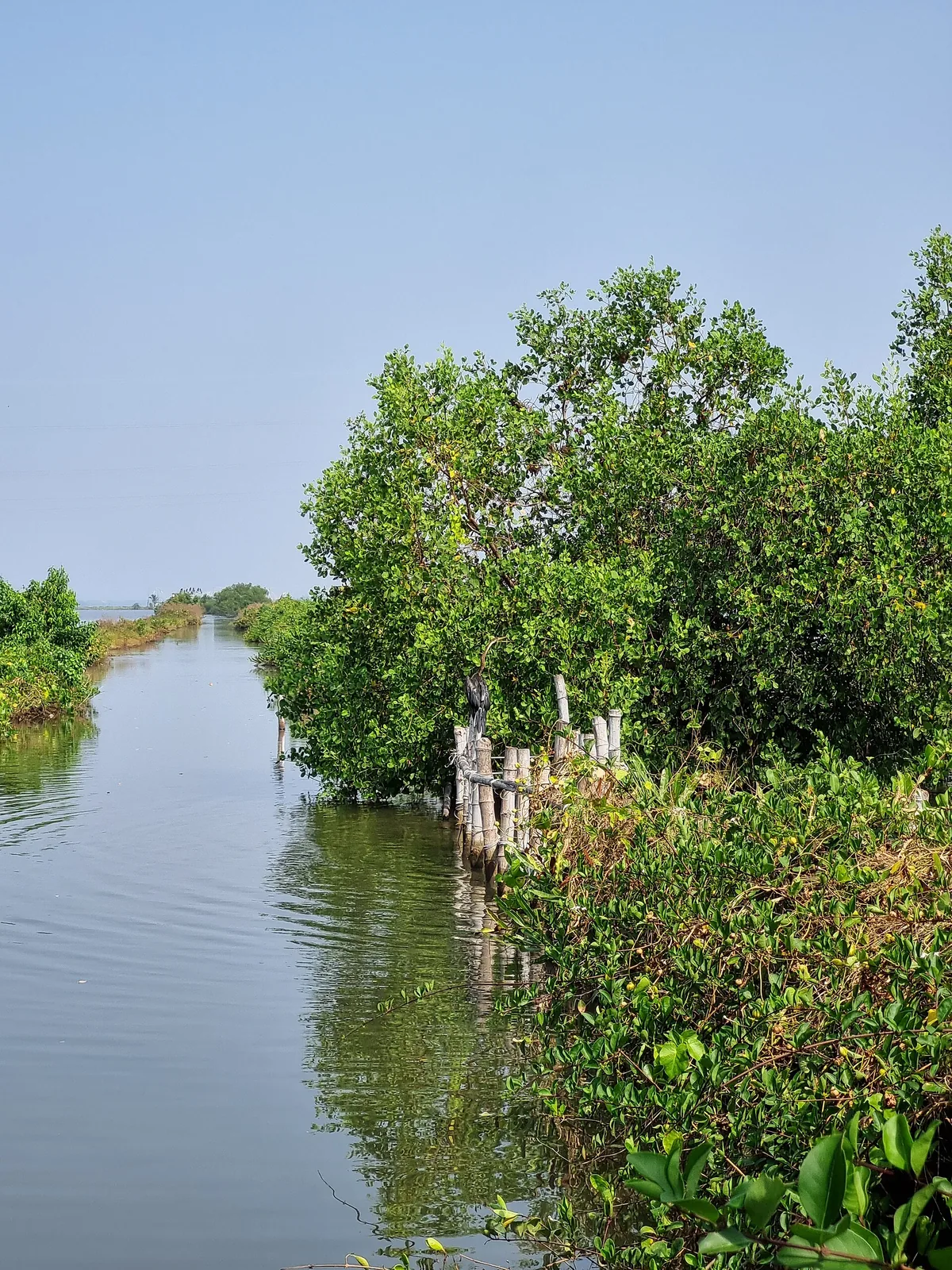
None of the above works without the mangrove. The tangle of prop roots between land and water is the nursery: prawns, crabs, oysters and small fish grow up inside it, sheltered from the things that would eat them, before they are large enough to be caught outside it. Remove the mangrove and you do not lose scenery, you lose the fishery two seasons later.
That is the pressure Kumbalangi is actually under. Reporting on the village describes real ecosystem strain on the creeks and mangroves as development and tourism have grown, and the model tourism village project of 2003 never delivered the integrated environmental side of its plan. The nets in your photographs depend on green edges that nobody photographs.
A fishery that stayed household-scale
What is unusual about Kumbalangi is not the methods — variants of all of them exist along the coast — but that they are still being practised at household scale twelve kilometres from a metro city. Fishing dominates the local economy alongside farming, coir spinning and toddy tapping, and increasingly boating for visitors; over forty thousand people live on about sixteen square kilometres of island, and a large share of the protein consumed here comes out of the water within sight of the houses.
It is worth being clear-eyed about the economics. Household-scale fishing is not romantic to the people doing it, and it survives because it pays enough, not because it is beautiful. Tourism money that reaches those households is the mechanism most likely to keep it going — which is the entire argument behind the 2003 designation, and the reason staying overnight matters more than turning up for two hours.
Seeing it without getting in the way
Go by canoe at dawn. Ask before photographing anyone working, and mean it. If you want to see the clam collection or a sluice-gate prawn filtration, ask your homestay to arrange it rather than approaching people in the water — it is somebody’s morning, not a demonstration. And then eat what comes out of it, which is the honest way to complete the transaction.
Frequently asked questions
What fish and shellfish come out of the Kumbalangi backwaters?
Karimeen (pearl spot), prawns — largely from the pokkali fields — mud crab, clams gathered by hand from the mud, and a mixed small catch from the Chinese nets. Most of it can be on a plate the same day it is taken.
What is kakka collection?
Clam gathering, done by hand and foot in the shallows — feeling for shells in the soft mud and lifting them into a basket. It is largely done by women, requires no equipment, and supplies the clams served in the village homestays.
How are prawns caught in the pokkali fields?
By tidal filtration at the sluice gates. A gate between the field and the creek is opened on the tide with a net across it, so prawns moving with the draining water are trapped. It is the direct working link between the farming cycle and the fishery.
Why do the mangroves matter to the fishery?
They are the nursery. Prawns, crabs, oysters and small fish grow up sheltered among the prop roots before they are big enough to be caught in open water. Lose the mangrove and the fishery follows a couple of seasons later — which is why the ecosystem pressure here is not an abstract concern.
Is fishing still the main occupation in Kumbalangi?
Yes — fishing dominates the local economy, alongside farming, coir spinning, toddy tapping and, increasingly, boating for visitors. More than forty thousand people live on roughly sixteen square kilometres of island, much of it within sight of the water they fish.
Can I watch the fishing without intruding?
Go out by canoe at first light and ask your homestay to arrange anything closer — a net haul, a clam collection, a sluice gate. Approaching people working in the water uninvited is intruding on somebody’s morning. Always ask before photographing faces.