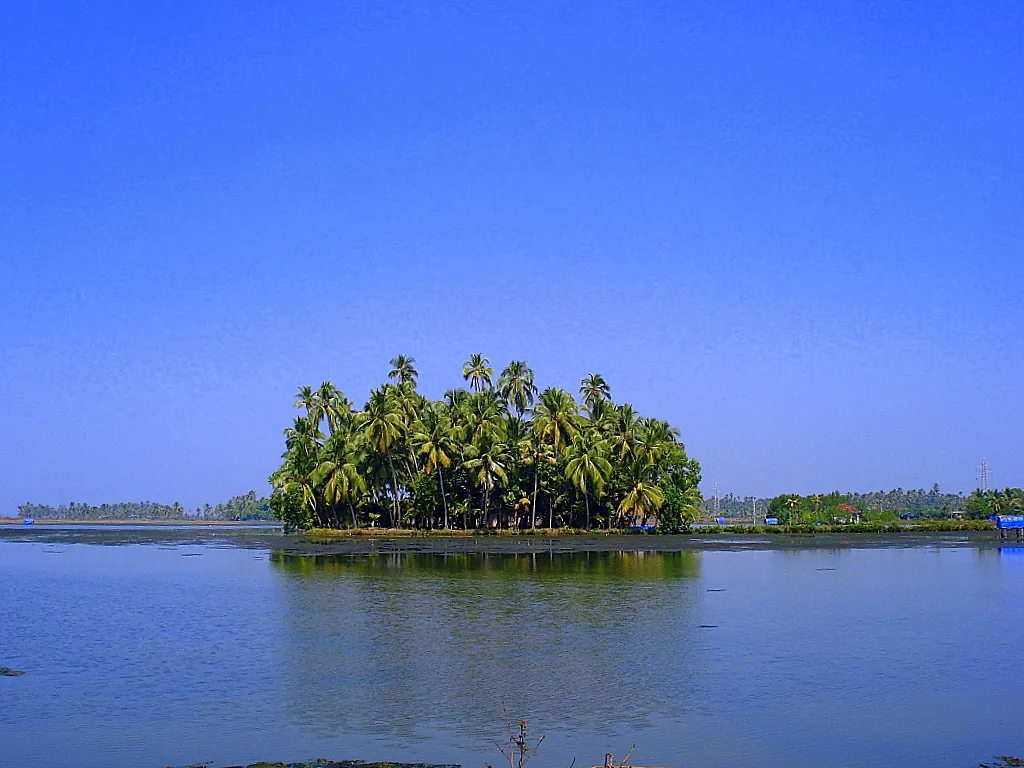
In 2003 the Kerala government designated Kumbalangi as a model tourism village — the first in India — under the Kumbalangi Integrated Tourism Village project. The idea was close to the opposite of how tourism normally arrives somewhere beautiful: instead of building a place for visitors, send the visitors into the place that already exists, and route the money to the households already working there.
The village underneath the designation
Kumbalangi is an island panchayat of about 16 square kilometres and more than forty thousand people, twelve kilometres south-west of Kochi city, ringed by tidal creeks and held together by mangrove. Around three-quarters of the population is Latin Catholic; literacy runs close to 96 per cent. Fishing dominates the economy, with more than a hundred Chinese fishing nets standing in the surrounding water, alongside farming, coir spinning, toddy tapping and — increasingly — ferrying visitors in canoes.
The name, incidentally, is not what most people assume. Kumbalanga is Malayalam for ash gourd, and the village is regularly said to be named after the vegetable. The accepted derivation is Kumbalam Vilangi — the island lying off Kumbalam — which is a plain description of an island separated from a mainland settlement by water. It is named for its own geography.
What the plan promised
- No purpose-built tourist structures — no resorts, no cottage blocks.
- Accommodation inside existing homes, run by the families in them.
- Plastic discouraged across the panchayat.
- Visitor money reaching fishing, farming and craft households directly.
- The village as the attraction, not a village-themed attraction.
For 2003 that was genuinely radical. Community-based tourism was not the fashionable term it later became, and the default template for a beautiful stretch of Kerala water was a resort with a gate on it. Kumbalangi is twelve kilometres from a metro city with an international airport. The market pressure to build that resort has been continuous for twenty years.
What actually happened
Less than the plan, and more than nothing. Reporting on the village describes a project that fell well short of its own targets, with real ecosystem pressure on the creeks and mangroves growing underneath the tourism rather than being solved by it. The integrated development that was supposed to accompany the designation largely did not arrive.
But the central prohibition held, and that is visible the moment you cross the bridge. There is still no resort strip. The nets are still worked because households need the fish rather than because visitors are watching. You are walking through a working village, not a reconstruction of one — and in an industry that is extremely good at building convincing fake versions of exactly this, keeping the real one is not a small achievement.
Then a film happened
In 2019 the Malayalam film Kumbalangi Nights was set here, was very good, and put both the village and its bioluminescent water in front of a national audience. Weekend traffic changed. So did the economics: the name on a film poster has done more for household income here than the government designation managed in sixteen years.
That is either encouraging or bleak depending on where you sit. A village that was formally protected as a model of community tourism ended up being rescued commercially by a movie — and film tourism brings people looking for a location, which is a different visitor from the one the 2003 plan imagined. Both kinds now arrive at the same jetty.
How to visit in the spirit of the thing
Stay overnight rather than day-tripping, because the money reaches a household rather than a boat operator, and because dusk and dawn are when the place is at its best. Take a canoe, not a motorboat. Book a village walk through your host. Eat what the kitchen is cooking. And if you are coming between March and May, ask about kavaru — the bioluminescence — and go out on a moonless night.
Frequently asked questions
Is Kumbalangi really India’s first model tourism village?
Yes — it was designated in 2003 by the Kerala government under the Kumbalangi Integrated Tourism Village project, and Kerala Tourism describes it as the first eco-tourism village in India. The designation came with a ban on purpose-built tourist structures, which is why there is no resort strip.
What does the name Kumbalangi mean?
It derives from Kumbalam Vilangi — the island lying off Kumbalam — describing an island separated from the mainland settlement of Kumbalam by water. Despite what visitors are often told, it has nothing to do with kumbalanga, the Malayalam word for ash gourd.
Are there hotels or resorts in Kumbalangi?
No resorts. The model village designation prohibits purpose-built tourist structures, so accommodation is in homestays inside existing houses, mostly along the northern waterfront. That is the intended design rather than a gap in the market.
Did the model tourism village project succeed?
Partly, and it is fair to say so. Reporting describes a project well short of its plan, with continuing ecosystem pressure on the creeks and mangroves. But the core rule held: no resorts were built, the nets are still worked by households, and the village remains a working one rather than a staged version of itself.
What is Kumbalangi Nights and did it change the village?
A 2019 Malayalam film set in the village, which brought both Kumbalangi and its bioluminescent backwaters to a national audience. It substantially increased weekend visitor traffic and household income — arguably more than the 2003 government designation ever did.
How far is Kumbalangi from Kochi?
About 12 km south-west of Kochi city centre, roughly 15 km from Ernakulam Junction and around 40 km from Cochin International Airport. It is an easy half-hour drive, which is exactly why the absence of resorts is remarkable.