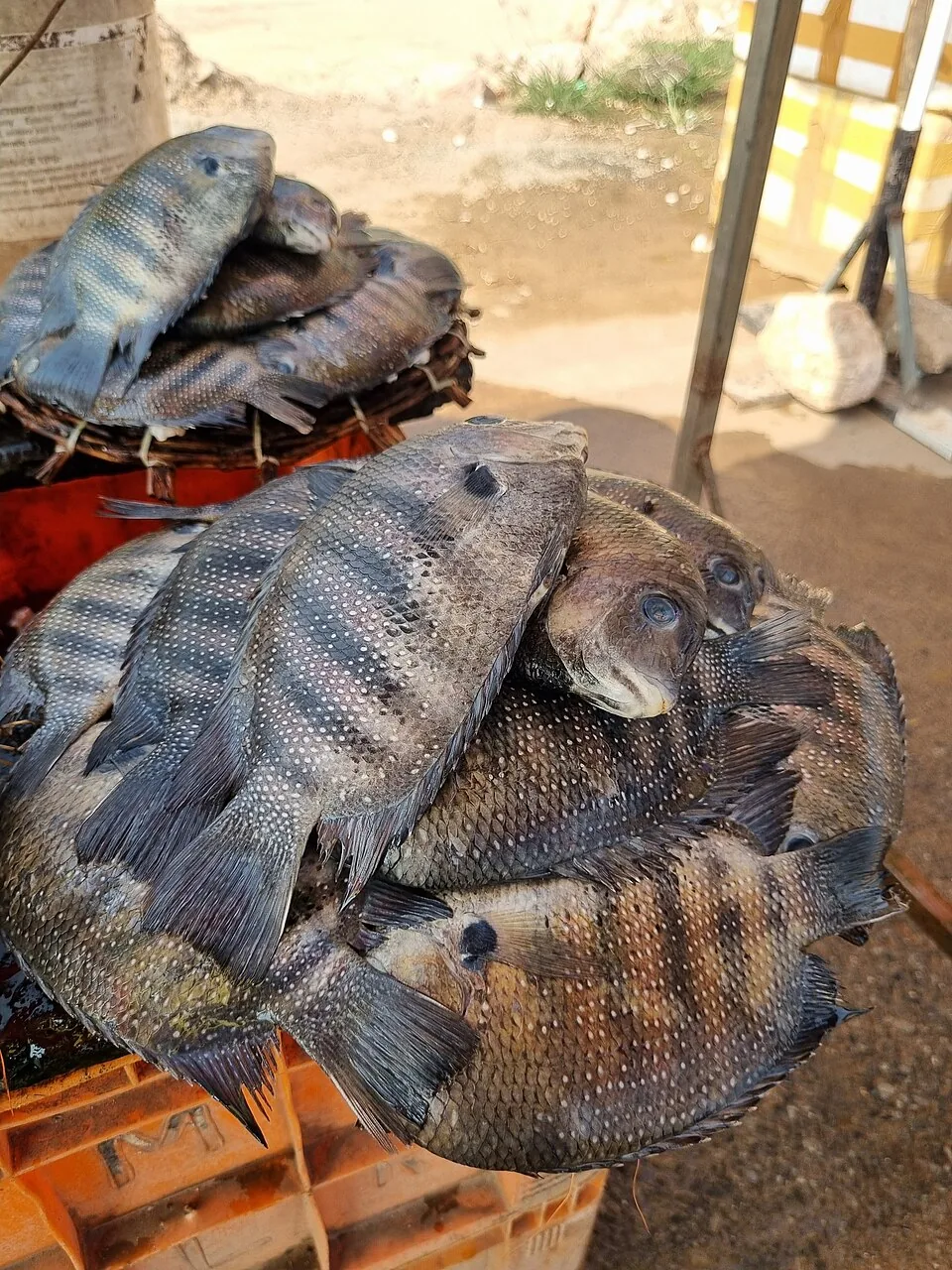
The karimeen that arrives at the table of a Kumbalangi seafood homestay is not remarkable for being good. It is remarkable for being karimeen. Across Kerala that is no longer a safe assumption, and understanding why is the most useful thing you can carry into a fish meal anywhere in the state.
A fish with a title
Karimeen — pearl spot, Etroplus suratensis, green chromide in the field guides — was declared the state fish of Kerala in 2010, and 2010–11 was formally observed as the Year of the Karimeen in an effort to lift production. It is a cichlid: deep-bodied, flat, dark, scattered with the pale spots that give it its English name.
What matters for Kumbalangi is where it lives. Karimeen is a brackish-water fish. It does not belong to the open sea and it does not belong to a river — it wants the zone where the two mix, which is precisely the description of the creeks that surround this village. A pearl spot eaten here has travelled from the water to the pan across a village, not across a state.
The numbers behind the fish
The demand for karimeen in Kerala runs at something like ten thousand tonnes a year. Farmed production, as of 2020, was around two thousand. That gap of eight thousand tonnes is the entire problem, because it does not go unfilled.
The wild fishery cannot make it up. Landings from Vembanad Lake — the system these creeks belong to — fell from about 1,252 tonnes in 1969 to roughly 135 tonnes in 2012–13. That is not a fluctuation; that is a collapse, over a single working lifetime.
- Mangrove loss: Kerala’s mangroves went from around 700 sq km in the 1980s to under 18 sq km by 2020.
- Those roots were the nursery for the hatchlings; sludge replaced them.
- Industrial effluent and urban run-off into the backwaters.
- Reclamation, dredging and barrages altering the salinity the fish depends on.
- Result: demand around 10,000 tonnes, farmed supply around 2,000, wild catch a fraction of what it was.
What gets served instead
Tilapia. Specifically the improved farmed strains that Indian aquaculture has scaled hard — tilapia made up some thirty thousand of seventy thousand tonnes of farmed fish nationally in 2022, and in parts of Kerala it is now the most cultivated fish there is.
At three to four hundred grams a tilapia is a similar size and a similar shape to a pearl spot, and once it is scored, coated in masala and wrapped in a banana leaf, most diners cannot tell. Restaurants have been caught substituting one for the other. This is not a conspiracy so much as arithmetic: if ten thousand tonnes are ordered and two thousand exist, something else is on eight thousand tonnes of plates.
It is worth being clear that tilapia is not a bad fish. It is a cheaper fish, sold at the price of a scarcer one, in a state that has built part of its culinary identity on the scarcer one.
How to know what you are eating
The reliable test is not the fish. It is the distance. In a household kitchen at Kumbalangi you can ask which water it came out of and who brought it, and get an answer with a name in it. A wild pearl spot typically runs three to four hundred grams, though they reach well over a kilo; the body is deep and laterally flattened, the colour dark green-grey, and the pale spots are unmistakable once you have seen a basket of them.
Ask before it is cooked rather than after, because the banana leaf is where certainty goes to die. A good host will simply tell you if tonight’s fish came from a farm — plenty of it does, legitimately, and there is nothing wrong with that. The problem is never farmed fish. It is farmed fish of a different species sold under this one’s name.
Why it belongs on this page
Kumbalangi’s homestay economy exists because the village refused resorts and kept its households in the food chain. The karimeen story is the same argument told through a fish: the value here is not a better recipe, it is a shorter distance between the water and the table, and a person who can account for it.
That is also why the decline matters to this village specifically rather than in the abstract. If the creeks stop producing pearl spot, what Kumbalangi sells is no longer verifiable, and a homestay dinner becomes the same transaction as a restaurant dinner in the city — just further from the airport.
Frequently asked questions
When was karimeen declared Kerala’s state fish?
In 2010. The following year, 2010–11, was observed as the Year of the Karimeen, an official push to raise production of Etroplus suratensis in the face of falling wild landings.
Why is karimeen getting scarcer?
Habitat, mainly. Kerala’s mangroves — the nursery ground for the hatchlings — fell from roughly 700 sq km in the 1980s to under 18 sq km by 2020, and industrial effluent, reclamation and altered salinity have degraded the backwaters further. Landings from Vembanad Lake dropped from about 1,252 tonnes in 1969 to around 135 tonnes in 2012–13.
Is tilapia really sold as karimeen?
It happens. Kerala’s demand runs near 10,000 tonnes a year against farmed production of roughly 2,000, and medium-sized tilapia of 300–400 g resembles pearl spot closely enough that restaurants have been found substituting it. Cooked in a banana leaf, few diners can tell the difference.
How do I tell a real pearl spot?
Look before it is cooked. A pearl spot is deep-bodied and flattened side to side, dark green-grey, and covered in the scattered pale spots it is named for. Wild fish usually weigh 300–400 g. The most reliable check is not the fish at all but the answer to “where did this come from?” — which a homestay can give you and a menu cannot.
Should I avoid ordering karimeen?
No. Order it where the supply chain is short and visible, which is exactly what a Kumbalangi homestay offers. The issue is not eating pearl spot; it is paying pearl spot prices for a substituted fish in places that cannot tell you where it came from.
Is farmed karimeen a problem?
Not in itself. Farmed pearl spot is a legitimate and necessary part of supply given how far the wild catch has fallen, and a good host will say plainly whether tonight’s fish was farmed. The problem is a different species being sold under the karimeen name.