If you look up Kumbhavurutty waterfalls you will be told, with complete consistency, that it is part of Thenmala — India's first planned eco-tourism destination — and managed within that framework. Dozens of sites say it.
It is not true, and the thing that disproves it is a signboard.
What the gate actually says
Two Wikimedians photographed this entrance on the afternoon of 21 June 2026, within about fifteen minutes of each other. One of their photographs is of the Forest Department's own board at the gate, and we have read it rather than taken anyone's word for what it says.
Across the top: KERALA FORESTS & WILDLIFE DEPARTMENT ACHENKOVIL FOREST DIVISION. In the middle, a photograph of the falls themselves with the staircase visible up the side. Below that, in English and Malayalam: KUMBHAVURUTTY WATER FALLS. Then a strip of four wildlife photographs — elephants, great hornbills, gaur, sambar — and along the bottom: WELCOME TO ACHENKOVIL FOREST DIVISION.
The word Thenmala does not appear on it anywhere.
And the office says more
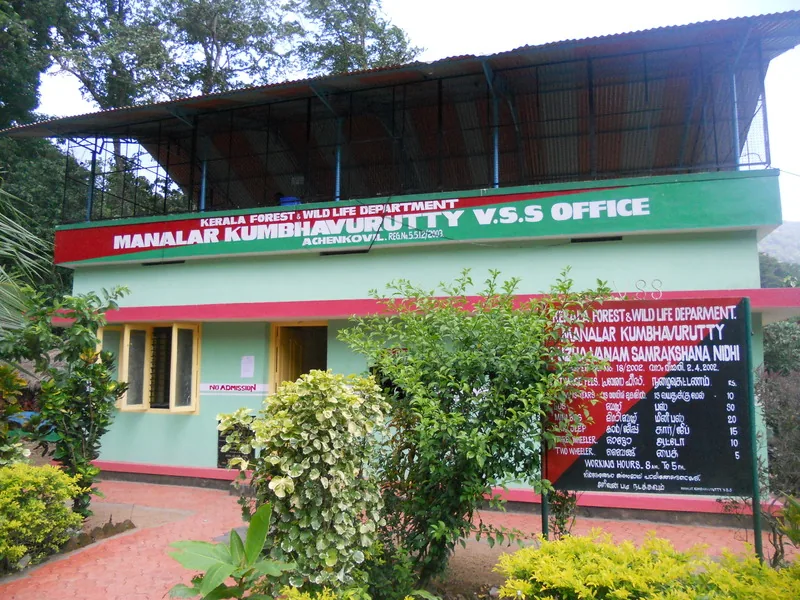
A few metres away stands a small building, photographed in July 2011, painted in green and red. Its lettering reads: KERALA FOREST & WILD LIFE DEPARTMENT — MANALAR KUMBHAVURUTTY V.S.S OFFICE — ACHENKOVIL, REG.No.551/2/2001.
V.S.S. stands for vana samrakshana samithy: a village forest-protection committee. Kerala's participatory forest management runs on them — a committee drawn from the settlements around a forest block, formally registered, sharing management and a share of the revenue with the Forest Department. The registration number on that wall dates this one to 2001.
So the institution here is not a tourism board and not a private operator. It is a local committee with a registration number, which has held this gate for a quarter of a century — and which also runs Manalar, the other waterfall two kilometres up the same river. One committee, two waterfalls.
The board that has been telling us the time since 2002
Beside the office door, in the same photograph, is a hand-painted board. It is headed KERALA FOREST & WILD LIFE DEPARMENT — the misspelling is on the board — MANALAR KUMBHAVURUTTY VANAM SAMRAKSHANA NIDHI, and cites order No. 18/2002 dated 2.4.2002. Under it is a fee table in English and Malayalam with entries for entrance, a jeep, a two-wheeler. And at the bottom, in capitals: WORKING HOURS 8 am To 5 pm.
Our own page published opening hours of 08:00 to 17:00. That is this board, verbatim. Our ticket prices were of the same vintage. We have, without knowing it, been republishing a signboard painted in April 2002 as current visitor information for a site that has since been closed for five years and reopened twice.
The word on that board worth carrying away is nidhi. It is not a tariff in the sense of a tax; it is a samrakshana nidhi, a protection fund. What you pay at this gate goes to the committee that protects the forest, not to a state exchequer. That is the whole design of the VSS model, and it is a rather more interesting thing to tell a visitor than the name of an eco-tourism brand thirty kilometres away.
Where the wrong story came from
We can trace the Thenmala claim reasonably well. It is published prominently on a domain called thenmalaecotourism.org — which is not the Thenmala operator. The real operator's site is the .com, and we established last week, on a different page, that the .org is a look-alike linked from no government page. From there the claim was copied outward into aggregators, and from the aggregators into us.
The other half of the error is simpler. Aryankavu, 35 kilometres away, is the nearest railway station. Travel sites list a nearest railhead, then a nearest town, and somewhere in that chain a railhead 35 km off turned into an address, and an address turned into a manager.
The geography was always against it. This fall is on the Achankovil river, which runs west to join the Pamba and reaches the sea through Vembanad. Thenmala sits on the Kallada, which reaches the sea at Ashtamudi. They are in different river basins, in different forest divisions, with the watershed between them. Nothing about them is the same except that both have trees and a gate.
Frequently asked questions
Who runs Kumbhavurutty waterfalls?
The Achenkovil Forest Division of the Kerala Forests & Wildlife Department, with the Manalar Kumbhavurutty Vana Samrakshana Samithy — a registered village forest-protection committee, Reg. No. 551/2/2001 — running the site day to day, including an eco-contact and nature interaction centre.
What is a vana samrakshana samithy?
A village forest-protection committee: a formally registered body drawn from the settlements around a forest block, which shares management responsibility and a share of the revenue with the Forest Department under Kerala's participatory forest management. The money collected at the gate goes to a samrakshana nidhi, a protection fund.
So it is not part of Thenmala eco-tourism?
No. The Forest Department's signboard at the gate reads Achenkovil Forest Division and does not mention Thenmala; Thenmala town is 18.4 km away in a different forest division and a different river basin. The claim appears to originate on a look-alike domain rather than with the Thenmala operator itself.
Why do so many sites say otherwise?
Two reasons compounding. The false claim is published on a look-alike domain that ranks well for the falls, and separately Aryankavu — 35 km off — is the nearest railhead, which the travel sites gradually converted into an address. We copied the result ourselves until this correction.
Does the same committee run other sites?
Yes. Its name is Manalar Kumbhavurutty, and it runs Manalar falls — also called Achankovil Falls — about 2.16 km away on the same river. DTPC Kollam files the two as one destination, which is the single most common mix-up here.