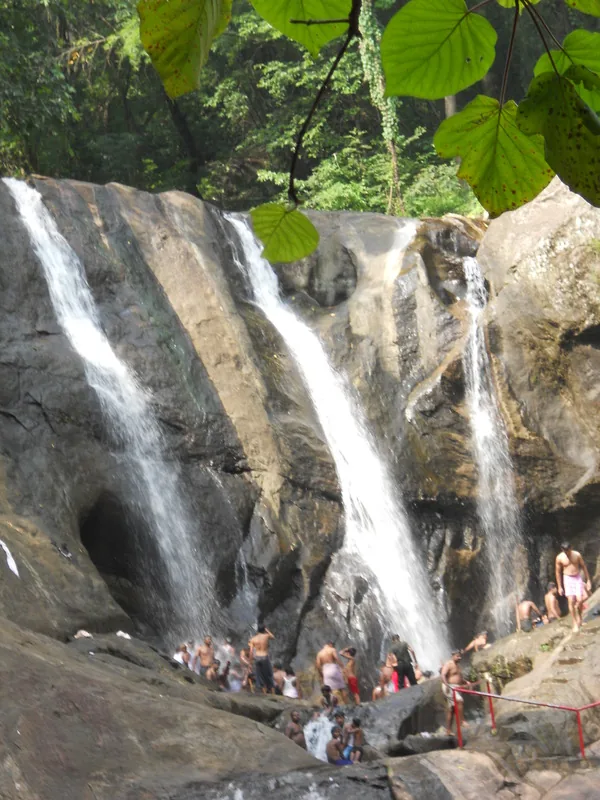
Our own page used to say that at Kumbhavurutty you might share the pool with nobody but dragonflies. It is a nice sentence. It is also the standard English framing of this place — undiscovered, unspoiled, quiet — and it survives entirely because almost nobody writing in English has looked at the Malayalam sources or at the photographs.
Look at the photographs. In frames taken in July 2011 the rock shelf under the fall is packed shoulder to shoulder. Dozens of people are standing directly in the chutes, in the water, with red steel railings behind them. Nobody in the picture is taking a photograph of the waterfall. They are in it.
What the Malayalam account adds
Malayalam Wikipedia carries a detail that appears in no English source we have found: that many visitors come from Tamil Nadu in the belief that the water here has medicinal properties, curing ailments including chronic skin disease, and that hundreds of visitors — women among them — bathe beneath the falls for that benefit.
We should be careful about how we hold that. It is one source, in one language, and we have not been able to corroborate it in a second. What we can say is that it is consistent with everything else about the place, and that it explains the physical evidence better than the tourism copy does.
Why it is entirely plausible
Start with the geography. This waterfall is on the Achankovil–Chenkottai road, on the route over the ghats to Tenkasi, about 27 kilometres east. That puts it inside the same cultural catchment as Courtallam — the falls above Tenkasi whose entire season is built on the belief that falling water heals, where the thirumanjanam months draw crowds who come specifically to stand under the water and where the medicinal reading of the cascade is not a fringe idea but the reason the place exists as a destination.
A Tamil family that goes to Courtallam does not have to travel much further to reach here, and the reason for going is the same reason. Kerala reads its waterfalls as scenery; the other side of this pass reads them as treatment. The road runs between the two.
Then look at what has been built. A staircase cut into the rock with steel handrails, climbing the side of the cascade so that people can get up to the water rather than merely see it. Railings along the shelf. A rail across the near edge of the plunge pool. These are not viewing platforms. They are the fittings of a place where the point is to get into the water, and the department has built for that use rather than against it.
And why it is dangerous
The Forest Department's own published warning is of slippery rocks and strong undercurrents. Admission is capped at 100 visitors an hour. There are trained guides on site, civil defence personnel, and an ambulance.
That is a heavy establishment for a small waterfall in a remote valley, and it is the department's answer to a bathing tradition it cannot simply forbid. You do not station an ambulance at a viewpoint.
This is where the usual account does real harm rather than merely being wrong. We told readers the pool was shallow — knee-to-waist deep, about a metre or less — and that a dip was popular. We have found no source for that depth anywhere. The photographs show a broad, dark plunge pool with a rail across it. Combined with the department's warning and the visitor cap, our reassurance pointed exactly the wrong way, to a place where people get into fast water on wet rock as a matter of course.
A name, offered as a reading
One more thing the photographs show, and it is unusual enough to be worth a paragraph. The cliff beside the chutes is pocked with dark circular hollows and cave-like pockets, scoured out of the rock. Malayalam Wikipedia describes the fall throwing up numerous whirlpools.
Kumbham is a pot. A fall that grinds pot-shaped hollows into stone is at least a defensible reading of the name, and it matches what you can see in a photograph — those are the classic potholes that spinning water and trapped grit cut into bedrock over a long time.
We offer it as a reading and not as a fact. We have found no source for the etymology of this name, and neither, as far as we can tell, has anyone else. Given what this page has just had to correct about invented institutional history, a plausible-sounding etymology is exactly the kind of thing we should hand over labelled as a guess.
Frequently asked questions
Do people bathe at Kumbhavurutty?
Yes, and it is the main reason people come. Photographs from 2011 show the rock shelf crowded with people standing directly under the chutes. The department has built a cut-rock staircase with handrails, railings on the shelf and a rail across the near edge of the pool for exactly that use.
Is the water thought to be medicinal?
Malayalam Wikipedia records that many visitors come from Tamil Nadu believing the water cures ailments including chronic skin disease, and that hundreds bathe beneath the falls for the benefit. We have found no English source that repeats it and no second source to corroborate it, so we give it as the Malayalam account rather than as established fact.
Why would visitors come from Tamil Nadu?
The falls are on the Achankovil–Chenkottai road, about 27 km from Tenkasi over the pass. That is the same cultural catchment as Courtallam, where an entire season is built on the belief that falling water heals. Geographically and culturally, the crossing is short.
Is it safe to bathe?
Treat it seriously. The Forest Department warns of slippery rocks and strong undercurrents, caps admission at 100 visitors an hour, and keeps guides, civil defence personnel and an ambulance on site. Our previous description of the pool as knee-to-waist deep had no source behind it and we have withdrawn it.
Is Kumbhavurutty undiscovered?
No, and that framing — ours included — does not survive contact with the evidence. A site with a hundred-visitor-an-hour cap, an ambulance on standby and photographs of a shelf packed shoulder to shoulder is a busy, managed, ticketed bathing place.
What does the name mean?
Nobody appears to know. Kumbham means a pot, and the cliff beside the chutes is scoured with pot-shaped hollows, which makes a pleasing reading — but we have found no source for the etymology and we offer that only as a guess.