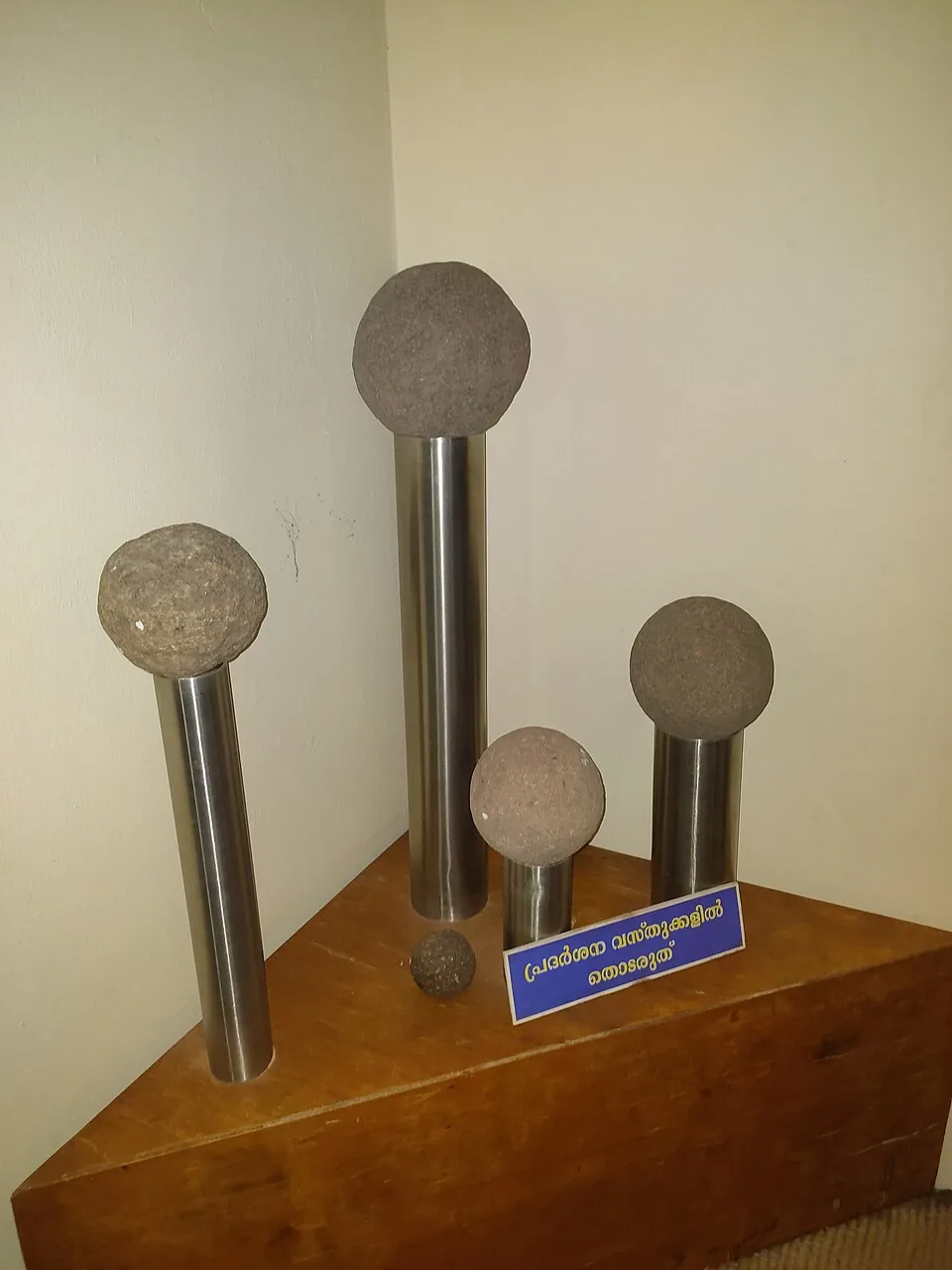
The stone shot standing on steel rods in the corner of this museum came from a fort that the Zamorin of Calicut authorised, garrisoned with his own admiral, and then besieged with twenty thousand of his own troops and a Portuguese fleet.
How that reversal was arranged is documented in unusual detail, because the Portuguese wrote it down.
The fort was the Zamorin’s idea
Nambiar records the origin plainly. While the Portuguese were negotiating for a fort site at Ponnani, the Calicut admiral asked the king’s permission to build a fort on a square peninsula at the mouth of the Kotta river, a little distance to the north of Calicut. The Zamorin granted the permission.
So Kottakkal was built as the answer to Ponnani — an alternative base, ready before the Portuguese fort went up. The sovereign who authorised it in the 1580s is the sovereign who besieged it in 1600.
What went up is described in the chronicles: on the land side a deep ditch with a double wall about seven feet thick, flanked at regular distances with towers mounted with cannon; between the two creeks a strong wall with two towers; the sea-shore lined with palisades and flanked by bastions, one higher than the other and mounted with heavy cannon to defend the harbour entrance — which was further secured by a boom of masts strongly chained together. From this base, De Couto complains, he began to make war on us, taking many of our ships richly laden.
The breach
The rupture between admiral and king, when it came, was almost domestic. Kunjali had the tail cut off a royal elephant grazing near Kotta — in spite of the entreaties of the mahout, as an insult to the Zamorin — and raided the house of the Nayar lord of Ariole.
A Jesuit, Padre Antonio, then at Calicut, worked on the young Zamorin’s anger and got Goa back to the negotiating table. In April 1598 Louis da Gama had returned to Goa with the Zamorin’s terms — thirty thousand patacos, Portuguese companies, half the spoils — which were refused; the Zamorin was declared an enemy, and Dom Fernando de Noronha was left blockading the mouth of the Kotta river.
The treaty
This is the paragraph. Nambiar, reading De Couto: Portuguese historians ascribe the origin of this base proposal to the Zamorin. The gallant Chief Captain did not remonstrate and was a partner in the treachery. In the terms of the treaty concluded soon after, given in painstaking detail by De Couto, there is the significant omission of the fate to be meted out to Kunjali on his capture, while the number of baskets and shovels the Zamorin had engaged himself to supply for the siege is mentioned. Both the king and the Chief Captain knew well what they proposed to do with regard to the rebel.
A treaty that counts the baskets and does not mention the man. The silence is the intent.
The scale, and the village
The Zamorin marched twenty thousand Nayars on Kotta and deployed his troops in a huge semicircle stretching from Iringal to the sea shore.
Iringal is the village this museum stands in. The siege line ran through it.
In December the fleet sailed: three galleys, twenty fustas, six Bassein boats, fifteen hundred men, joining eighteen ships already off Kotta. Goa sent a further galley, eleven ships, twenty-one other vessels and 790 men. The Zamorin contributed a thousand workmen, fifteen elephants, timber, an army of carpenters and five thousand more men, with four ships watching the river alongside thirty small boats.
André Furtado de Mendonça’s forces were not fully assembled until mid-February. He then learned that Kunjali had only eight hundred Moors inside the fort. Against them stood over twelve hundred Portuguese and over twelve thousand Nayars.
A caution on those figures: English Wikipedia’s account of the siege gives two thousand Portuguese, six thousand Nayars and fifteen hundred defenders, and dates the siege from 1 September 1599. Where Wikipedia and Nambiar differ we prefer Nambiar and tell you the numbers are disputed. Both agree on the dates that matter: 7 March and 16 March 1600.
Seventeen ships overland
Furtado could not force the river mouth. So he had seventeen ships dragged overland, by men and elephants, to get them where he needed them.
That single logistical fact says more about the site than any description of the walls. The Moorad river, which you can walk down and look at today — a wide tidal reach with painted wooden canoes drawn up on the mud — was the defence. It was easier to portage a fleet than to sail into it.
The assault
On 7 March 1600 the final attack went in. De Souza led four hundred men from the east; Pallota assaulted the bastion on the river bar; and with twelve hundred Portuguese, Furtado joined the Zamorin on the landward side to overawe the wavering ally.
Read that last clause again. The Portuguese commander positioned himself beside his own ally in order to intimidate him. Nobody in this alliance trusted anybody.
Furtado was also carrying a letter from the Viceroy ordering him not to assault. He called a Council of Captains, and assaulted anyway.
And in the corner of a three-room museum a few hundred metres away, six stone balls of graduated calibre stand on steel rods with a sign beside them, in Malayalam, asking you not to touch them.
Frequently asked questions
Why did the Zamorin turn against his own admiral?
The immediate breach was that Kunjali had the tail cut off a royal elephant grazing near Kotta as a calculated insult, and raided the house of the Nayar lord of Ariole. A Jesuit, Padre Antonio, then at Calicut, worked on the young Zamorin’s anger and reopened negotiations with Goa. The underlying issue was an admiral who had become an independent power on the Zamorin’s own coast.
What is significant about the treaty terms?
That they specify the number of baskets and shovels the Zamorin would supply for the siege, in painstaking detail, and say nothing at all about what would happen to Kunjali on his capture. Nambiar’s reading is blunt: both the king and the Chief Captain knew well what they proposed to do.
How large were the forces?
Disputed. Nambiar has over 1,200 Portuguese and over 12,000 Nayars against 800 Moors inside the fort; English Wikipedia gives 2,000 Portuguese, 6,000 Nayars and 1,500 defenders. We prefer Nambiar and flag the disagreement. Both agree the final assault was on 7 March 1600 and the surrender on 16 March.
Why were ships dragged overland?
Because André Furtado de Mendonça could not force the mouth of the Kotta (Moorad) river, which was the fort’s principal defence and could be closed with a boom of chained masts. Seventeen ships were hauled overland by men and elephants instead.