On this coast, when somebody wants an insider account of the Portuguese century — a Malabar voice rather than a European one — they cite the Tuhfat al-Mujahidin. Zainuddin Makhdum II of Ponnani, writing in Arabic, from here, about what was being done to here.
It was completed in 1583. Its narrative runs from 1498 to 1583. The dedication is to Ali Adil Shah I of Bijapur, who died in 1580.
Kunjali Marakkar IV did not become Kunjali until about 1595, and he was executed in 1600.
What that means
The Tuhfat cannot describe him. It cannot describe his fort, the siege that took it, the surrender, or the execution — and it does not, because it was finished seventeen years before any of it happened.
So every narrative account we have of the fall of Kottakkal is Portuguese. Diogo do Couto in the Décadas. The Jesuit Litterae Annuae. François Pyrard of Laval, who was in Goa between 1608 and 1610 and met people who had been there.
O. K. Nambiar, writing The Kunjalis: Admirals of Calicut — the standard Indian account, the one everything else draws on — quotes De Couto at length and verbatim. Not out of deference. Because there is nothing else to quote.
The Mappila side of this shore kept its memory of 1600 in a mosque and in a family’s oral tradition, not in a book. That is a completely legitimate way for a community to remember. It is also a way that leaves nothing for a historian to cite four centuries later.
The board on the wall
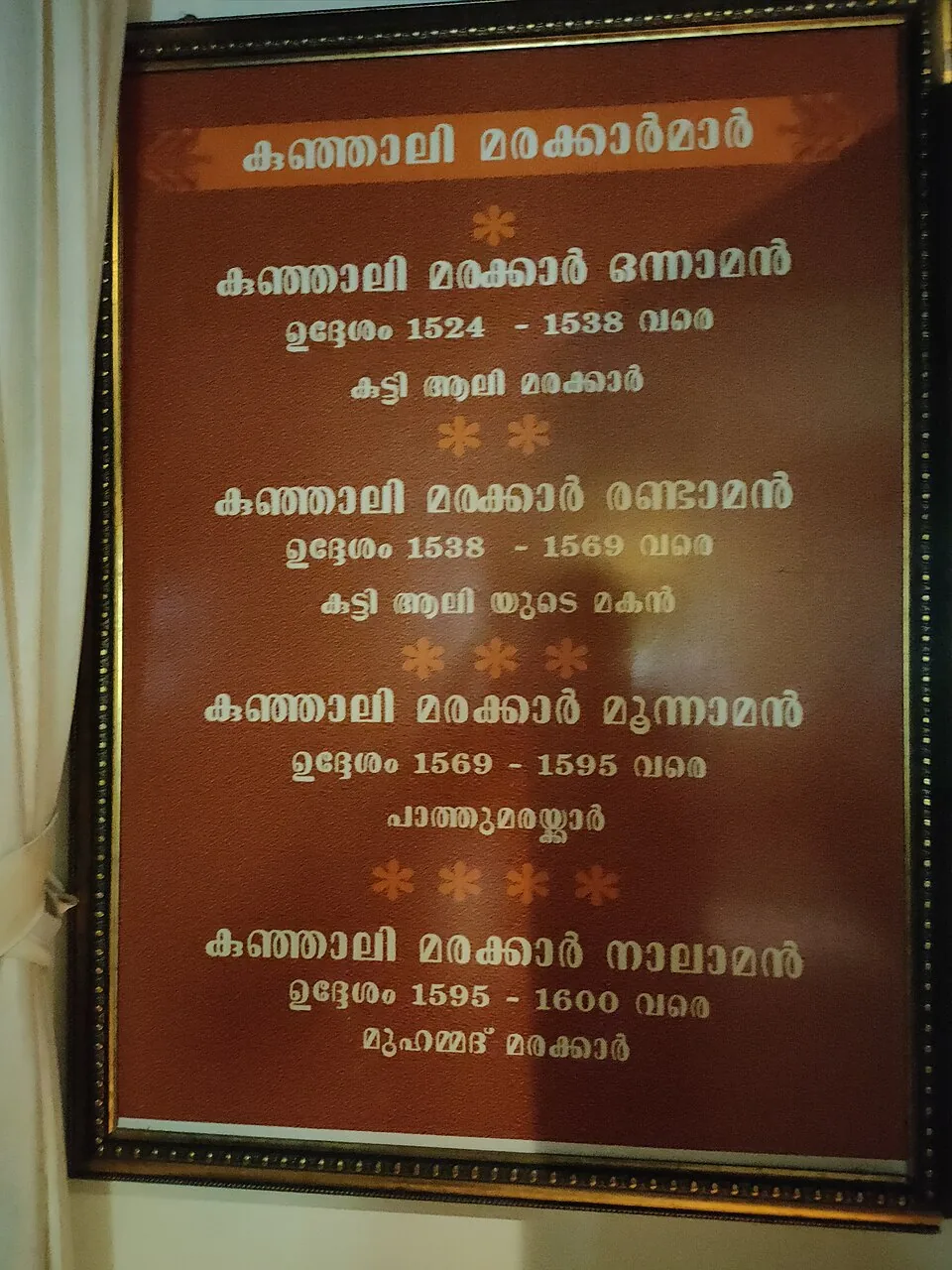
You can see the consequence hanging in the museum. There is a framed Malayalam panel, headed simply "the Kunjali Marakkars", listing four men:
Kunjali Marakkar I, approximately 1524 to 1538, Kutti Ali Marakkar. Kunjali Marakkar II, approximately 1538 to 1569, the son of Kutti Ali. Kunjali Marakkar III, approximately 1569 to 1595, Pathu Marakkar. Kunjali Marakkar IV, approximately 1595 to 1600, Muhammad Marakkar.
The word standing in front of every one of those date ranges is ഉദ്ദേശം — approximately. A state archaeology department, on the wall of the museum it runs to commemorate these men, declines to be certain about a single one of their dates.
And the second Kunjali it will not even name. The chronology copied across most of the web calls him Kutti Pokker and gives 1531 to 1571; the board says only "the son of Kutti Ali", and gives 1538 to 1569. English Wikipedia does not carry a complete four-man list with dates at all.
Which leaves this: the most authoritative enumeration of the four Kunjali Marakkars available anywhere is a framed sheet of card on the wall of a three-room house at Iringal, and it hedges every line.
Ten metres away, a different spelling
Walk out into the garden and there is a granite obelisk on a black polished plinth, chain-posted on a red terrazzo apron, with the Indian Navy crest and two gold inscriptions.
They read: THE KUNHALI MARAKKARS OCCUPY A SPECIAL POSITION IN THE HISTORY OF THE MALABAR COAST. THEY SYMBOLISE NATIVE RESISTANCE TO FOREIGN RULE, AND MADE LASTING CONTRIBUTIONS TO OUR GLORIOUS SEAFARING TRADITIONS. And: THIS MEMORIAL HAS BEEN ERECTED BY THE INDIAN NAVY AS A TRIBUTE TO THE KUNHALI MARAKKARS, WHOSE EXTRAORDINARY FEATS OF VALOUR OVER THE SEAS IN THE 16TH CENTURY NOT ONLY STAND OUT AS SHINING EPISODES IN OUR RICH MARITIME PAST, BUT ALSO CONTINUE TO INSPIRE THE INDIAN SEA FARER TO THIS DAY.
KUNHALI, not Kunjali. And plural, twice.
The Department’s board prints Kunjali. Kerala Tourism writes Kunjali, singular, as though there had been one man. Nambiar’s book is called The Kunjalis, plural. The Navy is the only one of them that both pluralises and spells it as this coast pronounces it, and it is standing about ten metres from a board that does neither.
Notice too what the Navy does not claim. No first navy of India. No invention of guerrilla warfare at sea. Just feats of valour over the seas in the sixteenth century. The institution with the strongest interest in claiming more is the one being careful — which, given how little written evidence survives, is the correct posture.
Why it matters on the spot
Because all three of these things are checkable while you are standing in the building. The board is on the wall. The obelisk is in the garden. And the 1583 completion date of the Tuhfat is not disputed by anybody.
Put them together and you get the honest shape of this site: a memorial to native resistance to foreign rule, where the dates are approximate, the name is spelled two ways in one compound, and the only surviving account of the last act was written by the men who carried it out.
Frequently asked questions
Why can’t the Tuhfat al-Mujahidin describe the siege of Kottakkal?
Because it was completed in 1583 and its narrative runs 1498–1583, while Kunjali IV became Kunjali around 1595 and was executed in 1600. The chronicle predates the entire episode by seventeen years, and does not cover it.
So where do accounts of the 1600 siege come from?
Portuguese sources: Diogo do Couto’s Décadas, the Jesuit Litterae Annuae, and François Pyrard of Laval, who was in Goa from 1608 to 1610. O. K. Nambiar’s The Kunjalis: Admirals of Calicut, the standard Indian account, quotes De Couto verbatim and at length because there is no alternative narrative to quote.
How many Kunjali Marakkars were there, and what are their dates?
Four, per the museum’s own framed board: Kutti Ali Marakkar (approx. 1524–1538), the son of Kutti Ali (approx. 1538–1569), Pathu Marakkar (approx. 1569–1595) and Muhammad Marakkar (approx. 1595–1600). Every date on the board is prefixed with ഉദ്ദേശം, approximately. Web chronologies name the second as Kutti Pokker with dates of 1531–1571; the museum declines to name him.
Is it Kunjali or Kunhali?
Both are in use in the same compound. The Archaeology Department’s board prints Kunjali; the Indian Navy’s obelisk in the garden carves KUNHALI, and puts it in the plural twice. Kerala Tourism uses Kunjali in the singular, which is the one form that is definitely wrong — there were four of them.