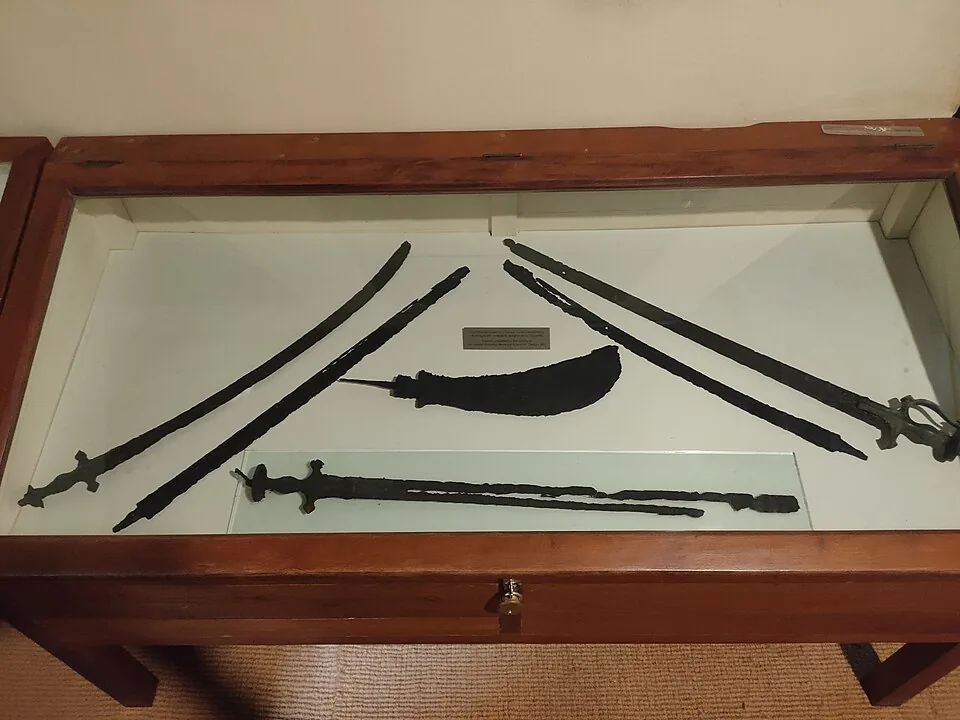
The sword case in this museum holds six corroded iron blades and one short curved weapon in a rotted scabbard. Nobody claims any of them is his. What is documented is what happened to the one sword that mattered, on a specific morning, in front of two armies.
The problem the two sides had
By March 1600 the fort was starving and Kunjali IV was willing to give it up. But he would surrender to the Zamorin, his own king, and to nobody else.
Nambiar states the impasse in four sentences: The Zamorin wanted Kunjali’s surrender, but not his death. Furtado wanted both. Kunjali would not surrender to any but the Zamorin. The Zamorin and Furtado hit upon a solution.
The solution was theatre. It was arranged between them that the Zamorin should agree to receive the surrender of Kunjali. At the surrender Kunjali was to be seized by Furtado by a show of force and thus taken off the Zamorin’s hands to be dealt with as he pleased.
The terms were real and formally exchanged. De Couto: In his extremity of want Kunjali sent envoys to the Zamorin heartily beseeching him to have mercy upon him and enquiring whether, if he should deliver himself up, the Zamorin would promise to spare the lives of him and his followers; this the Zamorin conceded and the agreement was ratified by the Olas of the parties.
The dream
This is the passage nobody uses, and it is the best thing in the literature. De Couto again:
Kunjali decided to yield himself up to the Zamorin, if he could obtain to have his life spared. But, as he related to his guards, he dreamt during the night that the Zamorin would give him up to the Admiral who would condemn him to die. They say that then he armed himself, urged the troops to make a sudden sortie, but the soldiers let him know that it would be foolish to offer themselves to die like that. Then some of the pseudo Priests, taking him aside and reciting some prayers over him, persuaded him that he would not die and that no confidence should be placed in dreams.
He dreamt exactly what happened. He told his guards about it. He armed himself and tried to fight his way out on the strength of it. And his own soldiers and his own clergy talked him out of believing it, on the reasonable ground that dreams are not evidence.
The surrender
16 March 1600. De Couto describes the procession out of the fort.
First came 400 moors, many of them wounded, with their children and wives, in such an impoverished condition that they seemed as dead. These the Zamorin bade go where they pleased. Last of all came Kunjali with a black kerchief on his head, and a sword in his hand with the point lowered. He was at that time a man of fifty, of middle height, muscular and broad-shouldered. He walked between three of his chief Moors. One of these was Chinali, a Chinese who had been servant at Malacca.
The sources disagree about whether Chinali was a rescued captive or a servant taken at Malacca; we will say only that the chronicles call him Chinali and leave it there.
The seizure, which went wrong
Kunjali walked straight to the Zamorin and delivered to him his sword in token of submission, throwing himself at his feet with much humility.
And then the staged part. De Couto: Some say, that the Zamorin, inasmuch as he had promised him life, had secretly advised the chief captain, when Kunjali should deliver himself up, to lay hands upon him, as though he were taking him by force, and so the chief captain did. For, as the Zamorin was standing by him, André Furtado advanced, and seizing him by the arm, pulled him aside, while the other gave a great lurch so as to be free. As he was then at the brink of a hole, the Chief Captain was in risk of falling therein, had not his arm been seized by Padre Fr. Diogo Homen who stood on one side. Diogo Baretto, who was on the other, fell into the hole and skinned all his leg.
The most carefully planned piece of political stagecraft on the Malabar coast that year ended with a Portuguese officer in a hole with a skinned leg.
And the Nayars did not buy it
This treachery was revolting to the code of honour of the Nayar soldiers who would not have the Portuguese lay hands on their brave countryman in violation of the well-known terms of surrender. A tumult arose among the Calicut Nayars who fell upon the Portuguese in an attempt to rescue the captive. Kunjali, having surrendered his sword, could not strike a blow for his freedom.
The Zamorin put the riot down with the utmost difficulty, and then gave the town over to his own soldiers to sack — partly, Nambiar says, to divert their mind from dwelling on the sordid incident.
Furtado razed the fort to the ground and set fire to the bazaars, town and mosque. He sailed for Goa on Saturday 25 March 1600 and reached the bar on 11 April.
What happened at the other end
Goa was not a triumph either. The Viceroy, Dom Francisco da Gama — whose brother Kunjali had once beaten at sea — sabotaged the celebration out of jealousy. A crowd stoned four or five captured Moplahs to death on the quay. Furtado refused to land. The citizens pulled down their own triumphal arches, and the thanksgiving service was held late and without him.
Kunjali went to the Tronco. The Viceroy fell ill, and on recovering sent word to the judges to sentence Kunjali offhand.
At the scaffold the accounts describe a man of fifty, fair, thick set and broadbreasted, of a low stature, well-shaped and strong, who conducted himself with great dignity and courage which won the respect of his pitiless foes. Chinali stood beside him. The crowd had strangely become silent. He cast his eyes over that vast multitude and bent his neck.
His head was salted and sent to Cannanore to be set on a standard; his body was quartered and displayed on the beaches at Panjim and Bardez. The executions of the other prisoners went on for several days, and not one that was taken escaped.
The coda, which brings it home
Eight years later, between June and October 1608, the French traveller François Pyrard of Laval was in Goa and met a young man of about thirty, in chains on the galley works.
He was a cousin of Kunjali, taken as a boy of thirteen at the battle off Cardiva in 1591 — by André Furtado, the same man — baptised Don Pedro Rodrigues, married to a Portuguese orphan, put in command of a squad of prisoners, and still shackled himself. He had been in the crowd when his kinsman was beheaded.
Pyrard also stayed with that man’s brother, Captain Kutty Ahmed of Badagara — which is Vadakara, six kilometres up the road from this museum.
One brother free on this shore, one brother in irons in Goa, seventeen years after the battle that separated them. That is what the end of the Kunjalis actually looked like, and none of it is on the walls here.
Frequently asked questions
When did Kunjali Marakkar IV surrender?
16 March 1600, after the final assault on 7 March. He walked out last, behind 400 wounded Moors and their families, with a black kerchief on his head and his sword point lowered, and delivered the sword to the Zamorin.
Was the seizure really staged in advance?
That is what De Couto reports and what Nambiar accepts: the Zamorin, having promised Kunjali his life, secretly advised the Portuguese chief captain to lay hands on him as though taking him by force. It went visibly wrong — Furtado nearly fell into a hole and another officer, Diogo Baretto, did fall in and skinned his leg — and the Zamorin’s own Nayars rioted in an attempt to rescue the prisoner.
What happened to him afterwards?
He was taken to Goa, where the Viceroy Dom Francisco da Gama had him sentenced summarily. He was beheaded; his head was salted and sent to Cannanore to be set on a standard, and his body was quartered and displayed on the beaches at Panjim and Bardez. The other prisoners were executed over several days.
Is his tomb at Kottakkal?
Nambiar records a memorial tomb kept by the family at Kotta beside his mother’s, and a tradition — explicitly given as family legend — that what lies under it is a bloodstained kerchief, since nothing of the body came home. Nambiar found the tomb decades ago with crumbling masonry, a dilapidated roof and a floor of loose mud. We have no current information on its condition, location or accessibility, so we do not send visitors to look for it.