Stand on the mound at Ramakkalmedu with the Kuravan and Kurathi behind you and you are facing east, out over Tamil Nadu. The thing the statue is named after is thirty kilometres in the other direction: Kuravanmala and Kurathimala, two granite hills with the Periyar running through a gap between them so narrow that Malayalam has a word for it. ഇടുക്ക്, idukku, the tight place. The district is named after that gap, and wedged into it is the Idukki arch dam.
Kerala State Electricity Board’s own board at the site sets out what is there: type of dam, concrete double curvature parabolic thin arch; river, Periyar; length at top, 365.76 m; height from deepest foundation, 169.16 m, printed beside its equivalent of 555.00 ft. It is the largest arch dam in India and one of the highest in Asia. And the reason anybody looked at that gorge at all is a man who never lived to see it filled.
The hunting trip
Karuvellayan Chemban Kolumban was the headman of the Oorali, and he lived at Narikkad in Chembacherry, about five kilometres from where the dam now stands, in what is today Vazhathope panchayat. In 1932, according to Malayalam Wikipedia citing both Manorama and Mathrubhumi, W. J. John, the superintendent of the Malankara Rubber Estate, went hunting in the Idukki forests and took Kolumban with him as his guide.
Somewhere on that walk Kolumban showed him the Periyar tearing through the gorge between the two hills. John worked out that a dam there would produce power and serve irrigation, studied the site with his engineer brother, and submitted a report to the Travancore government. Everything downstream of that — the Canadian aid, the technical consultancy of M/s Surveyor, Nenniger and Chenevert, the three dams at Idukki, Cheruthoni and Kulamavu, the commissioning by Prime Minister Indira Gandhi on 12 February 1976 — began with a man pointing at a gap in the hills.
⚠ Two dates circulate for that moment and it is worth setting them side by side. Kerala Tourism’s own newsletter of August 2020 says: “Legend has it that back in 1922, Kolumban joined a team headed by the Malankara Estate superintendent during a hunting trip in Idukki.” Malayalam Wikipedia, citing the two Malayalam dailies, gives 1932. Ten years apart, an official body against the press — except that the official body has hedged its own date with “legend has it”. Both are printed here, and neither is settled.
Honoured, and too early
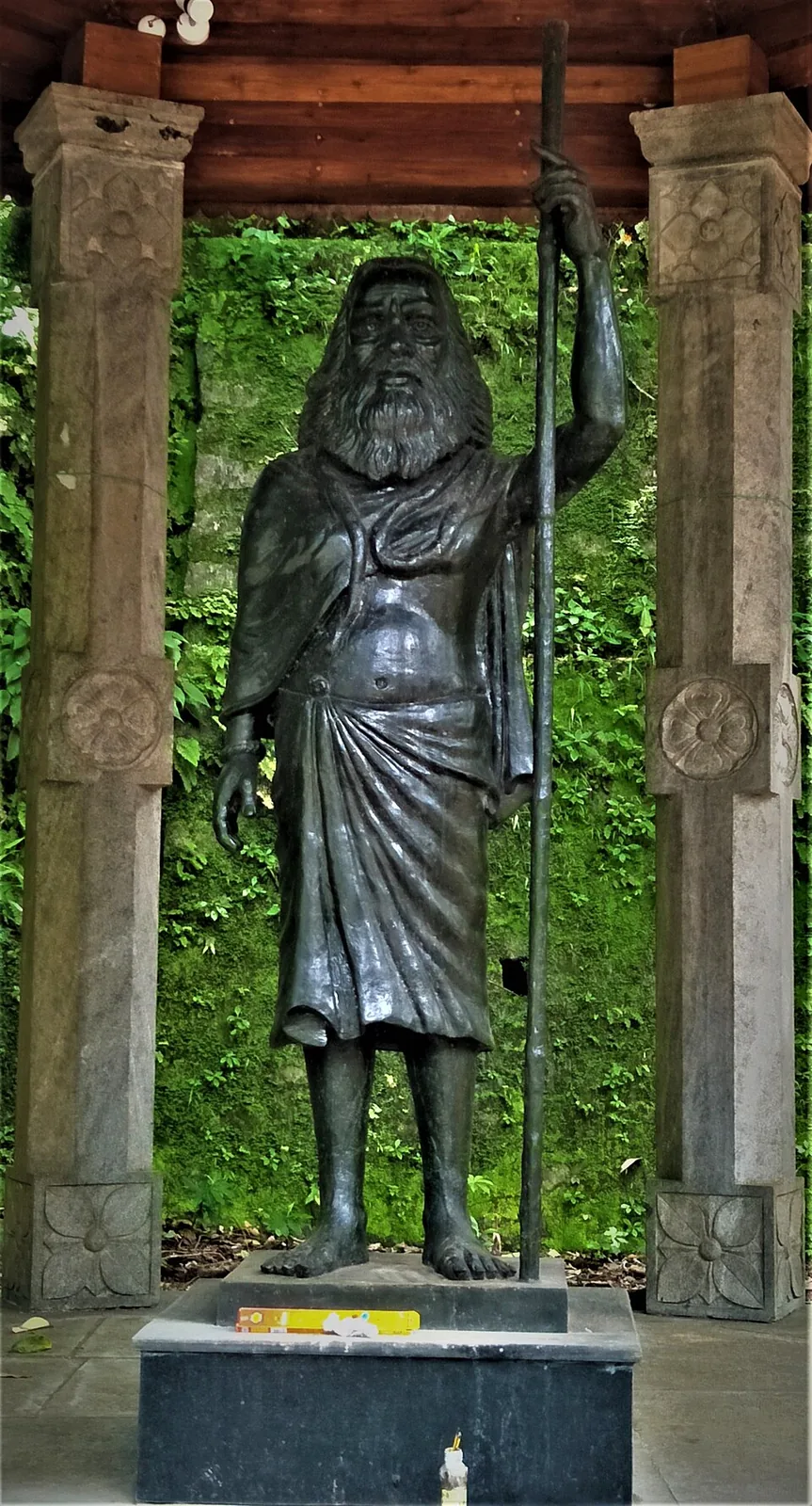
Kolumban was not forgotten while he was alive. He was a guest of honour when the Canadian government took over construction, and Malayalam Wikipedia records that he was honoured at all the major ceremonies of the project’s first phase. But he died on 21 June 1970 — at the age of 112 — six years before the dam was commissioned, and was cremated at Vellappara, on the shoulder facing the Idukki and Cheruthoni dams.
A statue of him went up beside the dam in 1976, made by the sculptor Kunnuvila Murali. Much later the Kerala Department of Archaeology built a memorial at his samadhi at Vellappara — begun in 2015, opened to the public in August 2020, a twelve-foot figure by the same sculptor, unveiled by the Minister for Ports, Museums, Archaeology and Archives together with the Minister for Power. The Kerala Forest Department’s boat on the Idukki reservoir is called Kolumban.
Kerala Tourism, announcing that memorial, quoted Mr Jayan P. Vijayan, Secretary of DTPC Idukki, in a sentence that is as good a summary as anyone has managed: “Kolumban is a person of immense historical importance. He is a figure of worship among the tribal community and much revered among the locals. His contribution is unparalleled. He was the one who showed the hills of Kuravan and Kurathi, thereby being instrumental in the setting up of the Idukki Dam.”
What this has to do with a statue on a ridge
Not everything, and more than it looks. The sculpture at Ramakkalmedu is not of Kolumban and does not claim to be. It is of a Kuravan, a Kurathi and their child — the people the two hills are named for. But the reason the hills are famous, the reason a district carries the name of the gap between them, and the reason there is anything at all to commemorate, is a piece of local knowledge that belonged to an Oorali headman and was given away on a hunting trip.
If you have a full day on this ridge, the drive is worth making: the Idukki arch dam is 44 kilometres and about fifty minutes west of the statue, and Vellappara is beside it. Seeing the gorge turns the statue at Ramakkalmedu from a photo stop into a monument that is pointing at something.