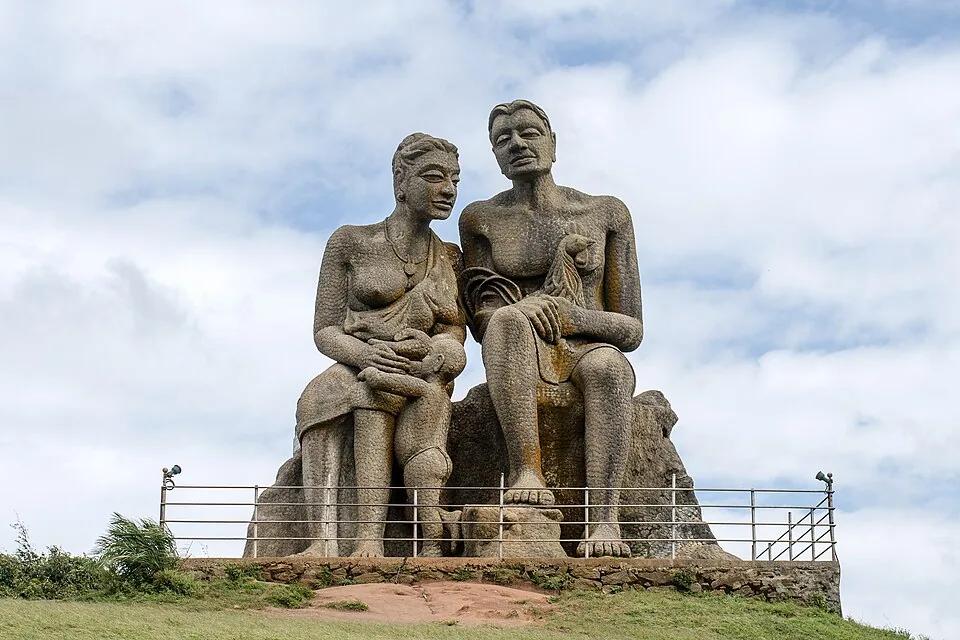
The Kuravan and Kurathi statue at Ramakkalmedu is one of the most photographed objects in the Idukki high range. It appears on the district tourism council’s own destination page, in Kerala Tourism’s newsletter, at the head of the Malayalam Wikipedia article about the place and in the infobox of the English one. It has been there since 2005. And two arms of the Kerala government describe it differently.
The District Tourism Promotion Council of Idukki, which runs the compound the statue stands in and takes ₹25 at the gate, writes on its own page: “With the landscape, it is the twin statues of the Kuruvan and Kuruvatti couple that is the main attraction here at Ramakkalmedu. It has the distinction of being the highest such statue in Kerala.” Twin. A couple. Two.
Kerala Tourism, in its Enchanting Kerala newsletter of March 2015, writes: “On the open meadows of the mount stand two huge statues of a ‘kuravan’ and a ‘kurathi’ and their child (people with tribal background) looking down nonchalantly at the visitors.” Two huge statues — and their child. Three figures.
What the photographs show
This is the unusual case where a dispute between sources can be closed by looking. We opened nine photographs of the group on Wikimedia Commons at full resolution, taken from four different angles by six different photographers across more than a decade, including frames from before and after the steel guard rail was installed around the plinth.
In every one of them there is a child. He stands on the plinth between the left-hand figure’s knees, his head at her forearm, one knee bent, and her hands are folded across him. In the frames taken from the left of the plinth he is unmistakable and takes up a third of the lower half of the composition. In the frames taken from the standard photographing spot — straight on, from the path — he is almost entirely hidden behind her shin.
That last sentence is probably the whole explanation. Very nearly every published image of this statue is taken from the same place, because that is where the path goes and where the group looks best against the sky. From there you see two adults. Walk twenty paces to the left and there are three figures.
What else is hiding in plain sight
Once you are looking properly, the same angle problem turns out to have hidden something else. The right-hand figure, the kuravan, is holding a bird — a fowl, wings folded, head up — cupped against his chest with one hand over it. There is something coiled at his hip that reads as a rolled mat or a basket. The left-hand figure wears a pendant on a cord at her throat and an ornament at her ear. None of that is visible from the front.
And the surface itself, which is the thing photographs flatten hardest: the entire casting — skin, cloth, the boulder the pair lean against, the plinth beneath them — is worked in an overlapping scaled texture, thousands of small facets, so that from any distance the figures read as one piece of stone rather than as sculpture placed on a rock. It is the reason to walk around this statue rather than photograph it and drive on.
Who made it, and how tall is it?
The sculptor is C. B. Jinan. That is well enough attested: Malayalam Wikipedia captions its own photograph of the group “കുറവനും കുറത്തിയും, ജിനന്റെ ശില്പം” — Kuravan and Kurathi, Jinan’s sculpture — and the photographer of one of the best frames on Wikimedia Commons described his own image, years ago and independently, as “A sculpture by Jinan @ Ramakkalmedu”. Three unconnected sources.
The year usually given is 2005, and that rests on weaker ground. It reaches English readers through commercial travel pages; English Wikipedia repeats it and cites one of those pages as its only source. No Kerala government body we could find publishes the year at all.
The height is weaker still. “40 ft” circulates everywhere. DTPC Idukki, asked the question by its own web page, says only that the group “has the distinction of being the highest such statue in Kerala” — a superlative with no number. Kerala Tourism gives no height. Malayalam Wikipedia says only that the statues were built “a few years ago”. We are not going to convert a photograph into a measurement, so this guide does not print one.
Why any of this matters
It matters a little because a monument’s own operator should be able to describe it, and it matters more because of what the third figure does to the meaning. Two adults on a hill are a couple, and the reading everyone reaches for is romantic — two lovers turned to stone, the dam built between them. A man, a woman and a child are a family, which is a different sculpture: not a legend but a people, sitting on a ridge, looking down at a plain.
Kerala Tourism’s own phrasing, awkward as it is, points at that reading: “a ‘kuravan’ and a ‘kurathi’ and their child (people with tribal background)”. Whatever else the group is doing on that mound, it is a portrait of a family of the Kuravar. Counting the figures correctly is the first step to seeing it.