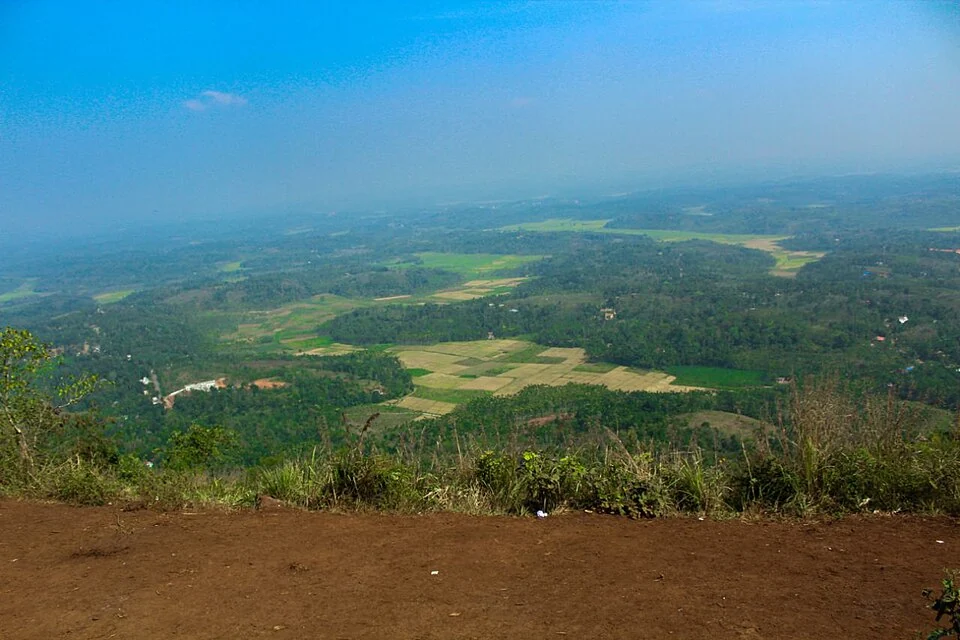
Rectangular fields spread between darker tree-covered patches below Kurumbalakotta. The foreground is an earth-edged viewing area, and haze softens the farther landscape. There is no dramatic cloud blanket in this photograph. Instead, it makes central Wayanad’s human geography visible.
Let the fields explain the valley
Begin with the shapes that can be distinguished clearly. Field boundaries create a different pattern from woodland, while scattered roofs mark small concentrations of buildings. The scene is a mosaic of land uses, not one continuous forest seen from above.
Kerala Tourism’s older Kurumbalakkotta account specifically describes paddy fields and palm groves in the view. That provides a local context, but a visitor should still avoid assigning a crop to every distant patch by colour alone. The important first observation is the contrast between cultivated openings and tree cover.
Follow the edges of those openings with the eye. They help show how the land folds and where a valley broadens. A clear daytime visit can make these relationships more legible than the early view for which the hill is best known.
The viewpoint stands within a lived-in region
Kottathara Panchayat places Kurumbalakotta near the boundaries of Kottathara, Kaniyambetta and Panamaram. The names remind a visitor that the panorama is also a set of local communities and administrative places. It should not be described as empty terrain simply because individual people are too small to see.
The approach roads and paths belong to that same landscape. They serve homes and farms as well as visitors going to the hill. Keep vehicles out of gates and turning spaces, and remain on the agreed walking route rather than cutting across a field edge for a shortcut.
That conduct is connected with the view itself. The patterns admired from above are the result of work and daily use below. Respecting them on the approach makes the outing more coherent than treating the villages as obstacles before the scenery.
A later visit has its own purpose
Dawn attracts people seeking a low cloud layer and changing light. Daylight can reward a different attention: the arrangement of fields, the contrast of nearby slopes and the position of distant hills. Neither view needs to be treated as the incomplete version of the other.
Choose a stable-weather period and a secure viewing position. A clearer panorama does not justify moving nearer a steep edge, and strong visibility in one direction does not establish a safe route across the whole hill.
Read the panchayat’s destination account for the locality and approaches. Then spend time with the actual patterns below. Kurumbalakotta can be memorable for revealing how Wayanad is inhabited, even on a morning when the cloud sea never forms.
Plan the visit: Kurumbalakotta.