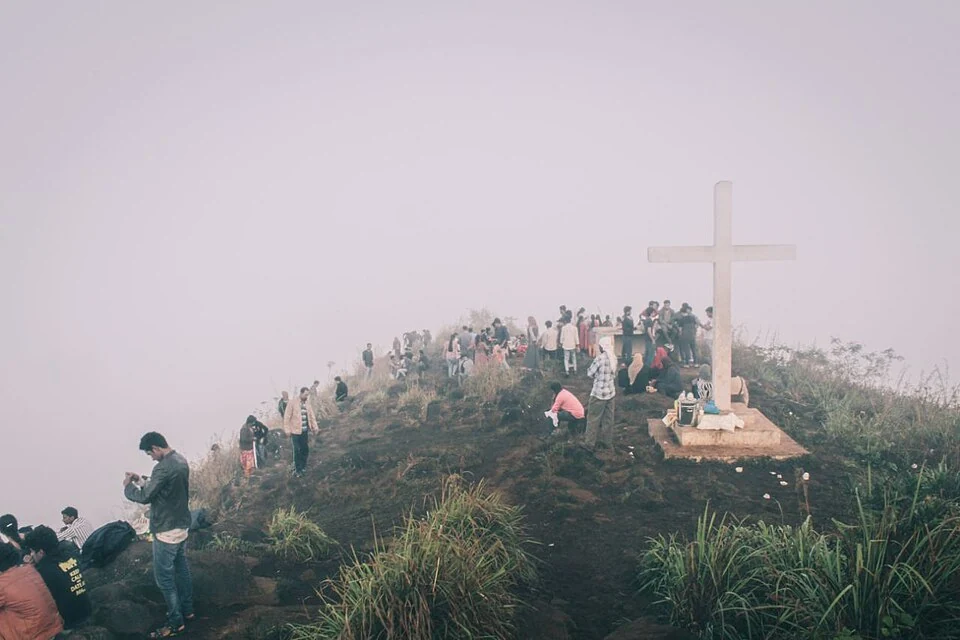
Visitors gather along a misty ridge beside a large white cross in a Kurumbalakotta photograph. It is a present-day scene of people using a high place, not a photograph of an excavated fort. That distinction is useful when approaching the historical stories attached to the hill.
More than one account survives
Kerala Tourism’s July 2014 article records a tradition that the hill held a fort of a Kurumbapaalakan, explained there as a king. It also mentions songs associating the fort with the Veda dynasty. These are strands of remembered narrative, not a precisely dated architectural record.
The current Kottathara Panchayat account gives another association: Kerala Varma Pazhassi Raja’s resistance to the British, with the hill described as a base for guerrilla activity. That is the local authority’s historical account and should be attributed as such.
Keep the accounts separate rather than joining every name into one uninterrupted fortress chronology. A hill can acquire several historical associations over time, and the survival of a story does not establish the date or location of a particular wall.
The view helps explain the lookout idea
Kurumbalakotta offers a wide prospect over surrounding country. Standing on permitted viewing ground, it is easy to understand why a high place might be remembered as a lookout. Visibility across fields and hills provides the physical setting in which such stories make sense.
That observation is an interpretation of the landscape, not proof of a specific military episode. Avoid naming an arbitrary patch of earth as a royal camp or a rock as a fort foundation without evidence tied to that feature.
The distinction makes the visit more interesting rather than less. It leaves room to discuss how geography shapes local memory while being honest about what the visitor can actually see. A panorama and a tradition can both be meaningful without an invented ruin connecting them.
Respect the hill’s present uses
The cross visible in the photograph is part of the contemporary ridge scene. Give religious markers ordinary respect, and allow space for people whose purpose differs from your own. A scenic visit does not make every object beside the path merely a prop for photographs.
The older tourism account also mentions a Bhagavathy temple in the broader descent itinerary. Any shrine visit should follow the real route and local access, not a desire to tick off every cultural reference from an article written years earlier.
Read the Kerala Tourism account together with the Kottathara Panchayat description. Their different emphases are worth retaining. The hill’s cultural story is richer when tradition, attributed history and visible present-day features each keep their own identity.
Plan the visit: Kurumbalakotta.