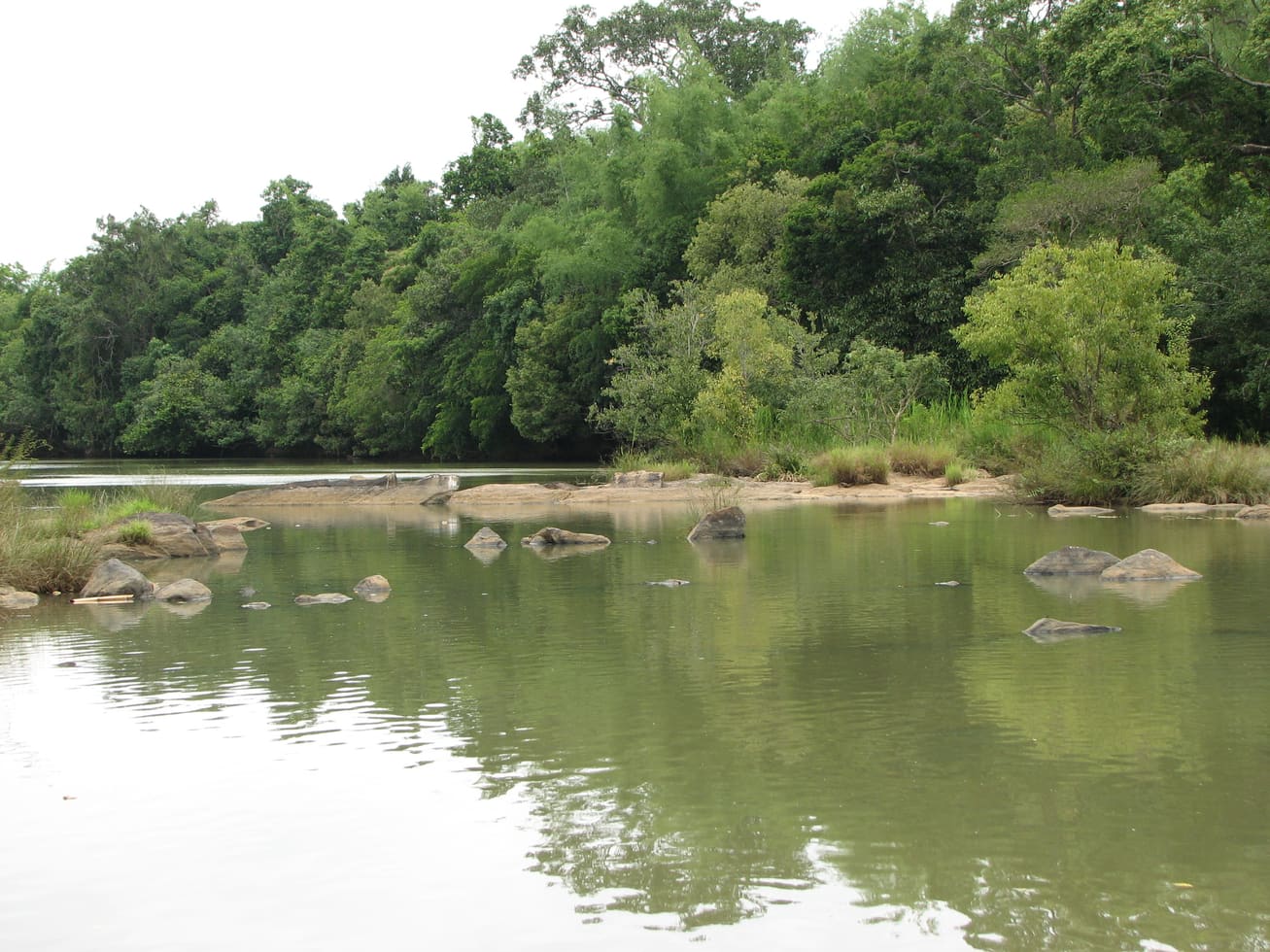
On the Kabini river, about 17 km east of Mananthavady, the water splits around a scatter of wooded islands that nobody lives on. This is Kuruva Island, or Kuruvadweep, and Kerala Tourism describes it as an uninhabited river island of about 950 acres in the middle of the Kabini. What looks from the bank like one island is really many, because The News Minute reported in 2021 that the group holds 64 islets, each covered in its own forest.
That forest is the reason the islands draw people, and it is also the reason their gates keep closing. Kerala Tourism lists dense trees, bamboo groves, rare orchids and medicinal plants under a shady canopy. It also names Malabar hornbills, parrots and kingfishers among the birds, along with butterflies and small mammals. The Forest Department, quoted by Onmanorama in September 2025, adds wild orchids and rare aquatic animals. A place this rich and this small cannot take crowds without damage. So for the last decade its story has been a long argument about how many people should cross the water each day.
The argument reached the courts in 2019. That March the Kerala High Court restricted entry at Kuruva, as well as at Chembra peak, Soochipara and Meenmutty. It acted on a petition from the Wayanad Prakruthi Samrakshana Samithi, an environmental group worried about the damage tourism was doing. The islands stayed shut for about two years. They reopened in April 2021, as The News Minute reported, once the court lifted its stay after the Forest Department said it had put protective measures in place.
Those measures came with a number. The Institute of Forest Genetics and Tree Breeding in Coimbatore studied the site and recommended a limit of 1,150 visitors a day. Even then, visitors could walk on only 20 hectares of a single islet, so most of the 64 islands stayed out of bounds. The Samithi's president, N. Badusha, argued that the carrying capacity study was not enough, which showed that the question was far from settled.
The islands closed again in 2024, and this time a death set it off. Onmanorama reported in October 2024 that the Kuruva Ecotourism Centre had closed after a High Court order on 17 February. That order followed the death of PV Paul, a man from Pakkam who was killed by an elephant. When the centre came back, the court cut the number of tourists allowed from 950 to 400. At first the Forest Department let people in only from the Pakkam side, and the Palvelicham entrance stayed closed.
That decision fell hard on the far bank. Onmanorama reported that hundreds of families on both banks of the Kabini depend on tourism, and Palvelicham's tourism workers said they had lost heavily while the centre was shut. One woman who ran an eatery there said she had relied on visitors for 15 years. So the people of Palvelicham formed an action council and pressed the district administration and the Forest Department to open both sides. After a meeting with the protesters, the authorities agreed to let 200 tourists a day enter through Palvelicham.
The river itself added one more kind of closing. Kerala Tourism says the islands open from October to May and close in the monsoon, from June to September, because heavy rain brings a risk of flooding. In 2025 the district administration shut Kuruva for more than three months of heavy rain. Onmanorama reported on 15 September 2025 that the ban had been lifted, after staff had cleaned the islands and the banks.
As of September 2025, Onmanorama put the limit at 488 visitors a day, split almost evenly between the Pakkam and Palvelicham entrances. Entry cost ₹247 a person. The rafts that once carried people across and down the river had not yet returned. That was because Chethalayam range officer M K Rajeevkumar said rafting would resume only after the strong currents eased. The Pakkam–Kuruva Forest Protection Samiti, a local committee, said it was ready to receive visitors.
All of this shapes what a visit feels like today. Because numbers are capped, a visit is a small, quiet one by design. On the islands, Kerala Tourism describes nature walks along marked trails, picnic spots with benches, and guided tours and nature talks run by the Forest Department. Swimming in the river is not allowed, and visitors carry their litter back out, which keeps the place in the condition that the whole fight has been about.
Most people come from Mananthavady, the nearest town, or from Kalpetta, about 45 km away according to Kerala Tourism. The drive often joins a morning at the river with an afternoon in the forests nearby. North of the river lies Tholpetty, where jeeps go into the same elephant country that cost PV Paul his life. Further on is Thirunelli Temple below the Brahmagiri hills.
The elephants that roam the Kabini banks do not stop at the river. They belong to a much larger forest that runs across Wayanad and over the state borders, and that forest has its own story. Follow it through the Wayanad Wildlife Sanctuary, or read the temple's tale in our Thirunelli story.
Frequently asked questions
Where is Kuruva Island?
It lies in the Kabini river, about 17 km east of Mananthavady and about 45 km from Kalpetta, according to Kerala Tourism.
How many people can visit Kuruva Island in a day?
As of September 2025, Onmanorama reported a limit of 488 visitors a day, shared between the Pakkam and Palvelicham entrances.
When is Kuruva Island open?
Kerala Tourism says it opens from October to May and closes in the June to September monsoon because of flood risk.
Why was Kuruva Island closed?
The High Court restricted entry in 2019 over environmental damage. The centre closed again in February 2024 after a man from Pakkam was killed by an elephant.