The largest temple complex near Chadayamangalam stands in a village that, for eight days in the autumn of 1938, declared it was not part of Travancore.
It started over a market toll.
The toll
A contractor named Abdul Razak held the right to collect toll from farmers selling at the Kadakkal market, and was collecting several times the amount actually due. Complaints went nowhere.
On 26 September 1938 a group of young Travancore State Congress sympathisers — Changuvila Unni, Beedi Velu and Mulakuthoppil Kunju — blocked the collection. Stones were thrown at the police outpost and the police withdrew to Kottarakkara.
Three days later, on 29 September, a magistrate's party arrived to find roughly a thousand demonstrators, described in the record as clad in khadar and wearing Gandhi caps. A head constable and a Daffadar were injured; the officials fled. The outpost was destroyed, the lockups broken open, the arms and provisions taken and the kitchen shed burnt.
And then they declared a country
Kummil Pakuthi — about fourteen square miles of it — was proclaimed independent.
The administration had a head of state and a head of government. Franco Raghavan, otherwise Puthiya Veettil Raghavan Pillai, became "Kadakkal Raja". And Chanthiran Kaliyambi, a Dalit man of the Kurava community, became "Janakiya Manthri" — the people's minister.
That second appointment is the one to hold on to. In 1938, in princely Travancore, an insurgent village made a Kurava man its minister.
They closed the schools. They posted a thousand volunteers. They broke up the roads to keep the military out. It lasted eight days.
What it cost
Five men died in custody: Beedi Velu, Ummini Sadanandan, Pangalkadu Narayanan, Mulakuthoppil Kunju and Parayattu Vasu.
Over eighty houses were destroyed and the recapturing force looted the village. Sixty-two accused were tried by a special magistrate at Kottarakkara, most receiving life sentences and forfeiture of property, the court holding that an attack directed against the police was tantamount to an attack against the Government. Adoor R. Parameswaran Pillai was held 141 days before he was tried at all.
Changanassery Parameswaran Pillai came to the village on 11 October 1938 at Gandhi's direction. He told The Indian Express three days later that "even common salt is not available for the people."
The Ministry of Home Affairs recognises the Kadakkal Revolt under the Swatantrata Sainik Samman Yojana of 1980. This is not local legend. It is on the Government of India's own list.
Why this is on a temple page
Because of what stands two years on either side of it.
On 12 November 1936 the Maharaja of Travancore issued the Temple Entry Proclamation, opening the state's temples to all Hindus regardless of caste. It is one of the landmark documents of Indian social reform, and the temples it covered were precisely this class: state-administered shrines of the kind that Kottukkal and the four Kadakkal temples still are, under the Travancore Devaswom Board.
Two years later, the same village that had just had its temples opened by the state made a Kurava man the minister of an administration that had rejected the state entirely.
Those two facts belong on the same page, and as far as we can find nobody has put them there. A proclamation from above and a rebellion from below, two years and a few hundred metres apart, both turning on who counts as a full member of a community.
What is there now
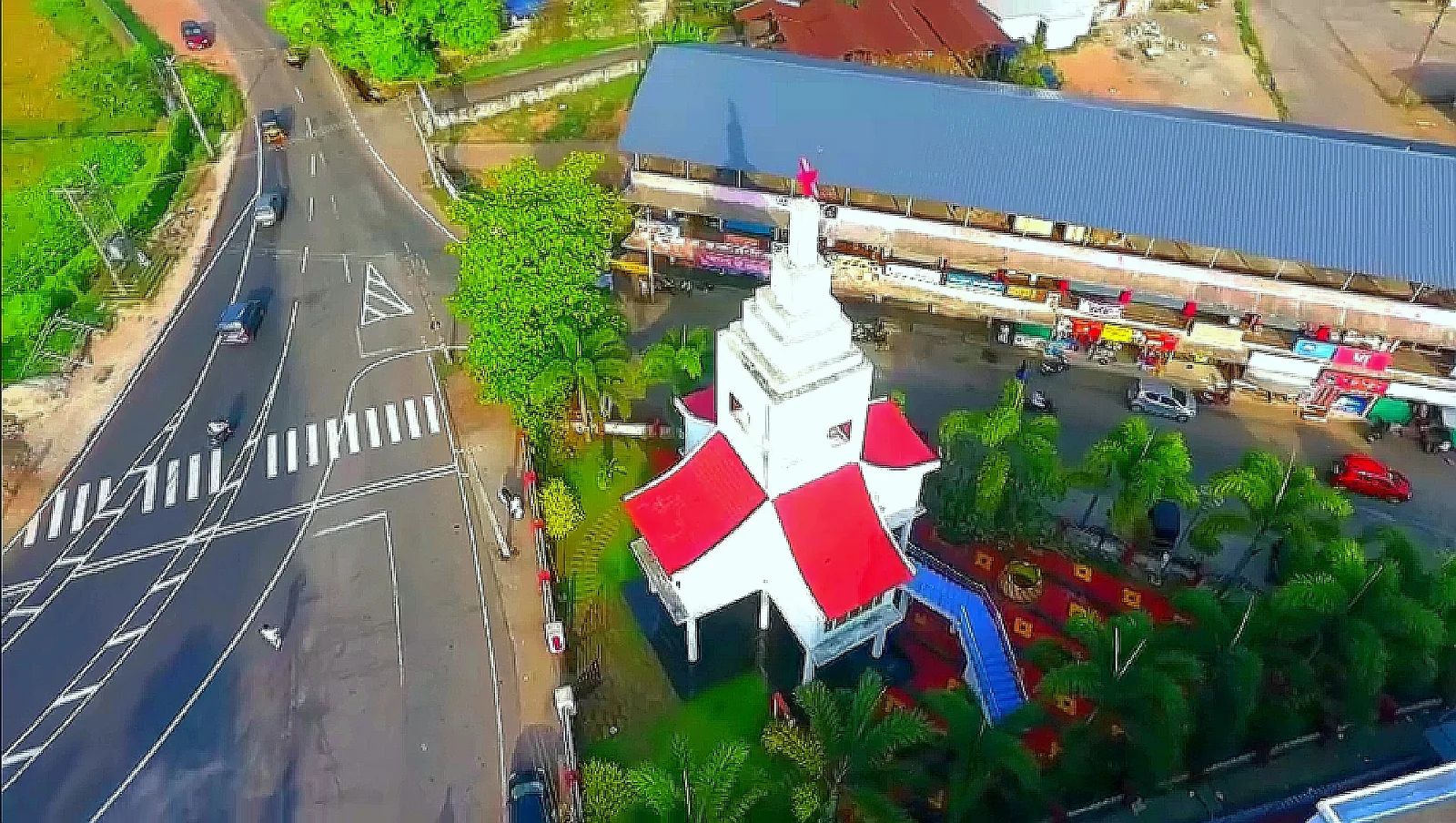
A memorial — the viplava smarakam — stands at the junction by the market: a white tiered tower with red and white pitched roofs and a red star at the top, in a small landscaped plot with traffic going past on both sides.
The star is not incidental. Kadakkal's politics did not stop in 1938, and the same village made news again in March 2025 when the Kerala High Court reprimanded the Travancore Devaswom Board over the temple festival, after film songs and party flags appeared at it — a temple festival, the reporting had the court say, and not a college annual day. We should be careful here: that account comes from news outlets and we have not read the order itself.
Which is its own kind of continuity. A village where the temple, the state and the party have been arguing about the same ground for the better part of a century, and are still at it.
Frequently asked questions
What was the Kadakkal Revolt?
An eight-day secession, 26 September to 5 October 1938, when Kummil Pakuthi — about fourteen square miles around Kadakkal — declared itself independent of Travancore after a dispute over excessive market tolls. It had a self-declared king and a people's minister, closed its schools, posted volunteers and broke up the roads.
Is it officially recognised?
Yes. The Ministry of Home Affairs recognises it under the Swatantrata Sainik Samman Yojana of 1980, the Government of India's scheme for the freedom struggle. There is also a 2025 paper on it in the World Journal of Advanced Research and Reviews — ⚠ whose text we could not extract, so we cite it as existing literature rather than quoting it.
Who was the Janakiya Manthri?
Chanthiran Kaliyambi, a Dalit man of the Kurava community, appointed people's minister of the self-declared administration. Franco Raghavan — Puthiya Veettil Raghavan Pillai — was named "Kadakkal Raja". The appointment of a Kurava man to that office in 1938 Travancore is the most striking single fact in the episode.
What happened to the people involved?
Five died in custody: Beedi Velu, Ummini Sadanandan, Pangalkadu Narayanan, Mulakuthoppil Kunju and Parayattu Vasu. Over eighty houses were destroyed and the village was looted by the recapturing force. Sixty-two were tried at Kottarakkara, most sentenced to life with forfeiture of property.
What does this have to do with the temples?
The Temple Entry Proclamation of 12 November 1936 had just opened Travancore's state-run temples to all Hindus regardless of caste — the class of temple that Kottukkal and the four Kadakkal shrines still belong to under the Devaswom Board. Two years later the same village made a Kurava man its minister. Both events turn on who counts as a full member of a community.
Can I see anything of it?
The revolt memorial stands at the junction by the Kadakkal market, a short walk from the temple complex. It carries a red star.