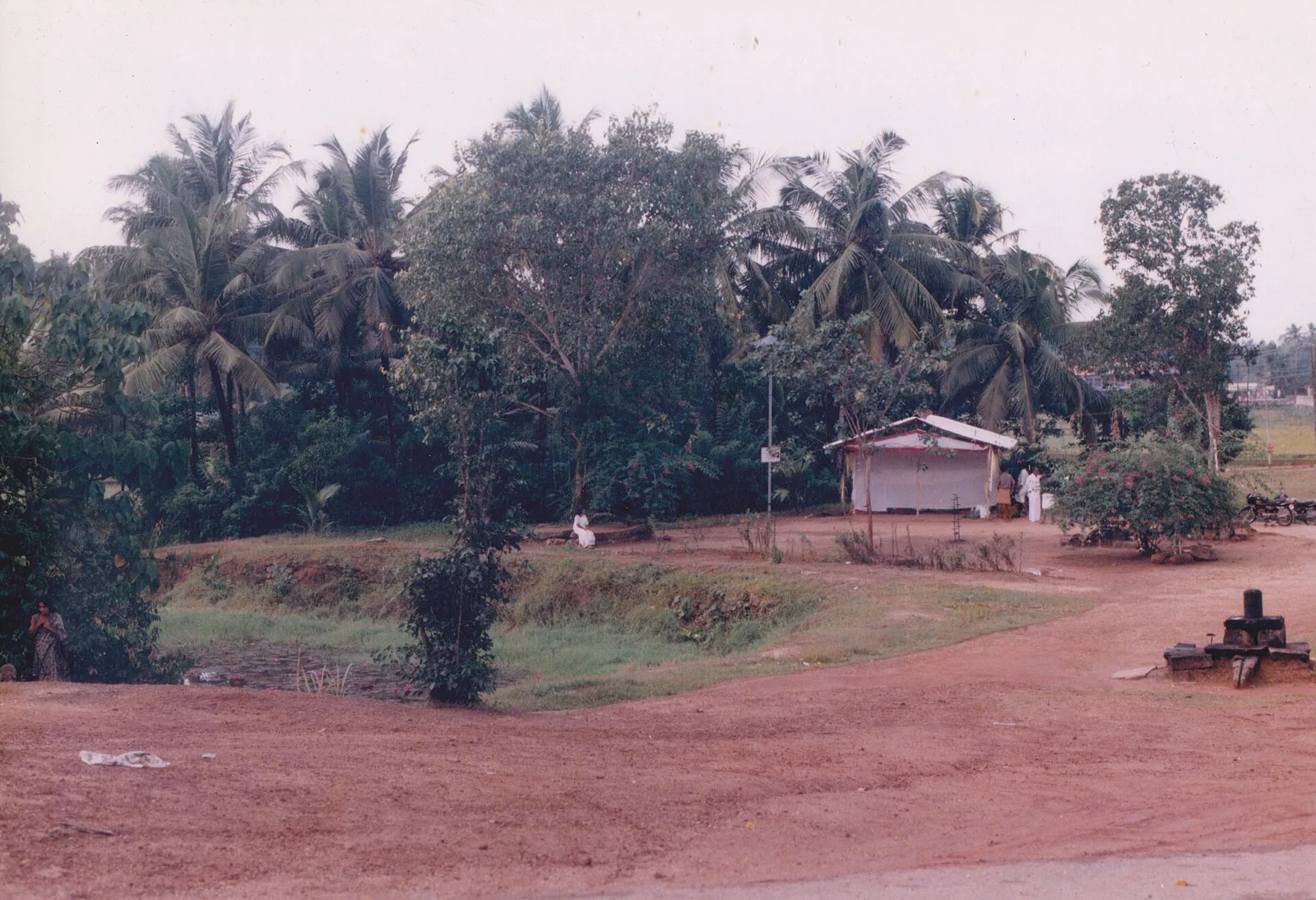
The shrines around Chadayamangalam are routinely tied to the Jatayu story, and that link is the reason most accounts give for visiting them.
We could not find a single named temple in this belt, other than the one standing on the rock itself, whose own tradition attaches it to Jatayu.
What is actually here is better, and it survives contact with a map.
This is kavu country
Within about nine kilometres of Chadayamangalam there are at least five sacred groves: Kilimarathukavu, Bharanikavu, Meeyana Nagayakshi Kavu, Appupankavu and Perootukavu.
A kavu is not a small temple. It is worship conducted in a stand of uncut forest — the grove itself is the shrine, and the trees are not landscaping but the thing being kept. It is an older form than the Brahminical temple, and historically it is the shrine type that non-Brahmin communities maintained when they were excluded from the other kind.
Five of them in one small area is a pattern, not a coincidence. And Kilimarathukavu, which is simultaneously a grove and one of the four temples of a Travancore Devaswom Board complex, is that entire history compressed into a single compound: the older layer absorbed rather than erased, still carrying its own name.
A serpent and a fighting hall
At Meeyana there is a nagayakshi kavu — a serpent shrine. Naga worship in Kerala is its own tradition, usually conducted in a grove at the corner of a family property, with its own iconography and its own rules about what may and may not be cut.
At Kadayattu there is a kalari temple — a shrine attached to the martial tradition, where the deity of a kalari is the deity of a training hall as much as of a village.
Neither is generic. You would not find this combination in an arbitrary nine kilometres of Kerala, and neither of them has anything to do with the Ramayana.
And a line of Sastha shrines pointing east
The other pattern in the list is a concentration of Sastha and Ayyappan shrines — Pattupurakkal Ayyappa Kshethram just west of the village, Dharma Sastha at Vayyanam, and more scattered through the belt.
That density is not random either. This is the western approach to the Sabarimala forest country, and a road that carries pilgrims tends to accumulate shrines to the deity they are walking towards. The religious geography here is partly a function of where people were going.
Under all of it, a cut rock
And then the oldest thing in the landscape, four and a half kilometres out: two rooms cut into a single laterite outcrop, facing east, each about ten feet by eight.
The Kottukkal cave temple is subtractive architecture — nothing was built here, material was removed. Both caves hold a monolithic Nandi and a Sivalinga; the larger has a pillared façade with two pillars cut from the living rock and a Ganapathi figure on a wall; the smaller has a standing Hanuman in a niche, hand on hip, carved in relief beside a wooden door.
The Kerala Department of Archaeology, which has protected it since 1966, reads that Hanuman not as a Ramayana site-claim but as the Nandi-Vanara episode of the Puranas. That is the protecting authority declining, in effect, to make the association our page was busy asserting.
It has its own page here, and it deserves it. What matters at belt level is the date: eighth or ninth century by the Department's reckoning, sixth to eighth by others. Either way it precedes everything else on this hillside, including the monumental sculpture, by more than a thousand years.
The layers, in order
Put them in sequence and the page writes itself. A rock cut for Shiva in the eighth or ninth century. Groves that are older in form than that, still being kept. A Devi temple whose sanctum has no image in it and whose worship right came from a bystander. A serpent shrine and a fighting hall. A line of Sastha temples pointing at Sabarimala. A Devaswom Board and a Department of Archaeology administering different aspects of the same buildings. A proclamation in 1936, a rebellion in 1938, and a High Court order in 2025.
None of that is a myth-cycle and all of it is checkable, which is the main thing the version of this page you would have read last week was not.
One name we are not printing
Our own map pin for this page sits about sixty-five metres from a mapped node labelled "Major Mahadeva Temple". The pin, as it turns out, is accidentally standing on an actual building.
We are not going to print that name. "Major" could not be verified in any source and reads like a transcription artefact, and a wrong proper noun published once becomes a wrong proper noun copied everywhere. There is a Mahadeva temple in the village. What it is properly called, we do not yet know, and saying so is better than guessing.
Frequently asked questions
So is there a Jatayu temple trail or not?
No. The Jatayu tradition attaches to the rock and to the place-name — Chadayamangalam is popularly read from Chatayan, the Malayalam form of Jatayu — and there is a Kodanda Rama temple on the rock itself with the Rama Padam footprint. The surrounding temples are dedicated to Shiva, Bhadrakali, Vishnu, Sastha, Ganapathi, a nagayakshi and a kalari. We asserted the trail eight times and could not support it once.
What is a kavu?
A sacred grove: the shrine is a stand of uncut forest rather than a building, and the trees are the thing being preserved. It is older in form than the Brahminical temple and historically the type non-Brahmin communities kept. There are at least five within nine kilometres here.
What is a nagayakshi shrine?
A serpent shrine. Naga worship is a distinct Kerala tradition with its own iconography and its own prohibitions, usually conducted in a grove. There is one at Meeyana, north-west of the village.
What is a kalari temple?
A shrine attached to the martial tradition — the deity of a kalari, or training hall, rather than of a settlement. Kadayattu Kalari Temple is the one in this belt.
Why are there so many Ayyappan temples here?
Because this is the western approach to the Sabarimala forest country. A route that carries pilgrims accumulates shrines to the deity they are travelling towards, and the Sastha and Ayyappan density along this belt reflects that.
What is the oldest thing here?
The Kottukkal rock-cut cave temple, 4.4 km ENE — two rooms cut into a single outcrop, dated by the Kerala Department of Archaeology to the 8th–9th centuries CE and by other sources to the 6th–8th. It has been a state protected monument since 1966 and it has its own page here.