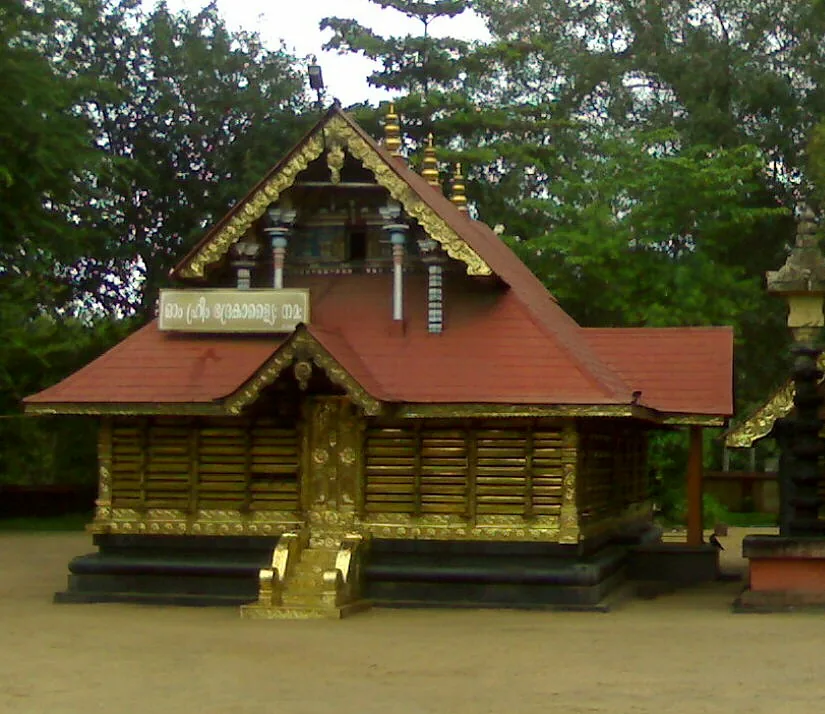
Most Kerala temples are organised around an image. The sanctum holds a murti, a priest of the appropriate lineage performs the daily rites for it, and everything else in the compound is arranged in relation to that centre.
Kadakkal is not organised that way. Its sanctum has no idol in it and the temple has no permanent priest. What the sanctum holds is a wooden peedika — a seat.
Four around a pond
The complex is four temples set equidistant around a central temple pond: the Devi temple, the Siva temple, the Thaliyil Mahavishnu temple and Kilimarathukavu. All four are separately mapped, and we found them on the map before we found the description, which is about as good as independent confirmation gets for something like this.
The arrangement itself is worth a moment. Four shrines placed around a single water body is a plan, not an accretion — somebody laid this out, or successive generations respected an original layout closely enough that it still reads as one.
Where the worship right came from
The tradition explains the empty sanctum, and it explains something more interesting than that.
The Devi is said to have come from Tamil country with four sisters. She killed a trader named Panayappan, who had exploited her family, and settled in the peedika. The Nettur Kurup witnessed it, and received her permission to perform the pooja.
Read that last sentence as a claim about authority rather than as a folk tale. The right to worship at Kadakkal descends from a permission given to an eyewitness — not from priestly descent, not from a ritual qualification, not from an endowment. Someone was there, and was asked.
That is a different theory of who may stand at a sanctum from the one operating at most major Kerala temples, and it survives in the physical arrangement: no image to be served, a seat instead, and a worship right founded on testimony.
The kavu in the complex
One of the four is Kilimarathukavu, and the suffix matters. A kavu is a sacred grove — worship in a stand of uncut forest rather than in a built temple. It is an older shrine form than the Brahminical temple, and historically it is the type that non-Brahmin communities kept.
So one of the four temples of a Devaswom Board complex is a grove. The older layer here did not get demolished and replaced; it got absorbed, and it kept its name. There are at least four more kavus within a few kilometres — Bharanikavu, Meeyana Nagayakshi Kavu, Appupankavu, Perootukavu — but Kilimarathukavu is the one where you can see both layers standing in the same compound.
A photograph of it before renovation shows what that means on the ground: a dense stand of trees, red laterite earth swept bare, a pond at the edge of the grove, a temporary shed and a small dark stone structure. Not a building with a shrine in it. A grove with a place in it.
Ten days in Kumbham
The festival is Kadakkal Thiruvathira, ten days in Kumbham — February or March — held on the Devi's birth nakshatra.
Day one is Pongala, with thousands of women cooking on the temple ground from about half past five in the morning. The festival opens with Kuthirayeduppu and Kuthiyottam and closes with Guruthi, which begins at midnight and runs to dawn.
One correction to how the horse procession is usually described, which we make because we looked at a photograph of it: the kuthira are not live horses. They are tall tiered lattice edifices, decorated and lit, carried in and stood up in a row — seven or more of them in one night shot, towering over a crowd of thousands. If you are picturing animals, you have the wrong image entirely.
Once in twelve years
And then the one worth planning around. The Thirumudi Ezhunnellathu carries the Devi's sacred circlet in procession to a sister temple at Anchal. It happens once every twelve years. It was held in 2002 and in 2015.
Which puts the next one in 2027 — inside the planning horizon of anyone reading this, and something almost no English-language page about Kollam district is going to tell them.
The modern turn
The complex is administered by the Travancore Devaswom Board, and in March 2025 the Kerala High Court reprimanded the Board over the conduct of this festival, after film songs and political flags appeared at it. The Board sought an explanation from the Temple Advisory Committee and Devaswom Vigilance investigated.
⚠ That account comes from news reporting rather than from the order or the Board, and we have not read either, so treat the court's wording as reported rather than quoted.
A temple whose sanctum is empty, whose worship right came from a bystander, whose festival is a row of lit towers at midnight, and which ends up in the High Court over a playlist — that is one of the more interesting religious institutions in Kollam district.
Frequently asked questions
Does the Kadakkal Devi temple really have no idol?
That is what the record says: no idol and no permanent priest, with a wooden peedika — a seat — in the sanctum. For a temple of this size in Kerala it is genuinely unusual, and it is the single most distinctive fact about the religious landscape around Chadayamangalam.
What are the four temples?
The Devi temple, the Siva temple, the Thaliyil Mahavishnu temple and Kilimarathukavu, set equidistant around a central temple pond. All four are separately mapped; Kilimarathukavu is the only one in the whole belt carrying a structured database record.
Who performs the worship?
The tradition holds that the Nettur Kurup, who witnessed the Devi killing the trader Panayappan and settling in the peedika, received her permission to perform the pooja. The worship right therefore descends from an eyewitness rather than from priestly lineage — which is a different theory of religious authority from the usual one.
When is the festival?
Kadakkal Thiruvathira, ten days in Kumbham (February–March) on the Devi's birth nakshatra. Pongala on day one from about 05:30, the Kuthirayeduppu and Kuthiyottam at the opening, and Guruthi from midnight to dawn at the close. Dates move with the Malayalam calendar.
Is the Kuthirayeduppu a horse procession?
Not with live horses. The kuthira are tall tiered decorated edifices, lit up and carried in — photographs of the festival show seven or more of them standing over a crowd at night. The English translation "horse procession" misleads badly.
What is the Thirumudi Ezhunnellathu and when is it next?
A procession carrying the Devi's sacred circlet to a sister temple at Anchal, held once every twelve years. It took place in 2002 and 2015, so the next is due in 2027.
Can non-Hindus enter?
These are Travancore Devaswom Board temples, and Board practice restricts sanctum entry to Hindus; signs to that effect are standard. Dress is the statewide TDB convention — mundu and no upper garment for men in the inner area, sari, set-mundu or salwar for women, no shorts.