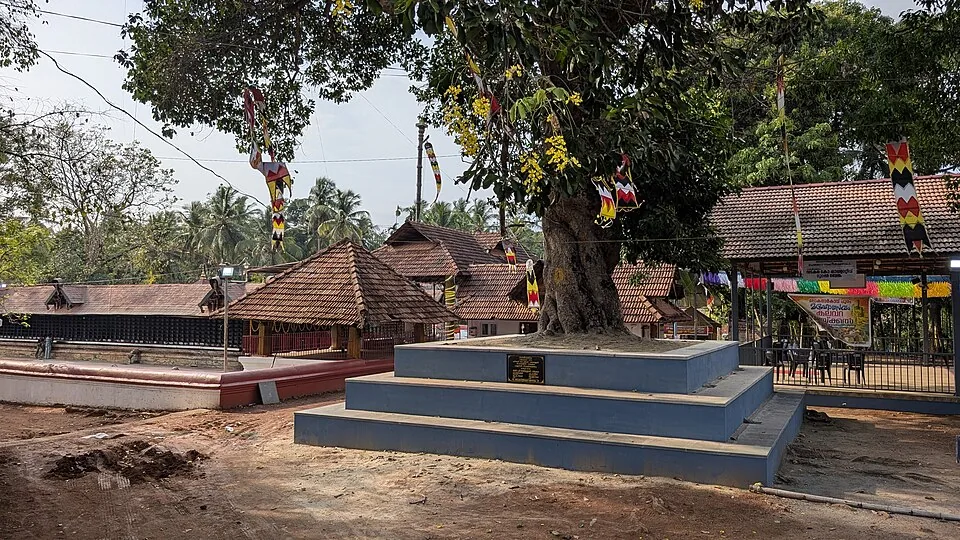
The martial reputation of Lokanarkavu is not atmosphere. This temple sits at the centre of a district where disputes between chieftaincies were once settled by contracted duel, and the shrine, the duelling platform and the training hall were parts of a single working system.
Ankam: a legal institution, not a brawl
The ankam was formal. When two parties in feudal North Malabar reached an impasse over territory, honour or inheritance, the matter could be referred to a regulated combat rather than to open warfare between their followings. Champions were contracted for the purpose, drawn from the martial families of the region — the Chekavar warrior communities among them. Terms, payment and the consequences of the outcome were agreed in advance, and the fight took place before witnesses.
It was staged on an ankathattu, a raised platform built for the occasion, and these were frequently erected near temples such as this one. The location was not incidental. A duel that settles a legal dispute needs to be public, witnessed and sanctified; a temple precinct supplies all three.
Seen this way, the system looks less like barbarism and more like an alternative to it. Substituting two contracted fighters for two armed followings is a method of containing violence, not of celebrating it — a recognisable piece of legal engineering, of the kind that societies without a strong central state tend to invent.
The goddess in the machinery
This is why the ballad heroes keep arriving at Lokanarkavilamma’s door in the songs, and why the temple’s association with them is structural rather than decorative. A man about to fight a duel on which his family’s standing and quite possibly his life depended came to the goddess first. The shrine beside the duelling ground was part of how the institution worked.
It also explains the character of the deity. Lokanarkavilamma is Bhagavathy, Durga — a goddess who both nurtures and destroys, and whose worship across North Malabar has always had an edge to it that gentler devotional traditions do not. A war-goddess is what a society organised around contracted combat requires.
Kalaripayattu, still here
The training system behind all this survives. Kalaripayattu — the martial art of Kerala, practised in a sunken earthen-floored kalari, combining strikes, grappling, weapons and a body of associated healing knowledge — is taught across this region today, and Vadakara and its surrounding villages are among its heartlands.
Practitioners frequently maintain a devotional connection to this temple, and the link is not a marketing exercise; it is a continuous thread running back to the world the ballads describe. Several kalaris in the area accept visitors for demonstrations, and a good demonstration is a genuinely startling thing to watch — the weapons work in particular is fast in a way that film choreography does not prepare you for.
Seeing it at festival time
The connection surfaces publicly during the temple’s festival calendar. The forty-one-day Mandala lamp season and the Pooram festival bring performance into the courtyard, including Thacholikali and other martial folk forms that dramatise the ballad material. If your interest is in this side of the temple, that is when to come — the stories are performed on the ground they belong to, rather than described.
Dates move with the Malayalam calendar, so confirm locally before planning a trip around them. Outside festival periods the grove is quiet, which has its own considerable merits, but the martial dimension is then something you have to reconstruct rather than watch.
What survives, and what does not
The duels are gone, obviously, and have been for a long time — the ankam belonged to a political order that the colonial state dismantled. What survives is the training tradition, the temple, the songs and the memory of the arrangement that connected them.
That is a more interesting inheritance than a ruin would be. Standing in the grove you are not looking at the remains of something finished; you are standing in a place where one part of a system is still fully alive, another is performed once a year, and the third exists only in verse. Sorting out which is which is much of what makes a visit here worth the detour inland from the coast. The rest of the district is on the Kozhikode hub.
Why a society builds a system like this
Institutions like the ankam appear where political authority is fragmented. Medieval North Malabar was a landscape of chieftaincies with overlapping claims and no single power able to impose a settlement from above, and in that situation every dispute carries the risk of escalating into a feud that neither side can afford. A contracted duel caps the cost. Two men fight instead of two followings, the outcome is agreed in advance to be binding, and the matter is closed.
Comparable arrangements turn up in medieval Europe, in Japan and elsewhere, and they tend to disappear at the same historical moment — when a central state becomes strong enough to insist that it alone may authorise violence. That is exactly what happened here. The colonial administration did not merely disapprove of the ankam; it removed the political conditions that made it necessary.
What kalari training actually involves
The training system deserves more than a passing mention because it is far broader than combat. A kalari is a sunken pit with an earthen floor, entered with the head uncovered and the feet bare, and instruction runs through a long sequence: body conditioning and stretching first, then unarmed sequences, then wooden weapons, then edged steel, in an order that can take years to work through.
Attached to it is a substantial body of medical knowledge — massage, bone-setting and treatment of injury — which was the practical necessity of any system that regularly damaged its practitioners, and which survives in the region as a living therapeutic tradition in its own right. A gurukkal is therefore as likely to be consulted about a back injury as about a technique.
Watching it properly
If you arrange a demonstration, a few things will improve it. Ask to see the empty-hand sequences before the weapons, because the weapons are so spectacular that they make everything else look like preparation, which is the reverse of how the training is organised. Watch the feet rather than the hands. And expect the whole thing to be much faster and much less decorative than screen depictions have led you to believe — the flourishes that film adds are precisely what the discipline strips out.