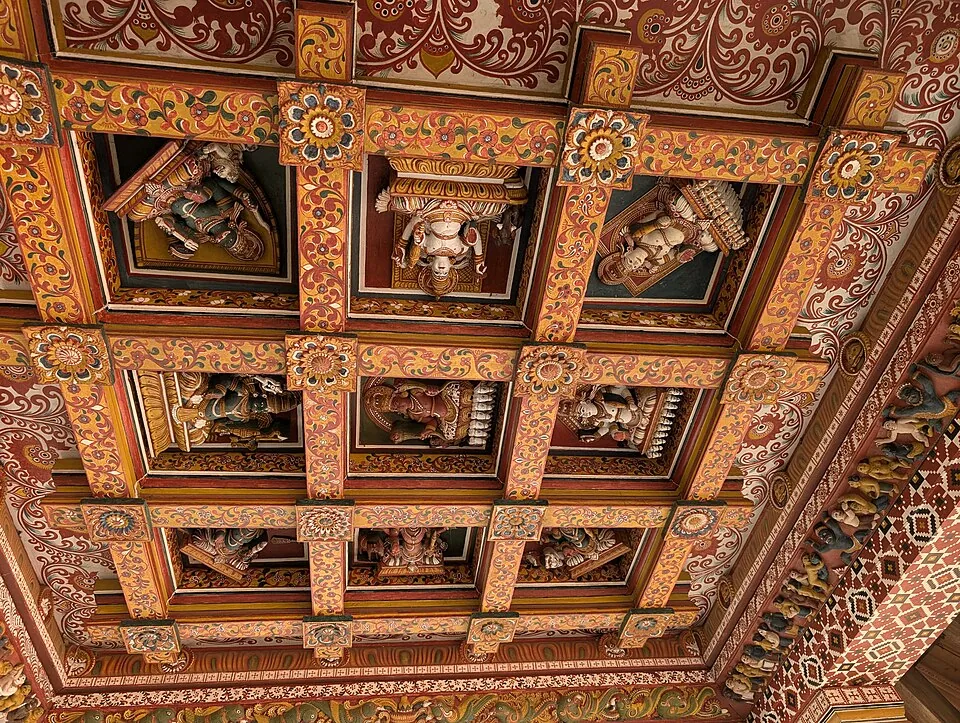
Stand in the grove at Lokanarkavu near Vadakara and someone will tell you about the heroes of the Vadakkan Pattukal — Thacholi Othenan, Unniyarcha, Aromal Chekavar — and about Chandu, the man who betrayed him. If they tell you Chandu was misunderstood, wronged, a decent man crushed by circumstance, then what you are hearing is not the ballad. It is a film script from 1989.
What the ballads say
The Vadakkan Pattukal are the Northern Ballads: Malayalam oral folk poetry from the medieval period, sung across North Malabar and transmitted by singing communities over many centuries before being collected and printed comparatively recently. They tell of warrior families, honour, contracted duels and spectacular violence, and this temple appears in them repeatedly as the shrine the heroes visit.
In that tradition, Chandu — Chanthu — is a villain, and not an ambiguous one. He is the cheat whose treachery brings about the death of Aromal Chekavar. That was his character for as long as the songs were sung. Nobody in the ballad audience was invited to sympathise with him.
What happened in 1989
On 14 April 1989 a Malayalam film called Oru Vadakkan Veeragatha was released, with a screenplay by M. T. Vasudevan Nair and directed by Hariharan. It took the same episode and retold it from Chandu’s point of view. In the film he is not a traitor but a good man — misread, disadvantaged, driven by circumstances the ballad had never bothered to give him.
The film was a considerable critical success. It won four National Film Awards, including Best Screenplay for Nair and Best Actor for Mammootty, and eight Kerala State Film Awards. It has remained a landmark of Malayalam cinema ever since.
The reversal took
And that is the remarkable part. A single screenwriter overturned the moral verdict of a centuries-old oral tradition, and the new verdict stuck. Ask people across Kerala about Chandu today and the sympathetic version is very often the one you will get — a reading that is about thirty-five years old, not the one that was sung in these villages for generations.
There is no deception involved. The film never pretended to be the ballad; reinterpretation was its entire artistic purpose, and it is a legitimate and much-admired piece of work. What is striking is simply how completely a popular retelling can displace the source in collective memory, and how fast — well within the lifetime of people still living in the district.
Why this matters at the temple
Because Lokanarkavu is where the ballad tradition is most physically present, and because the layers are not labelled. A visitor hearing the stories in the grove is receiving, in one undifferentiated stream, medieval oral poetry, later literary retellings, twentieth-century cinema and present-day local pride. All of it is worth hearing. Very little of it is distinguished as you receive it.
Holding the layers apart makes the place more interesting rather than less. The temple’s association with the ballads is genuinely old. The particular emotional colouring that most modern visitors bring to those ballads is genuinely new. Both facts are true at once, and noticing the join is most of the pleasure.
How much of it is history?
Less securely than the confident tellings suggest. Whether Othenan, Unniyarcha, Aromal and the rest were real fighters, poetic inventions, or compressed memories of actual warrior clans is unsettled, and firm biographical claims about them should be treated with caution. Oral traditions of this kind absorb, merge and reshape their subjects across centuries; that is what they are for.
What is not in doubt is the social world the songs describe. Feudal North Malabar did settle disputes by ankam, the formal contracted duel, and the kalari martial tradition that trained those fighters is still practised in this district today. The framework is historical even where the individuals are uncertain.
What to do with all this
Listen to everything you are told, and then ask which layer it comes from. If a detail is vivid, emotionally satisfying and psychologically modern, there is a fair chance it entered the tradition recently. If it is blunt, violent and morally uncomplicated, it is probably older. Neither is more valuable than the other, but they are different things, and Lokanarkavu is one of the few places where you can stand in one spot and hear several centuries of storytelling arriving at once. The rest of the district is on the Kozhikode hub.
Why retellings win
It is worth asking why the film version displaced the ballad so completely, because the answer is not simply that more people watch films than listen to folk songs. The deeper reason is that the two forms want different things from a character. Oral heroic poetry is not interested in interiority; it deals in deeds, oaths, betrayals and consequences, and its villains are villains because of what they do. A modern screenplay is interested in almost nothing else but interiority, and once you ask why a man acted as he did, the moral verdict is already unstable.
Chandu was therefore extremely vulnerable to reinterpretation. The ballads gave him an action and no motive. Supply a motive — social disadvantage, thwarted affection, a slight never redressed — and the same action reads completely differently without a single fact being changed. That is what the 1989 screenplay did, and it is why the reversal felt less like contradiction than like completion.
The pattern is not unique
This has happened to traditional villains all over the world, and usually in the same direction: from condemned to sympathetic, as audiences acquire an appetite for psychological explanation. What makes the Kerala case unusually clean is the compression. The transformation is datable to a single work with a single release date, its author is known, the awards it won are on record, and the older version is still recoverable in the songs. Most such shifts happen slowly and untraceably. This one has a receipt.
It also happened close enough to the present that both versions are alive simultaneously. There are people in this district who learned the ballad version first and watched the film later, and who can therefore hold the two accounts side by side — which is a rare and quickly closing window.