For a sanctuary of seventy-four square kilometres notified only in 2009, Malabar carries a remarkable density of type localities — the places where a species was first collected and formally described. Three organisms have this forest written into their scientific identity, and together they make the case for the sanctuary far better than a species count does.
The frog that lives inside a bamboo
Raorchestes ochlandrae, the Ochlandra reed frog, was described in 2007 with its type locality at Kakkayam Reserve Forest. It is small — males 22 to 26 millimetres, females about 23 — squat and flattened, with golden-yellow bands edged in dark brown running from the upper eyelid down the flanks.
What makes it a story is where it lives. It is found in dense stands of the reed bamboo Ochlandra setigera at forest edges, between about 600 and 1,000 metres. And it does not merely perch on the bamboo. It lives inside it, in the hollow internodal chambers of the culm, two to three metres off the ground. The species epithet is a formal scientific statement that this animal cannot be separated from that one plant.
It has since been recorded at other Western Ghats sites, so the line you will still find in 2010-era copy — that it is known only from Kakkayam dam site — is superseded. The type locality is the claim that does not expire.
The termite that proves the deadwood works
Glyptotermes chiraharitae is a dampwood termite described in 2016, with its type locality given as Malabar Wildlife Sanctuary itself. The epithet means ever-green, for the forest it was found in.
A dampwood termite is not a charismatic animal and it is a very useful one, because it is an indicator. It needs decaying wood held at high moisture, which in practice means closed-canopy evergreen forest with a functioning deadwood cycle — trees falling, staying wet, and rotting on the slope where they fell rather than being cleared. Its discovery six years after the sanctuary was inaugurated is evidence that the least glamorous habitat in the place was doing its job.
The frog that is known from nowhere else
Raorchestes kakkayamensis, the Kakkayam shrub frog, is the one that puts the place-name in the binomial. It was described in 2021 from an adult male collected at Kakkayam at around 750 metres, found on leaf litter and on vegetation a metre or three above the ground.
Two things about it are worth holding onto. Its type locality lies north of the Palghat Gap, the great biogeographic break in the Western Ghats, either side of which shrub frog lineages have been diverging for millions of years — so it is not merely a local variant of something southern. And the IUCN lists it as Data Deficient, known only from its type locality.
Set that against the legal position. A frog that has never been found anywhere on Earth except this forest was described to science in 2021, and the forest it lives in is held by a declaration of intention issued in 2009 that has never been finalised.
The wider inventory
The management plan prepared for the Northern Region and reported in March 2010 gives figures that are internally consistent in a way copied lists usually are not: 680 flowering plants of which 226 are Western Ghats endemics; 41 mammals with 6 endemics; 179 birds with 10; 36 reptiles with 12; 38 amphibians with 26; and 52 fishes with 8. Note the amphibian ratio — twenty-six of thirty-eight endemic — which is what the three type localities are a symptom of.
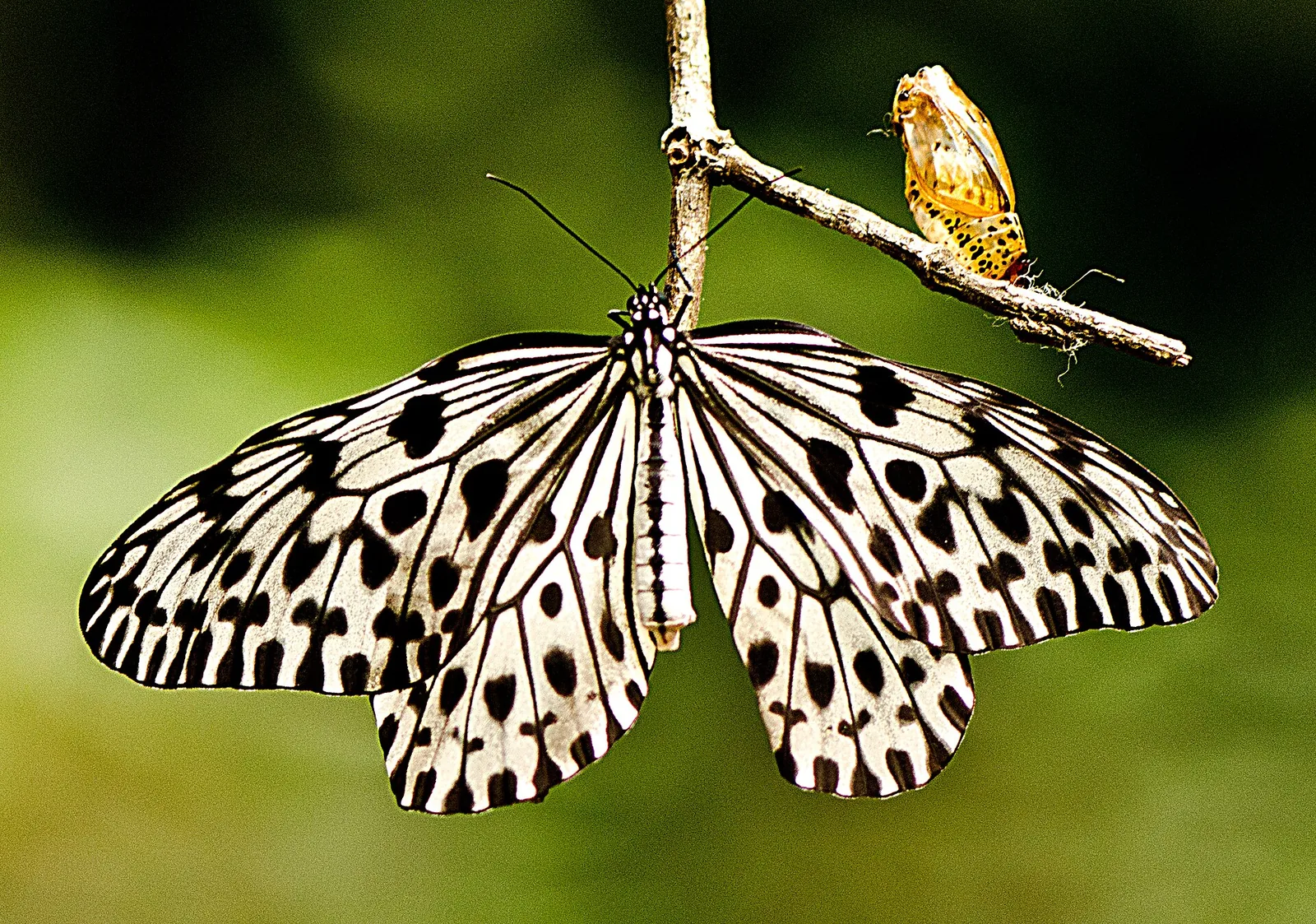
The six endemic mammals are named the same way across sources: lion-tailed macaque, Nilgiri langur, brown palm civet, stripe-necked mongoose, dusky palm squirrel and Malabar spiny dormouse. The Malabar Natural History Society records 94 butterflies here, twelve of them legally protected, with the Malabar tree nymph, Idea malabarica, as the flagship. Among birds, the Wayanad laughing thrush, Malabar parakeet, grey-headed bulbul, white-bellied blue flycatcher and small sunbird are all on the list.
A couple of numbers drift between sources and are better given as ranges than as facts: the bird count is 179 in the management plan and about 180 including fourteen migratory species in the inauguration reporting, and one local account gives twelve endemic birds against the plan’s ten.
And one thing this page will not do, because the temptation is obvious. Tiger, leopard, elephant and gaur are all on the recorded list, and the boat operator’s copy at the dam promises visitors will view herds of elephants and bison grazing in the catchment. There is no safari here, no game drive and no wildlife-viewing programme of any kind. Any sighting is incidental to a waterfall walk or a boat ride, and that promise is an electricity board’s marketing rather than an ecology statement.
Frequently asked questions
What species were first described here?
Three: the Ochlandra reed frog Raorchestes ochlandrae (2007), the dampwood termite Glyptotermes chiraharitae (2016) and the Kakkayam shrub frog Raorchestes kakkayamensis (2021).
Is any of them found only here?
The Kakkayam shrub frog is, as far as anyone knows — the IUCN lists it as Data Deficient and known only from its type locality. The reed frog has since been found at other Western Ghats sites.
Why does a frog living inside bamboo matter?
Because it ties the animal to one plant. Raorchestes ochlandrae lives in the hollow internodes of the reed bamboo Ochlandra setigera, two to three metres up, and the species epithet records that dependence formally.
Can I go and look for these?
Not in the sanctuary. There is no independent entry, no permit and no wildlife programme. The only walking open to visitors is the Forest Department’s roughly one-kilometre trail to Urakkuzhi Falls from the dam site.