Below the great embankment of Malampuzha Dam, among the fountains and clipped lawns of Kerala's largest reservoir garden, a woman lies stretched against the sky. She is enormous — some thirty feet of her — her legs parted, her breasts lifted, her eyes half-closed towards the clouds and her fingers lost in her hair. She is the Yakshi, sculpted by Kanayi Kunhiraman, and for more than half a century she has been the single most recognised — and most argued-over — piece of modern art in the state. Tourists photograph her by the thousand; moralists periodically demand she be draped. She has outlasted every attempt to make her behave.
The man who carved her
Kanayi Kunhiraman was born in 1937 in Kuttamath, in the far north of Kerala's Kasaragod district. He trained in sculpture at the Government College of Fine Arts in Chennai under the celebrated painter K. C. S. Paniker, and then won a Commonwealth Scholarship that took him to the Slade School of Fine Art in London in the mid-1960s. He returned home steeped in modernism but reaching, always, for the myths and forms of his own soil. He would go on to become one of Kerala's towering public sculptors — the man behind the vast Sagarakanyaka, or mermaid, on the sands at Shanghumugham in Thiruvananthapuram — before his death in 2022. But it was his very first major public commission that made his name.
That commission was the Yakshi, completed in 1969, not long after he came back from London. Working in concrete, he built her as a single reclining colossus set into the Malampuzha garden below the dam. The figure was unlike anything Kerala's public spaces had seen: monumental, frankly nude, and unmistakably sensual. It announced a new kind of Indian public art — one that borrowed the swelling, fertile forms of ancient temple sculpture but planted them, unapologetically, in a modern pleasure garden.
The yakshi of Kerala legend
To understand why the sculpture provokes such strong feeling, it helps to know who a yakshi is in the stories of the land. In Kerala folklore — and here we are firmly in the realm of legend, not record — the yakshi is a beautiful and dangerous female spirit. As the tales are told, she appears to a lone traveller at night, ravishing to look upon, and asks for a little slaked lime, or chunnambu, to chew with her betel. The man who follows her is said never to be seen alive again; by morning only bones are found beneath the pala tree, the fragrant Indian devil-tree with which she is forever linked. She is desire and death folded into one figure — the seductress who is also the destroyer. Generations of Malayalis grew up on these stories, and the word yakshi carries all of that charge.
Yet Kanayi always insisted his Yakshi was not that demoness of the horror tales. He described her, rather, as a celebration — of fertility, of the feminine, of nature's abundance and the life-force itself, closer to the earth-goddesses and fertile tree-spirits of ancient Indian art than to any bloodthirsty ghost. His Yakshi does not lure and kill; she simply is, vast and serene and utterly at ease in her own body. That gap — between the menacing spirit of legend and the artist's radiant emblem of life — is part of what has always made her hard for people to read.
- Sculptor: Kanayi Kunhiraman (born 1937), one of Kerala's foremost public sculptors.
- Completed: 1969, in concrete; it was his first major public commission.
- Height: commonly cited as around 30 feet / roughly 9 metres (figures vary between sources — treat as approximate).
- Where: the landscaped garden below Malampuzha Dam, near Palakkad, Kerala.
The row that never quite ends
The Yakshi was controversial from the moment she was conceived. Traditionalists who saw only nakedness were outraged that such a figure should stand in a public garden, and the objections reportedly grew ugly — the sculptor is said to have faced threats over the work as it went up. That a young artist held his nerve and finished her anyway is a large part of the legend that has since grown around the piece itself.
And the argument has never fully died down. Decades on, the Yakshi is still capable of igniting a fresh row — over a tourism department social-media post, over the old complaint that she is indecent, over whether a public statue should be so unashamedly sexual. In 2019, marking fifty years since she was completed, the Kerala government publicly honoured Kanayi for the work — a fitting turn for a sculpture once denounced as a scandal and now claimed as a cultural landmark. She has become a kind of barometer of the distance between how artists see the body and how the wider public does. The debate, in other words, is now part of the monument.
Seeing the Yakshi: the garden, dam and ropeway
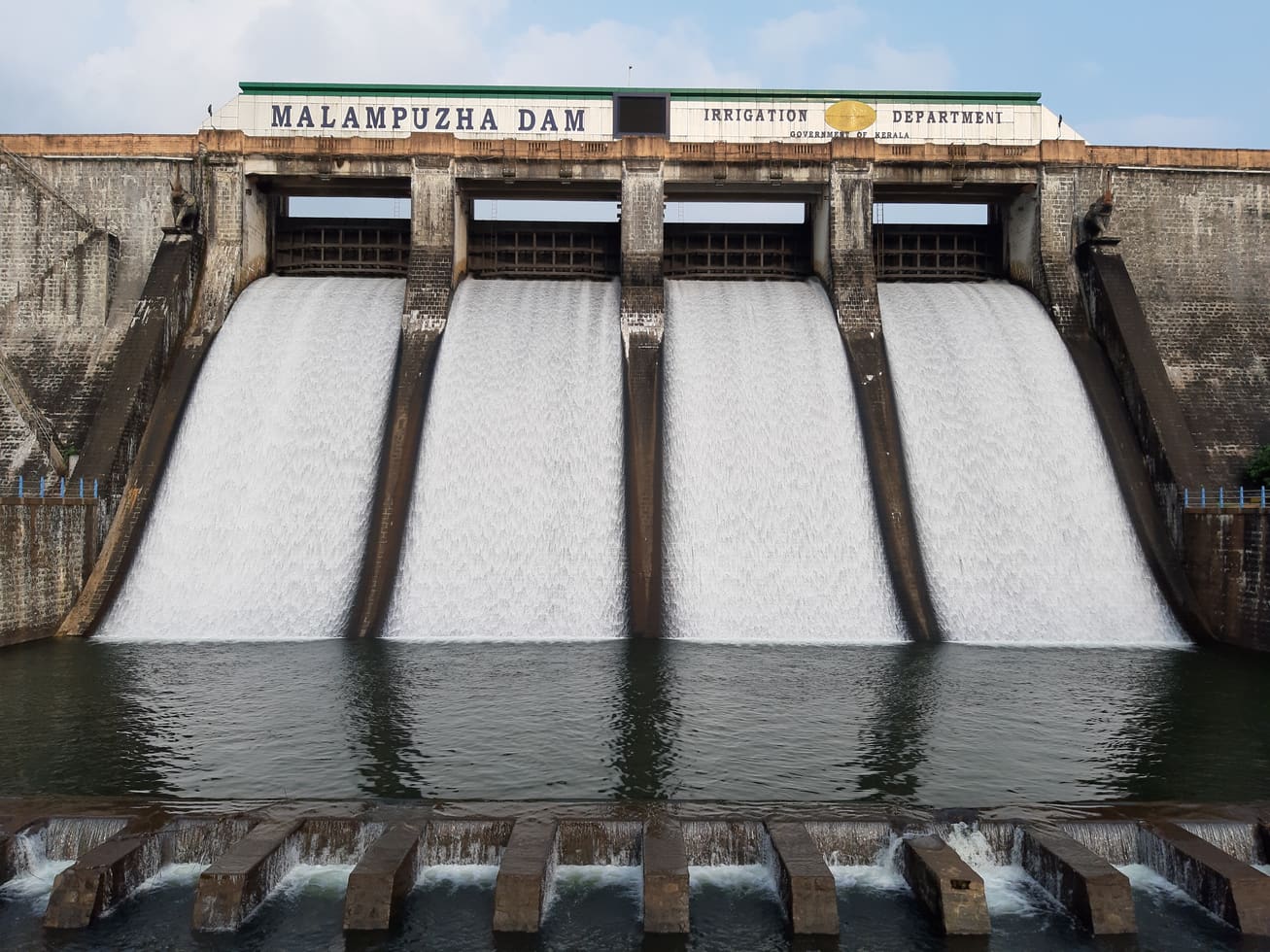
The Yakshi does not stand alone. She is the presiding figure of the Malampuzha garden, laid out below the largest reservoir in Kerala, whose dam was built in the 1950s across the Malampuzha river, a tributary of the Bharathapuzha. The garden is famous for its fountains and terraced flowerbeds, for an aerial ropeway that carries visitors over the greenery for a panoramic view of the dam, and for a whimsical rock garden built from recycled scrap — bangles, tiles, broken pots and tins — in the spirit of the Chandigarh rock garden. Come for the water and the ropeway; stay for the woman on the hill who has watched over it all, unbothered, since 1969. Opening hours and entry and ropeway charges change from time to time.
Frequently asked questions
Who made the Malampuzha Yakshi statue?
The sculptor Kanayi Kunhiraman (born 1937), one of Kerala's most celebrated public artists, who also created the Sagarakanyaka mermaid at Shanghumugham in Thiruvananthapuram. The Yakshi, completed in 1969, was his first major public commission.
What is a yakshi in Kerala folklore?
In legend — and it is legend, not history — a yakshi is a beautiful, dangerous female spirit who is said to appear to lone men at night, often near the pala tree, and lead them to their deaths. Kanayi, however, described his sculpture not as that demoness but as a celebration of fertility, femininity and the life-force.
Why is the sculpture controversial?
Because she is monumental and frankly nude. From the start, traditionalists objected to a large naked figure in a public garden, and the sculptor reportedly faced threats. The Yakshi still sparks periodic rows — yet in 2019 the state government honoured the work on its fiftieth anniversary.
What else is there to see at Malampuzha?
The Yakshi sits within the Malampuzha garden below Kerala's largest reservoir dam. The site is known for its landscaped fountains, an aerial ropeway with views over the dam, and a rock garden built from recycled materials. Check current timings and charges locally before visiting.