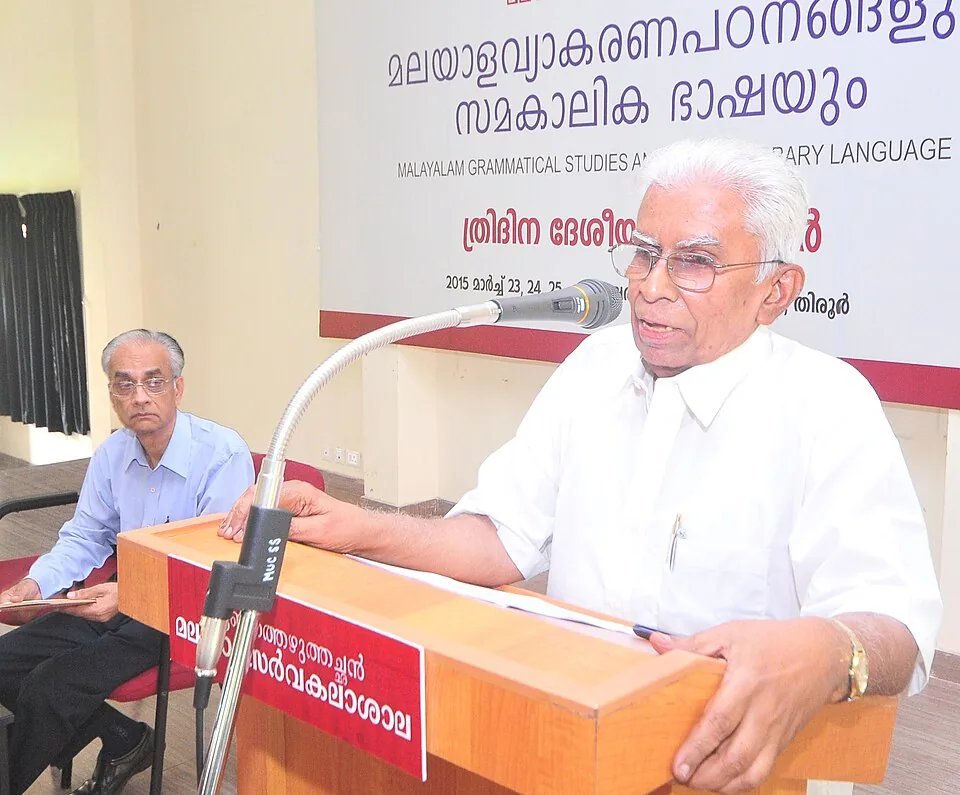
Kerala’s literacy is near-total and its public life is conducted in Malayalam, but its higher education has run in English for as long as it has existed. A student who thinks in Malayalam has had to change languages at exactly the point where the thinking gets hard. Thunchath Ezhuthachan Malayalam University, at Vakkad on the flat coastal land west of Tirur, was created to remove that switch.
Founded on nothing
It was created by ordinance in 2012 and inaugurated on 1 November that year by the chief minister, Oommen Chandy. At inauguration it had no land and no buildings; its offices ran out of the premises of the Thunchan Memorial Government College in Tirur. Teaching began the following year from an interim campus at Vakkad given the name Aksharam — a word that means a letter of the alphabet, and also the imperishable. A university with no address named its first one after the indestructible thing it was there to look after.
Its first vice-chancellor was K. Jayakumar, a retired chief secretary of Kerala who had written the project report that argued the university into existence and then had to build it.
The vocabulary problem
Nobody doubts that Malayalam can carry a discussion of Malayalam literature. The hard part is everything else, and the subject list reflects it: master’s degrees in journalism and mass communication, cultural heritage studies, environment studies, development studies, history, sociology and film studies, alongside linguistics and literature. Those are the fields where the terminology gap is widest.
So a good deal of the university’s effort goes into making the words. The Ezhuthachan study centre is compiling a lexicon of the poet the place is named for; an online Malayalam dictionary is in progress; there is a language technology centre, a heritage survey and a linguistic survey with a museum project attached. None of that is visible to a visitor walking across the campus, which is the ordinary condition of a research institution.
The recognition arrived while the first campus was still being built: Malayalam was designated a classical language of India in 2013, a status given on the antiquity and independence of a literary tradition. The university had been founded on the assumption.
A chair in Swabia
The university endows a Hermann Gundert Chair at the University of Tübingen in Germany, and the choice is not arbitrary. Gundert was a Württemberg missionary who reached Madras in 1836, settled in Kerala in 1838 and spent about twenty years at Thalassery up this coast. He founded Rajyasamacharam, the first Malayalam newspaper, in June 1847, and in 1872 published the Malayalam–English dictionary that still underlies Malayalam lexicography. When he went home he took the old Malayalam documents and scriptures he had collected around Malabar and gave them to Tübingen, where they have been ever since.
He was not the only one. Charles Whish, an East India Company servant on this coast, collected Malayalam and Sanskrit manuscripts in the 1830s and was the first European to argue, in a paper of 1832, that the mathematicians of Kerala had developed infinite series long before Newton and Leibniz — the school whose villages lie a few kilometres from this campus. His manuscripts left India too. The written record of the language, and of its most original piece of thinking, is dispersed across European libraries.
- This is a working university, not a visitor attraction. There is no tour and no ticket.
- There is a heritage museum on the grounds, but its hours are not published. Telephone 0494 2631230 first.
- Come on a working weekday in term time or there is nothing to see and nobody to ask.
- The pin code to give a driver is 676 502, Vakkad. A map search on the name alone can land next door.
- Thunchan Parambu is 5.4 km back east — the poet’s ground, and the institution named after him four centuries later.
Frequently asked questions
What is the Malayalam University?
Thunchath Ezhuthachan Malayalam University at Vakkad in Tirur, a state postgraduate and research university created by ordinance in 2012 to teach the humanities and social sciences through Malayalam rather than English.
Can visitors go in?
It is a working campus rather than a visitor attraction. There is a heritage museum on the grounds whose hours are not published; telephone 0494 2631230 before travelling for it.
Is it the same as Thunchan Parambu?
No. Thunchan Parambu is the memorial ground run by its own trust, 5.4 km east by road. The university is a separate state institution named after the same poet.