A journey gives the foundation story its shape
Kerala Tourism’s festival account introduces Malayalapuzha through a sacred narrative involving a Brahmin returning from Kollur. A saligramam accompanies the journey, and the goddess is understood to travel with him. The story’s central movement is from a distant pilgrimage place towards a chosen local home.
The Thombil household then becomes part of the narrative. Divine choice and the difficulty of moving the sacred object explain the attachment to a particular place. A later movement brings the deity to the present temple setting. These elements belong to the shrine’s foundation tradition, not to a dated construction contract.
What the story explains
The narrative gives religious meaning to location. It explains why the goddess is understood to belong at Malayalapuzha and why particular people and households enter the account. This is more specific than saying that the temple is “ancient” or importing a legend from another Bhadrakali shrine.
Dreams, sacred objects and divine instruction are the language through which the tradition presents that meaning. They should be reported respectfully as parts of the belief. They do not provide an archaeological date or establish that every visible roof and wall was built at the moment described.
The government temple page separately records a belief in an age of more than three thousand years. That statement and the foundation narrative should remain qualified. Repeating the age without the word “belief” changes the type of claim being made, even when the number is familiar from many descriptions.
The present temple and the remembered beginning
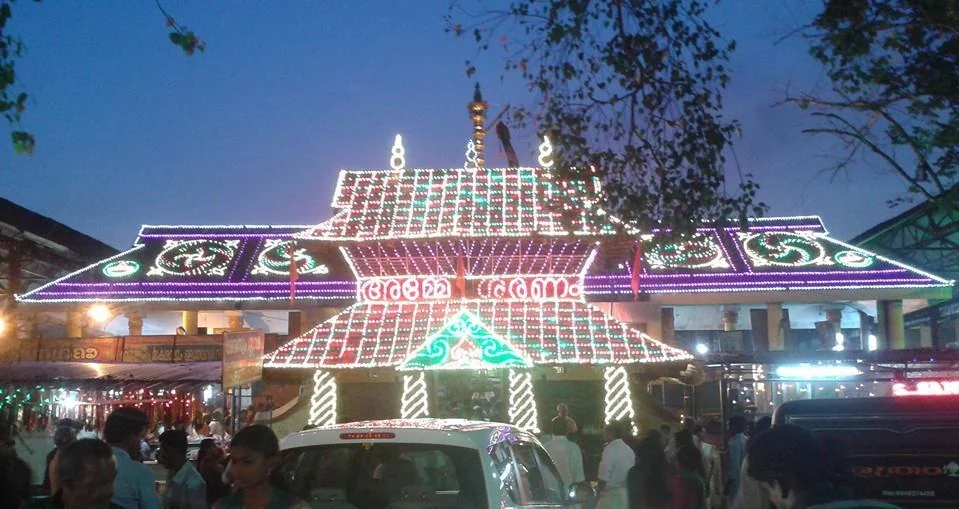
The night photograph accompanying this story shows the illuminated entrance and the people gathered before it. It records a particular celebration’s public appearance. It does not depict the legendary journey from Kollur or prove the age of the structures beneath the lights.
The contrast is useful: the foundation tradition gives an account of belonging, while the photograph shows a living place of worship in a later moment. A visitor can appreciate both without asking one to serve as evidence for the other.
At the temple, the layered entrance roofs and inward passages provide a visible setting for the story. Observe them from the permitted area and retain the distinction between architecture that can be seen and religious events remembered through tradition. There is no need to assign an unsupported date to a doorway in order to find it meaningful.
This approach also keeps nearby sacred traditions in their proper place. The government account’s Konna-tree and Sivalinga belief is another local religious subject; it should not be merged with the Kollur journey into a single sequence unless the source itself does so.
Read the foundation story before arriving, then let the actual worship and architecture have their own presence. Malayalapuzha’s history becomes clearer when a cherished sacred narrative is allowed to remain a narrative, rather than being forced into a chronology it does not supply.
Sources: Kerala Tourism: Malayalapuzha festival and foundation tradition and government temple account.
Plan the visit: Malayalapuzha Devi Temple.