Eleven days do not make one interchangeable event
Malayalapuzha’s annual festival begins on Thiruvathira in the Malayalam month of Kumbham and extends over eleven days in Kerala Tourism’s account. That sequence matters more than a generic instruction to visit “during festival time”. Different days carry different rites, and the final events cannot be assumed on an ordinary evening early in the celebration.
The Gregorian dates change with the calendar. A historical festival description explains the structure of the event; the temple’s current programme determines the dates and timings for a particular year. Choose a specific event only after those two kinds of information have been kept distinct.
From the opening to the concluding rites
The published account describes flag hoisting at the beginning and an opening procession associated with Kottaram. These acts establish the festival’s start. They are not simply decoration added to the ordinary darshan schedule, but part of a ceremonial progression.
Pallivetta is described on the ninth day. Aarattu, together with the concluding procession and flag lowering, belongs to the end of the eleven-day sequence. Understanding that order helps a visitor decide whether the interest is in an opening ceremony, a later ritual or the final gathering.
Music and performance accompany the celebration. The tourism account names forms including Kathakali and Pancharimelam, while its photographs show processional musicians and ceremonial umbrellas. The named traditions provide context, but only a current programme establishes which performance is scheduled on the chosen day.
The festival changes the visitor’s use of space
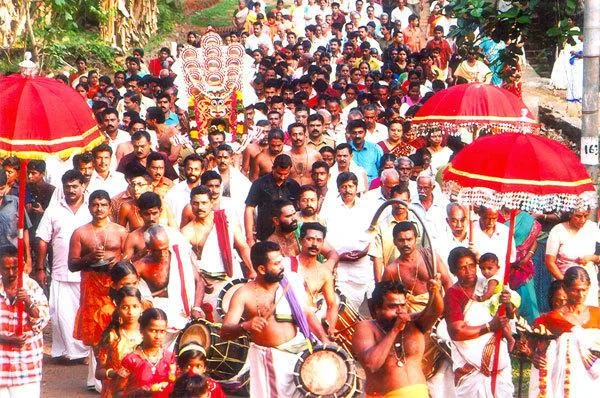
The story photograph shows drummers within a procession under red umbrellas. People and instruments occupy the approach as an active ceremonial space. A position suitable for an exterior photograph on a quieter day may be part of the moving route during the festival.
Arrive with a return meeting point outside that circulation. Keep the entrance and passages open, and follow the organisers’ direction about where spectators may stand. If elephants are part of an authorised procession, remain outside their working space and the area directed by handlers and staff.
The illuminated entrance photographs show another change: the temple’s roofline becomes part of a night-time public gathering. They record specific celebrations, not a guarantee that the same lighting and crowd arrangement recur every evening or remain installed after the festival.
Allow the event itself to determine the visit’s length. A procession may involve waiting and movement that differ from a short darshan visit. Do not assume that a historical programme gives an exact return time for the current year.
The reward for that care is a more legible celebration. Flag hoisting, Pallivetta, music and Aarattu become distinct parts of Malayalapuzha’s ritual year, rather than one undifferentiated scene of lights and crowds. A visitor can then attend one part with a clearer understanding of where it belongs in the whole.
Sources: Kerala Tourism: Malayalapuzha festival account and DTPC Pathanamthitta.
Plan the visit: Malayalapuzha Devi Temple.