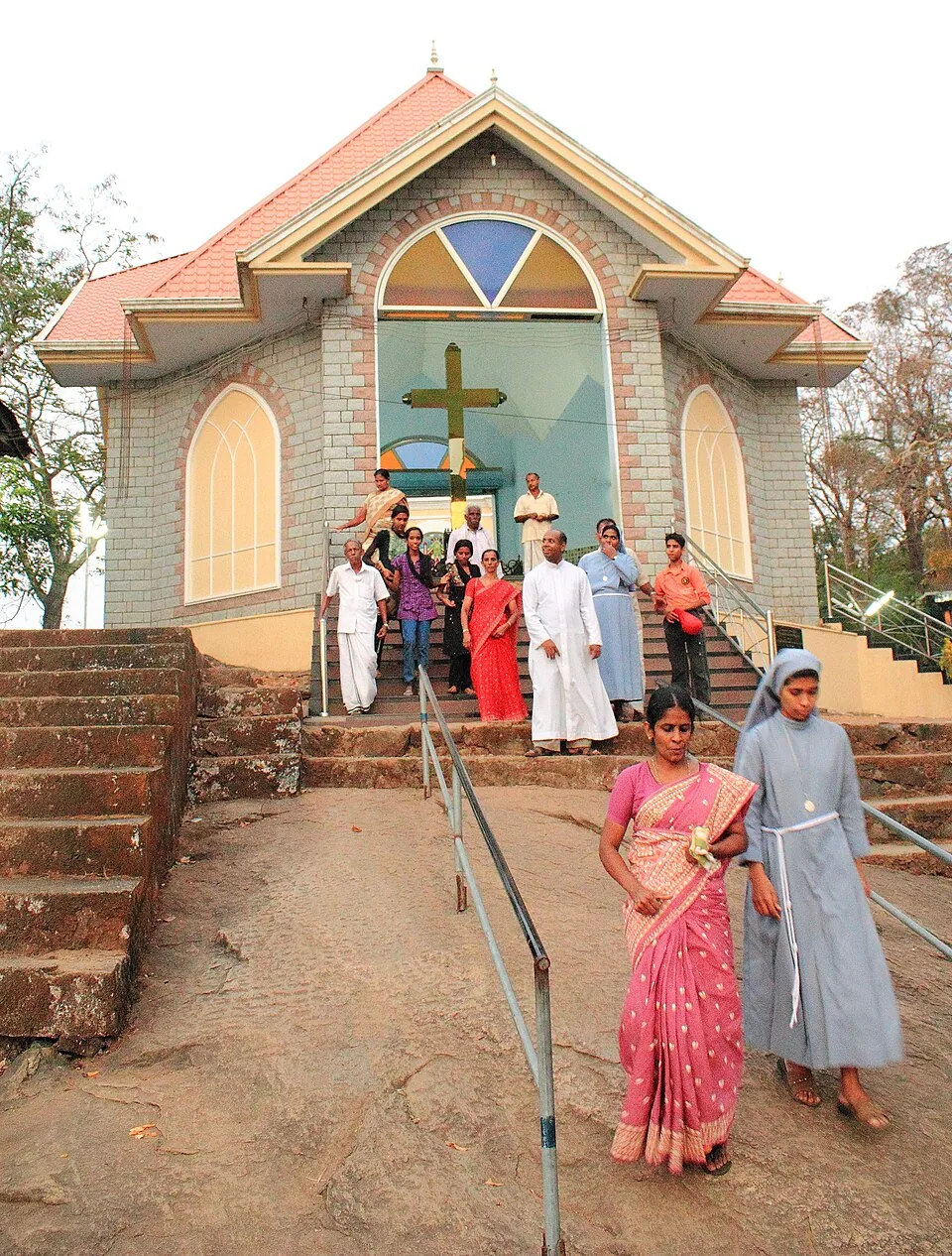
The climb to Malayattoor is done to a chant. Pilgrims going up the hill call out "Ponnum Kurishu Muthappo, Ponmala Kayattom" — O Patriarch of the Golden Cross, climb we shall this golden hill — and on the big days there are enough people on the path that you hear it before you see anyone.
The apostle on the hill
The tradition of the Saint Thomas Christians holds that the apostle Thomas landed on the Kerala coast at Muziris, near Kodungallur, in 52 CE. It is one of the oldest continuous Christian claims anywhere outside the Middle East, and it is the foundation of a community that has been on this coast for far longer than Christianity has been in most of Europe.
The Malayattoor story is a specific episode inside that. Thomas, travelling through the region and meeting hostility, is said to have fled up this hill. At the top he drew the sign of the cross on a rock and prayed. And the local people, according to the legend, then saw a golden cross appear at that spot — which is how the summit got its name. Kurisumudi: the hill of the cross.
A further strand of the tradition has the Virgin Mary appearing to console him there. On the rock at the summit, pilgrims are shown marks held to be the footprints and knee impressions of the apostle, left in the stone during that prayer.
What is at the top
A golden cross — the Ponnum Kurishu — crafted in 1736, marking the spot of the prayer, and the shrine church around it. The 1736 date is worth holding on to: it is a documented eighteenth-century object commemorating a first-century tradition, which is roughly the honest shape of the whole site.
- Kurisumudi rises above the church at the foot of the hill; the ascent is on a stepped and paved path.
- Many pilgrims go barefoot. You do not have to, and shoes are sensible if you are not used to it.
- Early morning is much the best time — cooler, and the light on the way up is worth it.
- Carry water. There is shade in places and none in others.
- It is a genuine climb rather than a stroll. Judge it honestly if you have knees or a heart condition.
The season, and what it turns into
For most of the year Malayattoor is a quiet hill with a church on it. During the annual pilgrimage season after Easter — the Malayattoor Perunnal — it becomes one of the largest gatherings in Kerala, with hundreds of thousands of pilgrims climbing the hill, many barefoot, many carrying crosses.
Those are two entirely different visits, and you should decide deliberately which one you want. The festival is extraordinary and it is also crowded, hot and slow. Outside the season you get the hill, the view over the Periyar valley and the forest, and time at the top.
What the Vatican actually declared
On 11 February 2004 the Congregation for the Clergy declared Malayattoor an International Shrine, in a decree read out by Cardinal Varkey Vithayathil — the first shrine in India to hold the status. You will also read, on signage and in a great deal of tourism copy, that it is one of only eight such shrines in the world. We can find nothing behind that number. The declaration itself puts no count on how many international shrines exist; it compares Malayattoor to famous pilgrimage centres such as Lourdes without ever totalling them. Treat the status as documented and the number as invented once and quoted ever since. It is also worth being clear about what the designation does and does not do: it recognises the standing of the pilgrimage, not the authenticity of the footprints.
It also makes the geography here unusually dense. Malayattoor is a short drive from Kalady, the birthplace of Adi Shankara — so within a few kilometres of Periyar riverbank you have one of the founding sites of Advaita Vedanta and an internationally designated Christian shrine tracing itself to an apostle. Kerala does this sort of thing casually, and it is worth noticing when it happens.
Frequently asked questions
What is Kurisumudi?
The hill above Malayattoor church, whose name means "hill of the cross". Tradition holds that the apostle Thomas fled here from hostile locals, drew a cross on a rock and prayed, after which a golden cross was seen at the spot.
What is the Ponnum Kurishu?
The golden cross at the summit, crafted in 1736, marking the place where Thomas is said to have prayed and where the Virgin Mary is held to have appeared to console him. Pilgrims chant "Ponnum Kurishu Muthappo, Ponmala Kayattom" on the way up.
Did St Thomas really come to Kerala?
The tradition of the Saint Thomas Christians holds that the apostle landed at Muziris near Kodungallur in 52 CE, and it is one of the oldest continuous Christian claims outside the Middle East. It is a matter of tradition rather than of documentary record, and it is held with great seriousness on this coast.
When is the Malayattoor pilgrimage season?
The main pilgrimage — the Malayattoor Perunnal — falls in the weeks after Easter, when hundreds of thousands climb the hill, many barefoot. Outside that season the hill is quiet, which is a completely different and in some ways better visit.
How hard is the climb to Malayattoor?
A genuine climb on a stepped and paved path rather than a stroll. Early morning is much the best time, carry water, and judge it honestly if you have knee or heart problems. Many pilgrims go barefoot; visitors need not.
What is an International Shrine and why does Malayattoor have that status?
A Vatican designation recognising a pilgrimage centre of international rather than merely regional significance. Malayattoor was declared one on 11 February 2004 by the Congregation for the Clergy, the first shrine in India to hold the status. The often-repeated claim that it is one of only eight in the world has no support in the declaration, which puts no number on them at all.