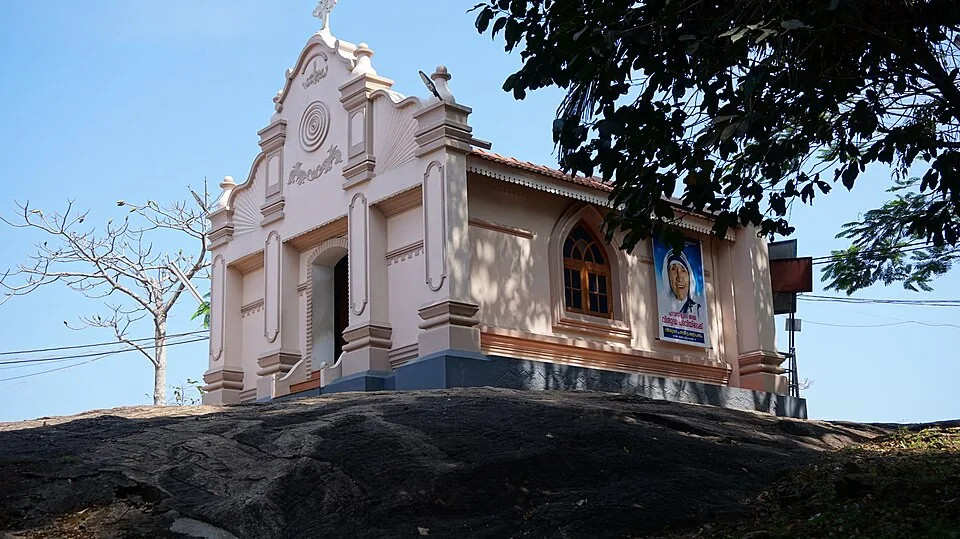
You will be told two things about Malayattoor before you have finished the climb. That it is an International Shrine, and that it is one of only about eight in the world.
The first is documented and can be dated precisely. The second appears to be nothing at all.
The declaration
The status came from the Vatican’s Congregation for the Clergy, and was read out by Cardinal Varkey Vithayathil at a gathering in Kochi. The date given is 11 February 2004. Kurisumudi became the first shrine in India to hold it — at the time, the only one.
The wording is worth quoting because it is careful. The declaration describes Malayattoor as a historic centre of Christianity in India closely linked with the preaching of St Thomas, the apostle of Christ, and the evangelisation of the subcontinent. It places the shrine alongside famous Christian shrines such as Our Lady of Lourdes.
What it does not do is put a number on how many international shrines exist. It compares; it does not count. The figure of eight that circulates in guidebooks, on signage and in a great deal of travel writing — including, until now, on this site — has no visible source. It is the classic shape of an invented statistic: specific enough to sound checked, small enough to sound impressive, and repeated until it is everywhere.
What is being recognised, and what is not
Read the sentence again and notice what it says. A historic centre of Christianity. Closely linked with the preaching of St Thomas.
It recognises the shrine’s standing and its association with the tradition. It does not certify that the apostle knelt on this rock in the first century, and no document from Rome could. The footprints and knee-marks kept behind glass at the summit are venerated, not authenticated — and the Church has always been more precise about that distinction than visitors, or tour operators, tend to be.
That is not a deflation. It is the honest shape of the thing. The St Thomas Christians of Kerala are one of the oldest Christian communities anywhere, their tradition places the apostle on this coast around AD 52, and the historical record for any of it is a matter of tradition rather than proof. A shrine can be immensely important without every detail of its story being demonstrable, and Rome recognised the importance without pretending to the proof.
The scale it recognises
Around four million pilgrims a year come to Malayattoor. The hill runs to roughly 609 metres and the ascent is a long, mostly unshaded climb of stone steps and rough track, made barefoot by a large share of the people on it, many of them carrying crosses.
The peak is the Malayattoor Perunnal, on the Sunday after Easter, when the path is continuously occupied and the cry of Ponnin Kurishu Muthappo carries up the hill. It is among the largest Christian pilgrimages in India, and it happens a few kilometres from the birthplace of Adi Shankara — a proximity Cardinal Vithayathil pointed to himself on the day the declaration was read.
What to do with this on the climb
Nothing, except carry the accurate version. Correct the number if someone offers you the eight; keep the date, which is real; and treat the summit as what the declaration calls it — a historic centre of Christianity in India — rather than as a forensic site.
Start early, take water, and go on a weekday outside the feast if you want the hill quiet. It is a shrine in continuous use rather than a monument, and the climb is the visit.
Frequently asked questions
When did Malayattoor become an International Shrine?
11 February 2004, by declaration of the Vatican’s Congregation for the Clergy, read out by Cardinal Varkey Vithayathil in Kochi. It was the first shrine in India to receive the status.
Is it one of only eight international shrines in the world?
There is no support for that figure. The declaration compares Malayattoor to famous shrines such as Lourdes but puts no number on how many international shrines exist. Treat the status as documented and the number as unsupported.
Does the declaration confirm that St Thomas was here?
No, and it does not attempt to. It describes Malayattoor as a historic centre of Christianity in India closely linked with the preaching of St Thomas and the evangelisation of the subcontinent — recognising the shrine’s standing and its association with the tradition. The footprints and knee-marks at the summit are venerated rather than authenticated.
How many pilgrims come?
About four million a year, with the heaviest crowds during Lent and at the Malayattoor Perunnal on the Sunday after Easter. The hill is roughly 609 metres and the climb is long and largely unshaded; many pilgrims make it barefoot.
Which church does the shrine belong to?
The Syro-Malabar Catholic Church, one of the Eastern Catholic churches in full communion with Rome and rooted in the ancient St Thomas Christian community of India.
When is the best time to climb?
Early morning, on a weekday outside the feast season, if you want the hill quiet. During the Perunnal the path is continuously occupied — which is worth seeing in its own right, but it is a different experience entirely.